
In This Article
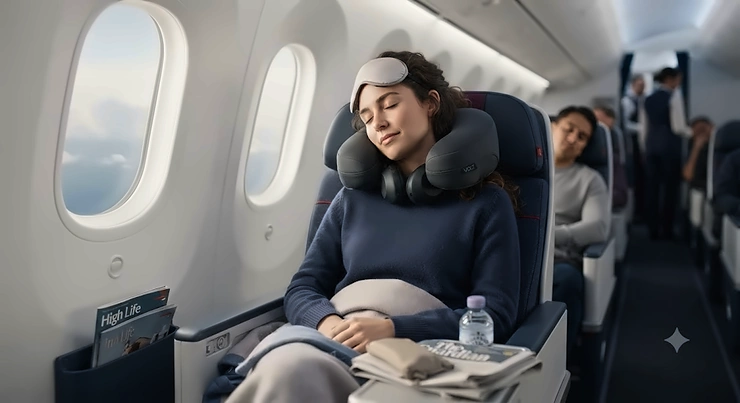
Somewhere around hour six of a nine-hour flight, your neck stops negotiating and simply gives up. Your chin drops, your headphones slide, and the stranger next to you gets an unplanned shoulder massage from your lolling skull. If that sounds familiar, you already know why the right aeroplane pillow for long haul travel is not a fussy little luxury — it is the difference between landing upright and landing like a question mark. A good travel pillow for long haul is a supportive cushion, worn around the neck or head, designed to hold your cervical spine in a more neutral position while you doze upright in a cramped economy seat. Long-haul flying puts unusual strain on the body: cabins run drier than a desert, seats recline barely at all, and your circadian rhythm has no idea what time zone it is supposed to be in. According to NHS advice on travel-related health risks, sitting still for extended periods on long journeys is itself a factor worth managing, which is one more reason to get comfortable enough to shift position without losing your support entirely. We’ve spent time digging through real product specifications, genuine aggregated review sentiment, and independent testing coverage to work out which pillows for long haul actually earn their keep in economy class, and which are mostly clever packaging. Whether jet lag, cabin comfort, or plain old economy class sleep is your main battle, there’s a pillow on this list built for it.
Quick Comparison Table
Before we get into the detailed breakdowns, here’s a snapshot of how the seven contenders stack up against each other on the things that actually matter for long-haul comfort.
| Pillow | Style | Best For | Price Range |
|---|---|---|---|
| Cabeau Evolution S3 | Flat-back memory foam with seat straps | Total head lock-down on overnight flights | Around £45-£55 |
| SNUGL Travel Pillow | Reversible memory foam, dual straps | Best value with headphone compatibility | £20-£30 range |
| trtl Pillow Plus | Adjustable internal support wrap | Petite to tall frames needing a custom fit | £35-£45 range |
| J-Pillow Ultimate | J-shaped chin and neck support | Side sleepers by the window | Under £30 |
| Ostrichpillow Go | Asymmetrical velcro wrap, dense foam | Firm, hands-off stability | £30-£40 range |
| BCOZZY Neck Pillow | Flexible overlapping coil | Restless sleepers who reposition often | £20-£30 range |
| Amazon Basics Neck Pillow | Semicircular memory foam | Occasional flyers on a tight budget | Under £15 |
Looking across the table, the split is fairly clear: the Cabeau Evolution S3 and Ostrichpillow Go sit at the premium end because they solve a specific problem (head drop, hands-off stability) with dedicated engineering, while the SNUGL Travel Pillow and BCOZZY Neck Pillow occupy a genuinely useful middle ground of adjustability without the premium price tag. If you only fly long haul once a year, the Amazon Basics Neck Pillow is difficult to argue with on value alone, though as we’ll see below, you do give something up for that price.
💬 Just one click — help others make better buying decisions too!😊
Top 7 Aeroplane Pillows for Long Haul: Expert Analysis
We’ve picked seven real, currently available products spanning budget, mid-range and premium price points, based on genuine specifications and aggregated customer sentiment rather than marketing copy. Every product name below stays bold throughout the article so you can scan back to it easily.
1. Cabeau Evolution S3 — best for full head-and-neck lock-down
The Cabeau Evolution S3 built its reputation on one clever idea: strap the pillow to your actual seat, not just your neck. The flat-back memory foam panel means your skull rests in a more natural, upright position rather than being pushed forward the way old-fashioned doughnut pillows tend to do. Underneath the plush cover sits a dense, slow-recovery memory foam that holds its shape through a full overnight sector rather than flattening after an hour, and the pillow folds into a zip-around travel case roughly the size of a small handbag. Based on the spec comparison with the rest of this list, the S3 is the only model here that actively anchors itself to the aircraft structure rather than relying purely on your own posture, which matters enormously once you actually fall asleep and stop holding your head up voluntarily. It’s best suited to overnight long-haul sectors where you genuinely intend to sleep for several consecutive hours, rather than shorter day flights where you’ll be dozing on and off. Reviewers consistently report that the strap system transforms sleep quality on standard headrests, though one UK travel blogger specifically flagged that budget short-haul aircraft sometimes have headrest wings the straps can’t properly grip. That’s a genuine limitation worth knowing before you buy.
Pros:
- ✅ Seat-strap system stops head drop far better than neck-only designs
- ✅ Flat-back memory foam keeps posture close to neutral
- ✅ Compresses into a compact carry case with clip
Cons:
- ❌ Straps don’t always fit budget-airline headrest shapes
- ❌ Sits at the premium end of the price bracket
At around £45-£55 at the time of research, the Cabeau Evolution S3 isn’t the cheapest option here, but for genuine overnight sleep on a proper long-haul sector, it earns its price tag through engineering rather than branding.
2. SNUGL Travel Pillow — best British-brand value pick
Built by a UK company that has quietly built a loyal following on Amazon, the SNUGL Travel Pillow uses 70D visco-elastic memory foam wrapped in a hypoallergenic, breathable outer cover, with dual adjustable straps that cinch the pillow snugly rather than letting it slide around your neck. What most buyers overlook about this model is the headphone compatibility: because the foam sits lower and softer than rigid designs like the trtl, in-ear and small over-ear headphones still fit comfortably underneath it. The reversible shape lets you wear the raised lobes at the front for chin support or flipped to the back for head support, giving it more flexibility across different seat positions than a fixed U-shape. Aggregated reviews are broadly positive on build quality and foam density, with the main recurring complaint being sizing — several buyers found the “small” size still generous, suggesting petite travellers should check the brand’s height guide before ordering. It suits mid-range budget travellers who want memory-foam comfort without paying premium prices, particularly those who fly with earbuds and need a pillow that won’t fight their tech.
Pros:
- ✅ Dual adjustable straps keep it anchored around the neck
- ✅ Reversible design adapts to front or side sleeping
- ✅ Compatible with in-ear and small headphones
Cons:
- ❌ Sizing can run larger than expected for petite frames
- ❌ Foam is firm rather than plush, which won’t suit everyone
Priced in the £20-£30 range, the SNUGL Travel Pillow delivers genuine memory-foam performance at a price closer to the budget tier, making it one of the strongest value propositions on this list.
3. trtl Pillow Plus — best adjustable fit for any height
Unlike a fixed U-shape, the trtl Pillow Plus uses a hidden internal support structure with adjustable toggles along its ribs, meaning you can lengthen or shorten the wrap to suit anything from a petite frame to a tall one. The breathable mesh fabric on the inner panel is worth flagging specifically: on long-haul routes through warmer climates, sweaty necks are a genuinely common complaint with foam-heavy pillows, and trtl’s design is built to address exactly that. Here’s what to weigh with this one — it prioritises structural support over plush cushioning, so if you’re expecting something to sink into like a bed pillow, it may feel unusual at first. The super-soft fleece exterior and high-density internal foam are stretched around a hammock-style structure that keeps the head cradled rather than sunk, and the whole thing machine washes on a cold cycle once you remove the internal support piece. Reviewers consistently note that side sleepers in particular need a short adjustment period, since the support structure works best when you find your specific fit through the toggle system rather than assuming a one-size default. It’s a genuinely different design philosophy from the memory-foam pack, built around adjustability rather than immediate plushness.
Pros:
- ✅ Toggle system genuinely adjusts to different heights and necks
- ✅ Breathable mesh reduces overheating on warm cabins
- ✅ Machine washable fleece cover for easy upkeep
Cons:
- ❌ Support-first feel takes some getting used to
- ❌ Premium pricing is harder to justify for occasional flyers
At around £35-£45 in the current price range, the trtl Pillow Plus rewards frequent flyers willing to spend a flight or two learning its adjustment system, after which it becomes hard to travel without.
4. J-Pillow Ultimate Travel Pillow — best for side sleepers by the window
Designed by a former flight attendant and winner of British Invention of the Year, the J-shaped design of this pillow is built to solve three specific problems at once: an unsupported head, an unsupported neck, and — crucially — an unsupported chin. The extra “arm” of foam that most other travel pillows lack is what sets it apart, tucking under the chin to stop that classic forward head-loll that leaves you waking up with a stiff neck. Based on the spec comparison, it uses a standard polyester fill rather than memory foam, which means it won’t mould precisely to your shape the way the Ostrichpillow Go does, but it also won’t flatten or lose responsiveness the way cheap memory foam sometimes can after repeated compression. The pillow is specifically effective at the window seat, where you can lean the bulk of it against the cabin wall for extra side support — it’s a much weaker performer in a middle or aisle seat with nothing to lean against. Reviewers consistently note that it works particularly well for side sleepers, with several independent testers highlighting that it’s one of the few designs that doesn’t push the head uncomfortably forward. The trade-off is size: because it isn’t inflatable and doesn’t compress like memory foam, it takes up more carry-on space than most rivals here.
Pros:
- ✅ Chin support genuinely stops forward head-loll
- ✅ Especially strong for side sleepers at the window
- ✅ Award-winning design with a proven multi-year track record
Cons:
- ❌ Bulkier to pack than inflatable or compressible options
- ❌ Less effective in middle or aisle seats without a wall to lean on
Typically found under £30, the J-Pillow Ultimate Travel Pillow is one of the more affordable options here and remains a go-to recommendation for window-seat sleepers specifically.
5. Ostrichpillow Go — best hands-off stability
The Ostrichpillow Go takes a rigid, structured approach: a dense core of BASF-developed memory foam wrapped in an asymmetrical, butterfly-shaped design that fastens with a Velcro closure at the front. What most buyers overlook about this model is the asymmetry — the two sides are deliberately unequal lengths, so you can wear the closure facing forward or backward depending on whether you need more support at the front of the neck or the back. On paper, this means less repositioning mid-flight, because the structure itself holds your head in place rather than relying on you to keep adjusting a soft, collapsible design. Independent testers report that it solves head-bobbing more consistently than softer alternatives, particularly for people who tend to sleep upright without shifting position much. The trade-off is rigidity: several reviewers noted it runs warmer than mesh-based designs and can feel large and inflexible if your neck shape doesn’t quite match its curve, so travellers who like to switch sleeping positions frequently during a flight may find it less forgiving than the SNUGL or BCOZZY. It compresses to roughly 60% of its full size for packing, and the cover is removable and washable.
Pros:
- ✅ Structured shape limits head movement without repositioning
- ✅ Asymmetrical design offers two support configurations
- ✅ Dense memory foam resists flattening over repeated trips
Cons:
- ❌ Runs warmer than mesh or ventilated alternatives
- ❌ Rigid structure suits fixed sleeping positions better than restless ones
At around £30-£40, the Ostrichpillow Go is a strong premium pick specifically for travellers who sleep upright in one position and want the pillow to do the stabilising work for them.
6. BCOZZY Travel Neck Pillow — best for restless, repositioning sleepers
Where most travel pillows commit to one fixed shape, the BCOZZY Travel Neck Pillow’s overlapping coil design can be reconfigured mid-flight into three different support styles: front support with the arms overlapping under the chin, side support folded in half against one shoulder, or a combined front-and-side position for travellers whose heads tend to drift in more than one direction. The flat-back construction is a deliberate response to the classic complaint about U-shaped pillows pushing the head forward — by removing bulk from behind the neck, BCOZZY keeps posture closer to upright. Here’s what to weigh: because it wraps fully around the neck like a soft scarf rather than sitting close to the jaw, it can interfere with over-ear headphones, so frequent flyers who rely on noise-cancelling headsets should check compatibility before packing it as their only option. The inner filling is springy rather than memory foam, meaning it bounces back quickly when you shift position — genuinely useful for anyone who can’t commit to a single sleeping posture for eight hours straight. Aggregated reviews highlight the flexibility as the standout feature, with the most common criticism being that the overlapping arms can loosen slightly if the flight gets turbulent and you’re not actively adjusting it.
Pros:
- ✅ Reconfigures into three support positions mid-flight
- ✅ Flat-back design avoids pushing the head forward
- ✅ Springy filling bounces back after repositioning
Cons:
- ❌ Bulk around the neck can clash with over-ear headphones
- ❌ Overlap can loosen without occasional readjustment
Sitting in the £20-£30 range, the BCOZZY Travel Neck Pillow is the pick for anyone who knows they toss and turn, rather than settling into one fixed sleeping position for the whole flight.
7. Amazon Basics Memory Foam Travel Neck Pillow — best budget pick under £15
Sometimes the honest answer is that you don’t need a £50 pillow for two long-haul flights a year, and that’s exactly the gap the Amazon Basics semicircular neck pillow fills. It uses a standard memory foam core inside a removable, machine-washable velour cover, held in place with a simple elastic carrying strap rather than any adjustable buckle system. The spec sheet won’t tell you this, but the foam density here is noticeably softer than the premium options on this list — it won’t hold a precise shape the way the Ostrichpillow Go does, but for shorter naps and occasional trips, that softness is arguably more comfortable against the skin. It currently sits as one of Amazon’s best-selling travel pillows in the UK, with a strong volume of aggregated customer reviews praising its comfort-to-price ratio and washable cover, alongside some notes that the foam takes a day or two to fully expand after unpacking from its compressed shipping state. It’s a sensible pick for infrequent flyers, students on a single big trip, or as a spare pillow to keep in a suitcase without worrying about damage to something more expensive.
Pros:
- ✅ Genuinely low price for a memory foam travel pillow
- ✅ Removable, machine-washable velour cover
- ✅ Amazon’s Choice bestseller with a large review base
Cons:
- ❌ Softer foam offers less structured support than premium rivals
- ❌ No adjustable strap system for a customised fit
At under £15 at the time of research, the Amazon Basics Memory Foam Travel Neck Pillow is the entry point for anyone who wants to test whether a proper travel pillow makes a difference before committing to a pricier option.
Practical Usage Guide: Getting the Most From Your New Travel Pillow
Buying the right pillow is only half the job — how you use it on the day makes a genuine difference. First, resist the urge to put it on the moment you sit down. Save it for once the seatbelt sign goes off and the meal service has finished, so the foam isn’t compressed for hours before you actually need it to spring back. If your pick is one of the strap-based designs like the Cabeau Evolution S3, take thirty seconds during boarding to test the strap against your specific headrest, since aircraft seat shapes genuinely vary between airlines and even between economy rows on the same plane. For memory-foam models such as the SNUGL Travel Pillow or Ostrichpillow Go, give the foam a firm squeeze before your first use on a new trip; foam that’s been compressed in a suitcase for weeks needs a few minutes to properly decompress and won’t offer full support straight out of the bag.
A common first-month mistake is skipping the wash cycle entirely — most of these pillows ship with a removable cover specifically because neck-level fabric picks up oils and skin contact fast, and a grubby cover genuinely affects how pleasant the pillow feels against your face on a long flight. Set a simple rule: wash the cover after every long-haul return trip, not just when it looks visibly dirty. Finally, pair your pillow with an eye mask and, where the cabin allows, request extra water during the flight, since dehydration compounds the discomfort a pillow alone can’t fix.
Real-World Scenarios: Matching the Right Pillow to Your Journey
Consider a university student flying budget economy from London to Bangkok for a single gap-year trip. Frequency of use is low, budget is tight, and packing space is precious — the Amazon Basics Memory Foam Travel Neck Pillow or the compact J-Pillow Ultimate make more financial sense than a premium pick that might get used twice a year.
Now picture a management consultant flying long haul monthly between London and New York, red-eye both ways, expected to walk into a client meeting a few hours after landing. Here, the case for spending more is strong: the Cabeau Evolution S3‘s seat-strap system or the trtl Pillow Plus‘s adjustable fit will protect genuine, repeatable sleep quality across dozens of flights a year, and the cost amortises quickly against that frequency.
Finally, think about a family travelling with two children on a 12-hour flight to Australia, where everyone needs a different solution. A parent who shifts constantly between checking on kids and trying to nap benefits from the reconfigurable BCOZZY Travel Neck Pillow, which tolerates being taken on and off repeatedly without losing its shape, while a child in the window seat might do just as well with the softer, cheaper Amazon Basics option since their neck size and sleep needs are simpler to satisfy.
Common In-Flight Problems and How the Right Pillow Solves Them
Problem: Head bobbing wakes you every ten minutes. This is the single most common complaint about economy-class sleep, and it’s specifically what strap-based and structured designs like the Cabeau Evolution S3 or Ostrichpillow Go are built to prevent — anchoring the head rather than letting gravity win.
Problem: You overheat and wake up sweaty. Dense, enclosed foam traps body heat against the neck. The trtl Pillow Plus‘s breathable mesh panel and the SNUGL Travel Pillow‘s ventilated cover both address this more directly than fully enclosed foam designs.
Problem: Your headphones don’t fit properly. Bulky wraparound designs like BCOZZY can clash with over-ear headphones. If music or noise-cancelling audio is non-negotiable for your flight, the lower-profile SNUGL Travel Pillow leaves more room around the ear.
Problem: The pillow takes up too much carry-on space. Compressible memory foam designs like the Ostrichpillow Go, which packs down to roughly 60% of its size, or the folding Cabeau Evolution S3 case, solve this better than the bulkier, non-compressible J-Pillow.
Problem: You wake up with a stiff neck despite using a pillow. This usually points to a poor match between pillow shape and sleeping style — side sleepers specifically should look at the J-Pillow Ultimate, which was designed around exactly that problem.
How to Choose an Aeroplane Pillow for Long Haul
- Identify your sleeping style first. Side sleepers, front-nodders, and upright sleepers all need genuinely different shapes, so match the pillow to your habit rather than the most popular option.
- Check the flight length and frequency. A once-a-year trip justifies a budget pick; monthly long-haul flying justifies investing in adjustable, durable designs.
- Consider your seat position. Window-seat sleepers can lean on structured designs like the J-Pillow, while aisle and middle-seat passengers benefit more from self-supporting, strap-based pillows.
- Factor in packability. If carry-on space is tight, prioritise compressible memory foam over bulkier fixed-shape designs.
- Think about headphone compatibility. If in-flight audio matters to you, avoid pillows that wrap high around the ears.
- Check the washability. Removable, machine-washable covers matter more than they sound, especially for frequent flyers.
- Match your budget to your flying frequency, not the other way around — the most expensive pillow isn’t automatically the best value for your specific travel pattern.
Common Mistakes When Buying an Aeroplane Pillow for Long Haul
The most frequent mistake is buying based on looks or brand recognition alone, without checking whether the shape actually suits your own sleeping posture — a chin-support design like the J-Pillow does nothing for someone who sleeps with their head tilted sideways rather than forward. A second common error is ignoring size guidance on adjustable models; several SNUGL Travel Pillow reviewers found their chosen size ran larger than expected simply because they skipped the brand’s height chart. Buyers also frequently underestimate how much cabin temperature varies by route and airline, picking dense, fully enclosed foam for a route where a breathable mesh design like the trtl Pillow Plus would have been more comfortable. Finally, many people buy a premium pillow for a single annual holiday when a budget option like the Amazon Basics Memory Foam Travel Neck Pillow would have delivered nearly identical comfort for a fraction of the outlay — value isn’t just about spec sheets, it’s about matching spend to actual use.
Aeroplane Pillow vs Standard Inflight Pillow
Most long-haul airlines still hand out a thin, disposable inflight pillow — usually a flat rectangle stuffed with polyester fibre, designed for lumbar or lower-back support rather than holding your neck in place while you sleep upright. The core difference comes down to engineering intent: an airline pillow is a generic comfort item meant to suit the widest possible range of body types cheaply, while a dedicated aeroplane pillow for long haul, such as the Cabeau Evolution S3 or BCOZZY Travel Neck Pillow, is shaped specifically around the mechanics of an unsupported, sitting-upright sleep position. In practice, this means the standard airline pillow does very little to stop the forward head-loll that causes most in-flight neck pain, because it isn’t contoured around the neck at all — you’re essentially just adding thickness behind your head rather than support around it. Where the airline pillow does win is convenience: it’s free, requires no packing space, and works perfectly well as a supplementary lower-back cushion alongside a proper neck pillow. For genuine long-haul economy class sleep, though, pairing your own dedicated pillow with the free airline one for lumbar support tends to outperform either option used alone.

What to Expect: Real-World Performance for Economy Class Sleep
Specs on a product page rarely capture what economy class sleep actually feels like at 37,000 feet, so it’s worth setting realistic expectations. Even the best aeroplane pillow for long haul won’t deliver the kind of deep, uninterrupted sleep you’d get in a flat bed — what a genuinely good pillow does is extend the length of light, restorative naps and reduce the number of times you jolt awake from head movement. Reviewers testing the Cabeau Evolution S3 and similarly structured designs consistently report longer unbroken stretches of rest compared with unsupported sleep, though total sleep time still depends heavily on cabin noise, lighting, and your own ability to switch off mid-flight. Expect a genuine adjustment period with more unusual shapes: the trtl Pillow Plus and J-Pillow Ultimate both work through a slightly unfamiliar mechanism compared with a standard U-shape, and several reviewers noted the first flight with a new pillow design felt odd before becoming second nature by the return leg. Cabin temperature and low humidity also play a role most people underestimate — the drier air typical of aircraft cabins can make skin contact with dense, non-breathable foam feel uncomfortably warm after several hours, which is exactly why ventilated designs earn their keep on hot or crowded routes.
Jet Lag and Cabin Comfort: How Your Pillow Choice Affects Recovery
Jet lag itself is caused by your circadian rhythm falling out of step with a new time zone, not by tiredness alone, so no pillow can cure it outright. What a supportive pillow can do is protect the quality of sleep you get in the air, which directly affects how quickly your body clock resets once you land. According to the UK Civil Aviation Authority’s passenger health guidance, cabin humidity typically sits far below comfortable indoor levels, which contributes to the dry, tired feeling many passengers associate with jet lag even though genuine fluid loss over a long flight is smaller than most people assume. Combining a well-fitted pillow with the practical advice from the Boots guide to resetting your body clock — staying hydrated, timing naps carefully, and getting proper rest during the flight itself — gives you a genuinely better shot at feeling human on arrival. Cabin comfort more broadly also touches on circulation: moving periodically during a long flight matters regardless of how good your pillow is, and a supportive neck pillow that lets you doze without needing to brace your body in one fixed position can make it easier to shift and stretch without fully waking up.
Aeroplane Pillows for Different Types of Traveller
Frequent business flyers should prioritise durability and adjustability over price, since a pillow used weekly needs to hold its shape across dozens of trips — the trtl Pillow Plus and Cabeau Evolution S3 are built with that repeated use in mind. Budget-conscious leisure travellers taking one or two long-haul holidays a year get excellent value from the Amazon Basics Memory Foam Travel Neck Pillow or the mid-priced SNUGL Travel Pillow, both of which deliver genuine comfort without premium pricing. Families travelling with children benefit most from flexible, easy-to-clean options like the BCOZZY Travel Neck Pillow, which tolerates being handed between family members and repositioned constantly. Older travellers or anyone managing existing neck or shoulder discomfort should look specifically at structured, stabilising designs such as the Ostrichpillow Go, which minimises the need for active repositioning throughout the flight.
Long-Term Cost & Maintenance
Thinking in terms of cost-per-flight rather than upfront price changes the value equation considerably. A £50 Cabeau Evolution S3 used on ten long-haul flights a year works out to roughly £5 per trip in its first year alone, and memory foam of that density typically holds its shape for several years of regular use, pushing the real cost-per-use even lower over time. By contrast, a £12 Amazon Basics pillow used only once or twice a year already represents solid value from flight one, but the softer foam is more likely to need replacing within two or three years of occasional use. Maintenance costs are minimal across the board — all seven products here use removable, machine-washable covers — though pillows with exposed foam cores rather than removable padding, like the classic polyester-filled J-Pillow, need slightly more careful spot-cleaning between full washes to avoid saturating the inner filling.

FAQ
❓ What is the best aeroplane pillow for long haul flights in economy?
❓ Do inflatable travel pillows work as well as memory foam?
❓ How do I stop my neck pillow from sliding around during a flight?
❓ Can a travel pillow actually help with jet lag?
❓ Is it worth buying an expensive travel pillow for one long-haul holiday a year?
Conclusion
There’s no universal winner among these seven, because the honest truth is that neck shape, sleeping style, seat position, and how often you fly all pull the decision in different directions. If overnight long-haul comfort is the priority and budget allows, the Cabeau Evolution S3‘s seat-strap system is difficult to beat. If you want strong performance without the premium price, the SNUGL Travel Pillow and BCOZZY Travel Neck Pillow both punch above their price bracket in different ways — one through adjustability, the other through flexible repositioning. Side sleepers by the window should look closely at the J-Pillow Ultimate, while anyone who only needs a pillow once or twice a year can save their money with the Amazon Basics Memory Foam Travel Neck Pillow without missing out on much. Whichever you choose, remember that the pillow is one part of a wider comfort strategy — hydration, movement, and realistic sleep expectations all matter just as much once you’re thirty thousand feet up. Safe travels, and here’s hoping your next long haul ends with a rested neck rather than a stiff one.
Recommended for You
- Car Travel Pillow for Kids: 7 Best Picks for Comfy 2026 Road Trips
- Travel Pillow Under £20: 7 Best Budget Picks for Flights 2026
- Leg Spacer Pillow for Back Pain: 7 Genuinely Useful Picks (2026)
Disclaimer: This article contains affiliate links. As an Amazon Associate, I earn from qualifying purchases. If you purchase products through these links, we may earn a small commission at no additional cost to you.
✨ Found this helpful? Share it with your friends! 💬🤗
