
In This Article
There’s a particular kind of helplessness that creeps in when someone you love can no longer shift their own weight in bed. Maybe it’s your mum after a stroke. Maybe it’s a resident on your care home floor who’s spent eleven hours flat on their back because nobody quite got round to turning her. Either way, the skin starts to complain before anyone else notices, and by the time a red mark appears over the sacrum, the damage is already underway. A positioning pillow for elderly users isn’t a luxury comfort item — it’s a piece of kit that does a genuinely unglamorous job: holding a fragile body at an angle that takes pressure off bone and onto muscle, so skin gets a chance to breathe and blood gets a chance to flow.

What is a positioning pillow for elderly people? In short, it’s a shaped foam wedge, roll, or cushion used to support and maintain a person’s body in bed or in a chair at a specific angle, reducing pressure on vulnerable areas like the hips, heels and sacrum and assisting carers with safer, gentler repositioning.
That last point matters as much as the skin science. A good positioning pillow for elderly use doesn’t just protect the person lying on it — it protects the back of whoever’s doing the turning, whether that’s a paid carer doing a twelve-hour shift or a daughter trying to manage solo overnight care. This guide pulls together genuine product research from the UK market, real specifications, honest aggregated review sentiment, and the clinical guidance behind why 30-degree positioning has become the gold standard, according to NICE’s quality standard on pressure ulcer prevention, which recommends repositioning at least every six hours for adults at risk of pressure ulcers and every four hours for those at high risk. We’ll walk through seven real products available in the UK, how they stack up, and — crucially — how to actually use them properly, because owning the right wedge and using it correctly are two very different things.
Quick Comparison: Positioning Pillows for Elderly at a Glance
Before diving into the detail, here’s the short version. If you’ve got five minutes and a decision to make, this table should get you most of the way there.
| Product | Best For | Approx. Price | Key Feature |
|---|---|---|---|
| NRS Healthcare T-Roll X-Large | Lateral positioning & spasm management | £35-£50 range | Tubular foam core, waterproof zip cover |
| NRS Healthcare Supportive Bed Wedge | General-purpose angled support | Around £50 | Firm dual-angle foam wedge |
| NRS Healthcare Repose Positioning Wedge | Leg and knee elevation | £30-£40 range | Slim profile, easy under-limb fit |
| NRS Healthcare Knee Pillow | Side-lying hip alignment | Under £20 | Strap-on, adjustable, lightweight |
| Flexicomfort 7-in-1 Bed Wedge | Multi-position adjustability | Mid-£60s | Memory foam, modular sections |
| NRS Healthcare Posture/Prone Wedge (Large) | Prone and upright positioning | £45-£60 range | High-density firm foam, large footprint |
| NRS Healthcare Bed Side Wedges Pack | Anti-roll turning support | £35-£50 range | Drawsheet + dual wedge turning kit |
A quick read of that table tells its own story: there isn’t one “best” positioning pillow for elderly care, because the job changes depending on whether you’re preventing someone rolling onto their back, holding a 30-degree tilt overnight, or simply propping up tired legs after a long day in the chair. The cheaper knee pillow and T-roll solve narrow, specific problems brilliantly but won’t help with full-body turning. The bed side wedge pack, on the other hand, is built specifically around the mechanics of safe turning rather than comfort alone, which is why it tends to show up more often in care home stock cupboards than in someone’s spare room. We’ll unpack exactly why in the sections below.
💬 Just one click — help others make better buying decisions too! 😊
✨ Don’t Miss These Exclusive Deals!
🔍 Take the guesswork out of choosing a positioning pillow for elderly care. Click through on any product below to check current pricing and availability — getting the right support in place today could mean one less pressure sore to manage next month.
Top 7 Positioning Pillows for Elderly: Expert Analysis
We’ve focused this list specifically on what’s genuinely available to buy in the UK, leaning heavily on NRS Healthcare’s range because it’s one of the largest dedicated positioning-aid suppliers stocked through Amazon UK, supplemented with a couple of well-reviewed alternatives that fill specific gaps. Every product below includes honest commentary grounded in its actual specifications and the aggregated sentiment found in real customer reviews — not invented testimonials.
1. NRS Healthcare T-Roll X-Large Positioning Support
The standout feature here is the shape: a long tubular foam core rather than a wedge, designed to sit alongside the body and stop it rolling rather than prop it up from beneath. At 71cm long, 20cm deep and 45cm high, it’s substantial enough to wedge behind the back or knees of an adult and hold them there without constant readjustment. The waterproof, vapour-permeable zipped cover is machine washable up to 60°C and tumble-dryable up to 100°C, which matters enormously in any setting dealing with incontinence or night sweats — a detail that separates genuine clinical-grade kit from soft furnishings dressed up as medical aids.
What most buyers overlook about a T-roll is that it isn’t really a “comfort” pillow at all — it’s a postural management tool, originally developed for conditions like multiple sclerosis where spasm can pull the body out of alignment. Based on the specification, it’s best suited to people who need their hips and knees held in a neutral position to prevent contractures, rather than someone who simply wants softer support for an evening in bed. Reviewers on the NRS Healthcare storefront consistently note the brand’s reputation for durability, with the wider product range carrying a strong overall satisfaction rating across thousands of recent orders, though specific public reviews for this exact size are limited — worth flagging honestly rather than inventing detail that isn’t there.
Pros: genuinely waterproof cover suitable for clinical hygiene standards; substantial size holds position without slipping; eligible for VAT relief for disabled or chronically sick users in the UK. Cons: its shape is less versatile than a wedge for general comfort positioning; the firm tubular core isn’t to everyone’s taste for prolonged head support.
At a price typically in the £35-£50 range at the time of research, it sits firmly in mid-range territory — check current price before buying, as availability and cost shift regularly. For anyone managing spasm-related positioning at home or in a care setting, it’s a sound, purpose-built choice.

2. NRS Healthcare Supportive Bed Wedge
This one does the classic job: a firm, angled foam wedge designed to sit behind the upper body so someone can be propped semi-upright in bed, or flipped to support the legs and elevate swollen feet. Two wedges used together extend the range of achievable angles, which is a small detail with a real practical payoff — it means one purchase can flex between head elevation and leg elevation depending on the day’s need.
Here’s what the spec sheet won’t tell you, but real buyer reports do: this wedge runs firm. Genuine reviews on Amazon UK describe it as “very firm but fine with pillows” and note it took some airing out before the initial new-foam smell faded. That’s useful, honest context — not every review is glowing, and a positioning pillow for elderly use that’s too rigid for one person’s taste can be exactly right for another whose medical condition (acid reflux, chest infections, post-op recovery) genuinely benefits from unyielding support that won’t compress overnight. One reviewer described it helping a relative achieve their “first good night’s sleep” after a chest infection, simply by replacing a precarious stack of ordinary pillows with one stable, angled surface — a small but telling example of why purpose-built positioning beats improvised cushions.
Pros: doubles as back support or leg elevation; removable Proban-treated cotton cover that’s hand-washable; genuinely sturdy build that holds its angle for months. Cons: firmness is divisive — some users find it too hard without an extra pillow layered on top; new-foam odour needs airing before first use.
Priced around £50 at the time of research, it represents solid mid-range value for a wedge that’s flexible enough to handle more than one job.
3. NRS Healthcare Repose Positioning Wedge for Legs
Where the bed wedge above is built for the torso, this one is scaled and angled specifically for legs and knees — sliding under the lower limbs to elevate them, reduce pressure on heels (a notoriously common pressure-sore site), and encourage venous return for anyone with swelling or poor circulation. Slimmer and lighter than the full-body wedges in this list, it’s designed to be repositioned easily by a single carer without needing to lift the whole leg awkwardly.
The real-world value here is in heel protection specifically. Heels carry a disproportionate share of pressure-injury risk because there’s almost no soft tissue between bone and skin, and a wedge that floats the heel clear of the mattress — rather than simply cushioning it — does more to prevent breakdown than a soft pillow ever could. Based on the spec comparison with bulkier full-torso wedges, this is the better pick specifically for someone whose risk area is the lower leg or heel rather than the sacrum or hip.
Pros: lightweight and easy to reposition single-handedly; purpose-shaped for heel offloading rather than general comfort; complements rather than replaces a torso wedge. Cons: limited use beyond leg elevation; doesn’t address upper-body or lateral positioning needs on its own.
Expect a price in the £30-£40 range at the time of research — genuinely good value for a targeted pressure-relief tool, though always worth checking current price given how these listings shift.
4. NRS Healthcare Knee Pillow with Adjustable Strap and Cover
Small, light, and unapologetically single-purpose: this strap-on knee pillow sits between the knees during side-lying to keep the hips aligned and stop the top leg dragging the spine out of position. At 23cm high, 15cm wide and 9.5cm deep, it’s the most compact product on this list, and the adjustable Velcro strap means it stays put even if the person shifts in the night — something a loose, unsecured pillow simply can’t do.
What most buyers overlook about knee pillows is how much hip and lower-back discomfort they solve for a product this modest. For elderly side-sleepers with arthritis or hip replacements, an unsupported top knee can mean genuine, repeated pain through the night; this product addresses that single problem efficiently rather than trying to be a do-everything positioning system. It complies with UK fire retardancy regulations (BS5852), a detail that matters more than it sounds in care settings where fire safety standards for soft furnishings are non-negotiable.
Pros: genuinely affordable entry point into positioning aids; strap keeps it in place through movement; compliant with UK fire safety standard BS5852. Cons: solves one problem only — it won’t help with pressure-area offloading elsewhere; the smallest sizing in this list may not suit larger body frames comfortably.
Typically under £20 at the time of research, this is the cheapest genuinely useful product on the list and a sensible starting point for anyone testing whether positioning aids make a difference before investing further.
5. Flexicomfort 7-in-1 Bed Wedge Pillow
This one takes a different design philosophy entirely: rather than a single fixed-angle foam block, it’s built from modular memory foam sections that fold and rearrange into multiple configurations — incline support, head elevation, leg elevation, or flat use. With over 3,000 ratings averaging 4.2 out of 5 stars on Amazon UK, it’s one of the more heavily reviewed products in this category, giving us a genuinely useful sample of aggregated sentiment to draw on rather than a handful of isolated comments.
Reviewers consistently report that the modularity is the main selling point — being able to reconfigure the same product for reading support one day and leg elevation the next suits households caring for someone whose needs change day to day, rather than a static care home environment where one fixed configuration usually does the job for an entire shift pattern. The trade-off, based on the spec comparison with the firmer NRS wedges above, is that memory foam compresses more over time and under sustained body weight than the denser foam used in clinical-grade NRS products — fine for nightly comfort use, less ideal as a long-term pressure-offloading tool for someone bedbound around the clock.
Pros: highly adaptable across multiple use-cases; strong, large-sample review base inspires more confidence than newer or less-reviewed listings; washable cover included. Cons: softer memory foam may compress faster under prolonged, continuous use than denser clinical wedges; bulkier to store when not in its assembled configuration.
At around the mid-£60s mark at the time of research, it sits above the basic NRS wedges in price but reflects genuinely broader functionality — a reasonable trade for households wanting one flexible product rather than several specific ones.
6. NRS Healthcare Posture, Prone or Bed Wedge (Large)
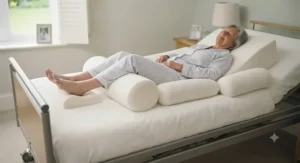
This large-format wedge is built for a less commonly discussed positioning need: prone lying, where someone is supported face-down or semi-prone, often to relieve pressure entirely off the back, sacrum and heels for a period. It’s a position increasingly recommended in pressure-ulcer guidance as an alternative to constant back-and-side rotation, though it requires more careful supervision given the postural and breathing considerations involved for frail or elderly users.
Here’s what most generic comfort wedges won’t tell you: prone positioning needs genuinely firm, stable support, because a soft or collapsing surface under the chest and pelvis can restrict breathing rather than relieve pressure. Based on the high-density foam specification, this wedge is built with that stability requirement in mind rather than as a soft “extra pillow” — which is exactly why it belongs in a dedicated positioning toolkit rather than being substituted with an ordinary cushion. It’s a specialist tool, and it should generally be introduced under guidance from a district nurse, tissue viability specialist, or care home’s clinical lead rather than trial-and-error at home.
Pros: enables prone positioning as a genuine alternative to side-lying rotation; high-density foam holds shape and support reliably; large footprint suits taller or larger-framed users. Cons: prone positioning isn’t appropriate for everyone and needs professional guidance first; the larger size needs more storage space than slimmer wedges.
Priced in the £45-£60 range at the time of research, it’s a mid-to-upper-range investment best suited to households or care settings already working with a clinical positioning plan rather than a first-time buyer.
7. NRS Healthcare Bed Side Wedges Pack
The last product on this list approaches the problem from a completely different angle — quite literally. Rather than supporting one part of the body, this pack consists of two foam wedges that attach to a cotton draw sheet via hook-and-loop strips, creating a barrier that stops someone rolling out of bed while also assisting with turning, since the wedges can be repositioned to either side as needed. At 900 x 200 x 200mm each, they’re substantial, high-density foam pieces with a wipe-clean polyurethane cover.
What stands out in genuine Amazon UK reviews is how often this product gets credited with restoring a sense of safety rather than just comfort — one reviewer specifically described it making their “elderly vulnerable mum feel safer,” while others praised how easy the wedges are to wipe down and reposition during routine care. That combination of fall-prevention and turning assistance is fairly unusual in a single product; most positioning pillows pick one job and stick to it. Based on the spec comparison with the simpler T-roll above, the draw-sheet attachment system is the meaningful upgrade here — it turns loose wedges into a fixed, predictable barrier rather than something that can slide away mid-turn, which matters enormously when a single carer is managing the move alone.
Pros: dual function as both anti-roll barrier and turning aid; genuine, specific positive review sentiment around safety and ease of cleaning; suitable for any single bed without special fitting. Cons: it’s bulkier as a complete kit than a standalone wedge; the Velcro attachment can be noisy, which one reviewer noted as a minor but real downside during night-time use.
Expect a price in the £35-£50 range at the time of research for the complete pack — genuinely solid value given it replaces both a positioning aid and a basic bed-rail alternative in one purchase.
Practical Usage Guide: Getting the Most From a Positioning Pillow
Buying the right wedge is only half the job. Used badly, even the best positioning pillow for elderly care can do almost nothing — or, in rare cases, make things worse by creating new pressure points.
Start by establishing the angle properly. The 30-degree tilt, rather than the 90-degree side-lying position, has become the recommended standard precisely because it can be simply achieved using pillows or wedges and allows the body weight to be supported on large muscles such as the buttocks, avoiding the bony prominences that increase pressure-injury risk. A useful check, drawn directly from clinical guidance, is sliding a flat hand between the person and the mattress at the hip — if you can feel the coccyx and sacrum are clear of the surface, the position is correct.
In the first thirty days of using a new positioning pillow, the most common mistake is over-correcting: piling on extra pillows around a wedge “just in case,” which often undoes the carefully engineered angle the product was designed to hold. Resist that urge. Maintenance is straightforward but easy to neglect — wipe-clean covers should be cleaned at every change of incontinence pad or sheet, not just on a weekly laundry cycle, and foam should be checked periodically for compression or splitting, since a wedge that’s lost its shape stops doing its job even if it still looks fine from the outside.

Real-World Scenarios: Matching the Pillow to the Person
It helps to think in terms of actual situations rather than abstract product categories. Consider three common profiles.
First, a family caring for an elderly parent at home after a hip fracture, managing care alone overnight with no hoist and limited budget. Here, a single NRS Supportive Bed Wedge combined with the Knee Pillow covers most needs affordably — propping the torso for comfortable breathing while keeping the hips aligned during side-lying, all for under £70 combined.
Second, a care home resident assessed as high pressure-ulcer risk, repositioned every four hours per NICE guidance, cared for by rotating shift staff. Here, the Bed Side Wedges Pack earns its keep — the draw-sheet system means any staff member, regardless of how familiar they are with that specific resident, can achieve a consistent, predictable turn without guesswork.
Third, someone managing fluctuating mobility at home — good days where they want to sit up and read, harder days needing full leg elevation. The Flexicomfort 7-in-1’s modularity suits this kind of variable need far better than a fixed-angle wedge ever could.
Problem → Solution: Common Positioning Pillow Issues
A handful of problems come up again and again, and each has a fairly specific fix rather than a vague “try harder” answer.
Problem: the wedge keeps sliding on a slippery duvet cover. Solution: switch to a cotton or poly-cotton sheet directly under the wedge rather than relying on a synthetic duvet surface, which dramatically reduces unwanted movement.
Problem: the person keeps rolling back onto their back overnight. Solution: this usually means the angle is too shallow or the wedge is too small — sizing up, or adding the T-roll alongside an existing wedge, tends to resolve it.
Problem: skin redness appears despite using a wedge. Solution: this is a signal to reassess frequency, not just equipment — even the best positioning pillow for elderly care can’t substitute for genuinely scheduled repositioning, and persistent redness after pressure relief warrants a call to a district nurse or GP.
Problem: a carer is struggling physically to reposition someone solo. Solution: this is precisely where draw-sheet systems and slide sheets earn their cost — manual lifting without assistive equipment is exactly the kind of activity UK guidance on manual handling identifies as a leading contributor to work-related musculoskeletal ill-health.
Problem: foam wedges develop an odour when new. Solution: this is common with vacuum-packed foam products and usually resolves within 24-48 hours of airing in a well-ventilated room before first use.
How to Choose a Positioning Pillow for Elderly Care
Picking the right product comes down to working through a short list of practical questions in order, rather than starting with price.
- Identify the specific risk area first. Heels, sacrum, hips and shoulders each respond better to differently shaped products — a torso wedge won’t help a heel pressure sore, and vice versa.
- Check who’s doing the turning. A solo family carer needs lighter, easier-to-reposition products than a two-person care home team using a hoist.
- Match firmness to medical need, not personal comfort preference. Firmer foam genuinely suits pressure-offloading and post-surgical support better than soft memory foam, even if it feels less plush.
- Confirm the cover is genuinely waterproof and washable, not just water-resistant. Incontinence management makes this a non-negotiable spec, not a nice-to-have.
- Consider how often the position needs changing. Modular products like the Flexicomfort suit variable daily needs; fixed wedges suit consistent, scheduled repositioning regimes.
- Check VAT relief eligibility. Many positioning aids qualify for VAT-free purchase for disabled or chronically sick individuals in the UK, which can meaningfully reduce cost.
- Don’t buy in isolation from a wider care plan. A positioning pillow for elderly use works best alongside a documented repositioning schedule, not as a standalone fix.
Wedge Positioning Pillow for Elderly vs Standard Pillows
| Factor | Wedge Positioning Pillow | Standard Pillow Stack |
|---|---|---|
| Angle consistency | Fixed, engineered angle holds overnight | Drifts and flattens within hours |
| Pressure distribution | Designed around bony prominence avoidance | Largely incidental, not engineered |
| Hygiene | Wipe-clean, washable covers as standard | Fabric absorbs moisture, harder to clean |
| Cost over time | Higher upfront, lasts years | Cheaper upfront, replaced frequently |
| Clinical suitability | Recommended in pressure-ulcer guidance | Not a recognised clinical intervention |
The pattern in that table is consistent rather than surprising: a wedge positioning pillow for elderly care earns its higher upfront cost through engineering that an improvised pillow stack simply can’t replicate, particularly around maintaining a stable 30-degree angle through a full night’s sleep. That said, standard pillows aren’t worthless — they’re a reasonable stopgap for short-term, low-risk situations, just not a substitute for someone genuinely at risk of pressure injury.

Turning and Positioning Pillow Elderly: What to Expect in Real-World Use
Specs on a product page rarely capture what daily use actually feels like, so it’s worth translating them into everyday experience. In practice, a turning and positioning pillow for elderly care changes the physical rhythm of caregiving more than people expect going in. Instead of the slow, often two-person struggle of manually rolling someone and propping loose pillows behind them — pillows that inevitably slip within the hour — a properly fitted wedge or draw-sheet system turns a five-minute wrestling match into a thirty-second adjustment.
What reviewers and carers consistently report isn’t dramatic transformation but quiet relief: fewer overnight callouts because someone’s slipped out of position, less visible skin redness at the morning check, and noticeably less physical strain on the carer’s own back. That last point deserves more attention than it usually gets, because caregiver injury is a genuinely under-discussed cost of inadequate positioning equipment.
Lateral Positioning Pillow: Technique and Safety
A lateral positioning pillow — typically a wedge or roll placed behind the back to hold a side-lying tilt — is one of the most evidence-backed tools in pressure-ulcer prevention, but the angle matters more than people assume. Clinical trial research published in the Journal of Clinical Nursing has specifically found that the 90-degree lateral position decreases blood flow and oxygen tension to near-anoxic levels and increases interface pressure, while the 30-degree lateral inclined position avoids this effect, which is why every reputable UK supplier markets its wedges around the 30-degree figure rather than a full side-lying 90-degree turn.
Safety-wise, a lateral positioning pillow should always leave both hips visible to a carer doing a visual check, with legs supported separately rather than crossed or twisted, since unsupported limbs in this position are a common and easily preventable source of additional discomfort. International guidelines recommend the use of the 30° side-lying position in preference to the 90° side-lying position, achieved by rolling the person to a gently tilted angle using offloading devices rather than a sharp, full rotation onto the hip.
Body Positioning Pillow Care Home: Protocols That Actually Work
In a care home setting, a body positioning pillow is never used in isolation — it’s one component of a documented repositioning schedule that’s assessed, recorded and reviewed per resident. What tends to separate care homes with genuinely low pressure-ulcer rates from those struggling isn’t necessarily better equipment, but more consistent use of it: the same wedge angle, the same check process, applied by every staff member on every shift, rather than reinvented informally each time.
A workable protocol generally includes an individual risk assessment on admission, a repositioning frequency matched to that risk level, equipment specifically allocated and labelled per resident (rather than shared loosely between rooms), and a simple recorded check — often a signature or initials on a chart each time a turn happens — so gaps in coverage are visible rather than assumed. None of this requires expensive technology; it requires consistency, and the right body positioning pillow for elderly residents removes much of the guesswork that consistency depends on.
Repositioning Care Home Protocol: Regulatory and Compliance Guide
UK care homes don’t have free rein on how repositioning is handled — there’s a genuine regulatory backbone underpinning it. NICE quality standards require service providers including care homes with nursing to ensure that people at risk of developing pressure ulcers are given advice on the benefits of repositioning and frequency of repositioning according to their level of risk, and that advice needs to be individualised rather than applied as a blanket rule across every resident.
This isn’t just clinical best practice; it intersects directly with the Care Quality Commission’s regulatory expectations and, more broadly, with the legal duties care providers carry as employers. The practical mechanics of how a 30-degree tilt is actually achieved and checked at the bedside are well explained in Wounds UK’s clinical guidance on repositioning for pressure ulcer prevention. For a deeper, practitioner-level breakdown of how repositioning protocol decisions should be made and reviewed, the Royal College of Nursing’s published guidance on moving and handling is a genuinely useful reference point for care home managers building or auditing their own repositioning care home protocol.
Manual Handling Elderly: Legal Duties and Safe Practice
Repositioning an elderly person isn’t just a clinical task — under UK law, it’s manual handling, and that brings specific legal obligations into play. HSE’s guidance on moving and handling in health and social care confirms that moving and handling is a regular and significant part of the working day in health and social care, and where it isn’t done safely it can cause serious injury to both service users and staff. Employers have a duty to take action to prevent or minimise that risk, which in practice means proper risk assessment, adequate equipment, and trained staff rather than relying on goodwill and improvisation.
For families managing manual handling elderly relatives at home without that institutional backing, the same physical risks apply even without the same legal framework — a positioning pillow that reduces the physical effort of a turn isn’t just a comfort upgrade, it’s a genuine injury-prevention measure for whoever’s doing the lifting. The HSE’s official guidance on the Manual Handling Operations Regulations remains the definitive UK reference for the legal framework behind this duty.
Easy Reposition Pillow Elderly: Features That Actually Matter (and Those That Don’t)
Marketing copy on positioning pillows tends to lean hard on comfort language — “plush,” “luxurious,” “hotel-quality” — none of which actually predicts whether a product helps with repositioning. An easy reposition pillow for elderly use earns that label through a much narrower set of features: a non-slip base or attachment system, a weight that one carer can lift and adjust without strain, a shape that holds its angle under real body weight rather than just on a product photo, and a cover that survives repeated washing without losing its waterproof seal.
Conversely, features that sound appealing but rarely matter in practice include elaborate multi-zone “ergonomic” foam cutting (most genuine pressure relief comes from angle and density, not novelty contouring), and decorative fabric covers that prioritise appearance over the wipe-clean hygiene standard that actually matters in care use. If a listing spends more words describing the colour options than the foam density or cover material, that’s usually a fair signal about where the manufacturer’s priorities sit.
Long-Term Cost and Maintenance
It’s tempting to compare positioning pillows purely on sticker price, but that misses most of the real cost picture. A £20 knee pillow that needs replacing every six months under daily use works out more expensive over two years than a £50 NRS wedge built from denser, more durable foam that holds its shape for several years with basic care. Maintenance costs are mostly about time rather than money — regular wipe-downs, periodic checks for compression or splitting foam, and replacing covers rather than whole units when only the fabric wears out.
The genuinely hidden cost worth weighing is the alternative: a single hospital-acquired pressure ulcer is expensive to treat, painful for the person involved, and can extend a hospital stay considerably — making a modest upfront investment in proper positioning equipment one of the more straightforwardly cost-effective purchases in elderly care, even before factoring in quality of life.
Common Mistakes When Buying a Positioning Pillow for Elderly Care
The most frequent mistake is buying based on the softest-looking product photo rather than the actual clinical need — softness and pressure relief are not the same thing, and in some cases work against each other. A close second is buying a single, general-purpose wedge and expecting it to cover every positioning need, when most genuine care situations benefit from combining two complementary products, such as a torso wedge with a knee pillow. Skipping the washable-cover check is another recurring error, particularly for households who don’t initially anticipate incontinence becoming part of the care picture. Finally, plenty of buyers skip checking VAT relief eligibility entirely, paying full price on products that often qualify for VAT-free purchase for disabled or chronically sick users in the UK — a straightforward saving that’s easy to miss.

Frequently Asked Questions
❓ What is the best positioning pillow for elderly bed sores?
❓ How often should an elderly person be repositioned?
❓ Can a positioning pillow replace professional manual handling equipment?
❓ Are positioning pillows for elderly use available VAT-free?
❓ What's the difference between a wedge and a roll positioning pillow?
Conclusion
There’s no single perfect positioning pillow for elderly care, and that’s not really a failing of the products — it’s a reflection of how different one person’s needs are from another’s. What stays consistent across every product on this list, and every piece of clinical guidance behind it, is the underlying principle: pressure relief through proper angle and genuine repositioning frequency, not improvisation with whatever pillows happen to be on the bed. Whether you’re caring for one person at home or managing a wing of a care home, the right combination of wedge, roll or knee support — chosen against the actual risk area rather than how plush it looks online — makes a measurable difference to both comfort and skin integrity. Pair the right equipment with a consistent routine, and you’re giving someone a genuinely better chance at avoiding the kind of slow, painful damage that’s almost entirely preventable with the right approach.
✨ Don’t Miss These Exclusive Deals!
🔍 Take positioning care to the next level with these carefully researched products. Click on any item above to check current pricing and availability — the right support, in place today, genuinely helps protect comfort and skin health for the people you care for.
Recommended for You
- Best Pillow for Elderly UK 2026: 7 Top Picks for Neck Pain & Better Sleep
- Best Postpartum Recovery Pillow UK 2026: 7 Expert Picks for Real Relief
- Best Nursing Pillow UK 2026: 7 Top Picks for Effortless Feeding
Disclaimer: This article contains affiliate links. As an Amazon Associate, I earn from qualifying purchases. If you purchase products through these links, we may earn a small commission at no additional cost to you.
✨ Found this helpful? Share it with your friends! 💬🤗
