
In This Article
You sleep for seven or eight hours, and yet you wake up with a blocked nose, itchy eyes, and a vague sense that the world is conspiring against you. Sound familiar? Before you blame the neighbour’s cat or the pollen count, have a closer look at what you’re pressing your face into every single night.

A dust mite proof pillow might be the one thing standing between you and a genuinely restorative night’s sleep — and if you suffer from house dust mite (HDM) allergy, getting this right is less of a lifestyle upgrade and more of a medical necessity. According to the North West Allergy Network NHS, one in five adults in the UK will test positive for HDM sensitisation. That’s a significant chunk of the population stuffing their faces into allergen hotbeds every night.
And the problem is more acute in Britain than almost anywhere else. Our homes are warm, well-insulated, and — let’s be honest — somewhat damp. Dust mites absolutely love temperatures between 20–25°C and humidity above 50%, and that description fits a large proportion of British bedrooms from September through April. The bedroom, and specifically the pillow, is the single biggest source of HDM allergen exposure, which means choosing the right pillow is your most powerful first line of defence.
This guide reviews seven of the best dust mite proof pillows available on Amazon.co.uk in 2026, covering budget through to premium options, so you can find the right fit regardless of how severe your allergy is — or how much you’re willing to spend.
Quick Comparison: Top 7 Dust Mite Proof Pillows at a Glance
| Product | Type | Allergy Protection | Price Range | Best For |
|---|---|---|---|---|
| Silentnight Anti-Allergy Pillow Pack of 2 | Treated hollowfibre | Allergy UK Approved | Under £25 | Budget buyers, first-timers |
| Slumberdown Anti-Allergy Pillows 2 Pack | Treated hollowfibre | Allergy UK Approved | Under £30 | Side & back sleepers |
| Panda Hybrid Bamboo Pillow | CharcoCell Foam™ + bamboo | OEKO-TEX® S100, BS 7177 | Mid-£50s–£70s | Hot sleepers, tech lovers |
| Panda Memory Foam Bamboo Pillow | Memory foam + bamboo | OEKO-TEX® S100 | Mid-£40s–£60s | Orthopaedic support seekers |
| Adam Home Hotel Quality Pillows 2 Pack | Hollowfibre down alternative | Hypoallergenic certified | Under £30 | Versatile sleepers, all budgets |
| BedStory 4 Pack Anti-Allergy Pillows | Hypoallergenic fibre | Dust mite resistant fill | Under £35 | Families, spare rooms |
| Utopia Bedding Zippered Pillow Protectors (4 Pack) | Waterproof encasement | Anti bed bug & HDM barrier | Under £20 | Protecting existing pillows |
The table above tells a useful story in one glance: there are two fundamental strategies here — buying a pillow whose filling itself resists mites (Silentnight, Slumberdown, Panda, Adam Home, BedStory), and buying an encasement that creates a physical barrier around your existing pillow (Utopia Bedding). For mild sensitisation, a treated anti-allergy pillow alone may be sufficient. For moderate-to-severe allergy sufferers or asthmatics, the gold standard — as the NHS recommends — is to combine both approaches: a quality anti-allergy pillow inside a barrier encasement.
💬 Just one click — help others make better buying decisions too! 😊
✨ Don’t Miss These Exclusive Deals!
🔍 Take your allergy management to the next level with these carefully selected pillows. Click on any highlighted product name to check current pricing and availability on Amazon.co.uk. These picks will help you sleep — and breathe — better every single night!
Top 7 Dust Mite Proof Pillows: Expert Analysis
1. Silentnight Anti-Allergy Pillow Pack of 2 — The Nation’s Trusted Starting Point
If you’re stepping into the world of anti-allergy bedding for the first time, Silentnight is the most sensible place to start. Britain’s most established sleep brand — with over 75 years of heritage — these pillows are filled with specially treated anti-allergy hollowfibre, which actively works against bacteria and dust mites rather than merely claiming to be “hypoallergenic.”
The filling incorporates Lurol AM-7 antimicrobial treatment, a biocide that inhibits mite colonisation at a molecular level. That’s not marketing language — it’s the same technology approved by the British Allergy Foundation (Allergy UK). Machine washable and sized to UK standard 48×74cm, they’re straightforward to maintain. Medium support suits most side and back sleepers.
What most UK buyers overlook is that the antimicrobial treatment does diminish over time — expect it to remain effective for roughly 30 washes or 12–18 months of regular use, after which replacement is sensible. At this price range, that’s still excellent value per night. UK reviewers frequently note the reduction in morning nasal congestion within a matter of days.
✅ Allergy UK Approved
✅ Machine washable, easy care
✅ Medium support for side/back sleepers
❌ Anti-allergy treatment weakens over time
❌ Filling may flatten faster than premium alternatives
Price range: Under £25 for the pair — arguably the most cost-effective entry point into proper dust mite protection on Amazon.co.uk.
2. Slumberdown Anti-Allergy Pillows 2 Pack — UK-Made, Certified, and Quietly Excellent
Slumberdown sits a step above the basic end of the market, and it earns that position with a combination of British manufacturing credentials and independent certification. Like Silentnight, these carry Allergy UK approval — but what distinguishes them is the anti-bacterial cover fabric, which adds a secondary layer of protection beyond the treated filling alone.
Made in the UK to standard sizing (48×74cm), the medium support level works particularly well for back sleepers, and the bounceback hollowfibre filling provides a softer, more plush feel than some budget alternatives. The certified anti-allergy treatment has been independently verified to reduce allergen presence, not simply asserted on the packaging.
In practice, these perform well in typically damp British bedrooms precisely because the outer cover’s antimicrobial properties help resist the moisture that dust mites need to thrive. If you live in a Victorian terrace in Manchester or a ground-floor flat in Bristol — properties prone to retaining humidity — the dual-layer protection here is well worth the modest price premium over own-label alternatives.
✅ Allergy UK Approved and independently tested
✅ UK-manufactured to British sizing standards
✅ Anti-bacterial outer cover + treated filling
❌ Medium support only — firm sleepers may prefer alternatives
❌ Not ideal for stomach sleepers
Price range: Under £30 for the pair — a strong mid-budget choice, particularly for allergy sufferers in older, damper British homes.
3. Panda Hybrid Bamboo Pillow — Premium Technology for the Genuinely Serious Sufferer
Here’s where things get considerably more sophisticated. The Panda Hybrid Bamboo Pillow is, frankly, in a different league from treated hollowfibre — and the price reflects that. But for anyone with moderate-to-severe dust mite allergy, or anyone sharing a bedroom with a partner who snores AND has allergies (the true British domestic double-whammy), this is worth every penny.
The pillow features CharcoCell Foam™ — an orthopaedic-grade adaptive foam infused with activated bamboo charcoal — surrounded by Active O₂ Micro-pods™ that channel airflow through the structure and prevent the heat and moisture build-up that dust mites require to survive. The outer BambooCloud™ quilted cover is naturally hypoallergenic, antibacterial, and moisture-wicking; bamboo’s natural properties make it genuinely inhospitable to microorganisms.
Crucially, the Panda Hybrid complies with UK fire safety standard BS 7177 and carries OEKO-TEX® Standard 100 certification — meaning every component has been independently tested against over 1,000 regulated and unregulated chemicals. This isn’t a product that talks about safety; it’s one that demonstrates it. Dimensions are 70×40×13cm, slightly larger than standard UK sizing, which suits those who prefer more pillow surface area.
UK reviewers consistently describe the bamboo cover as luxuriously soft with none of the plasticky feel associated with some barrier covers. The zip-off cover is machine washable at 30°C; the inner core is wipe-clean only, so pair it with a barrier encasement for maximum protection.
✅ OEKO-TEX® S100 certified, BS 7177 UK fire safety compliant
✅ Naturally antibacterial bamboo cover + charcoal-infused foam
✅ Active airflow system prevents heat and moisture — key for HDM control
❌ Higher price point
❌ Inner foam not washable — encasement recommended for severe allergy
Price range: Mid-£50s to £70s — a significant step up, but one that comes with a 10-year guarantee and a 30-night trial period through the Panda website, or check current availability on Amazon.co.uk.
4. Panda Memory Foam Bamboo Pillow — Orthopaedic Support Without the Allergen Compromise
If the Hybrid is Panda’s show-off, the Memory Foam Bamboo Pillow is its workhorse — more classical in shape (60×40×12cm), contoured to mould around your sleeping position, and wrapped in the same naturally hypoallergenic BambooCloud™ cover. Where the Hybrid excels at airflow management, this model excels at pressure relief and neck support.
The OEKO-TEX® Standard 100 certified memory foam filling is independently verified to be free of harmful substances. For allergy sufferers who also deal with neck pain — and given the amount of time allergy-related sleep disruption costs people, that’s more common than you’d think — this combination of orthopaedic support and allergen resistance is genuinely difficult to find elsewhere at this price point.
One thing worth noting: memory foam retains heat more than hollowfibre, which means it creates a slightly warmer sleep environment. In a warm bedroom, this could theoretically increase localised humidity. The bamboo cover mitigates this considerably, but if you already sleep hot, the Hybrid model above is the wiser choice.
✅ OEKO-TEX® S100 certified throughout
✅ Orthopaedic contouring — ideal for neck and shoulder alignment
✅ Naturally antibacterial bamboo cover
❌ Memory foam retains heat more than fibre alternatives
❌ Inner core not machine washable
Price range: Mid-£40s to £60s — strong value for a premium anti-allergy pillow with genuine orthopaedic credentials.
5. Adam Home Hotel Quality Pillows 2 Pack — The Underrated Option That Punches Above Its Weight
You won’t see Adam Home on many “best of” lists, which is somewhat baffling given the quality-to-price ratio on offer here. These hotel-style pillows feature a hypoallergenic, dust mite resistant hollowfibre fill with a quilted cover — the kind of combination you’d typically expect to pay considerably more for.
The quilted exterior fabric is denser than the standard flat weave used on many budget anti-allergy pillows, which provides a more robust physical barrier in addition to the treated fill. Suitable for side, back, and stomach sleepers, they’re unusually versatile for a pillow at this price point. UK reviewers note they maintain their loft better than most comparably priced alternatives.
What I particularly appreciate is that these are sold as a lifetime guarantee product — a bold claim for bedding, but one that signals confidence in material quality. For a household setting up a spare bedroom, replacing a child’s pillow, or simply testing the waters of anti-allergy bedding without a major financial commitment, these represent one of the better value propositions on Amazon.co.uk right now.
✅ Hypoallergenic and dust mite resistant fill
✅ Quilted cover adds extra barrier density
✅ Versatile — suits multiple sleeping positions
❌ Less scientifically documented allergy protection than Allergy UK-approved options
❌ Cheaper-feeling packaging (the pillow itself is the product, not the presentation)
Price range: Under £30 for the pair — a genuinely underappreciated option for budget-conscious households.
6. BedStory 4 Pack Anti-Allergy Pillows — Best for Families and Full Bedroom Overhauls
Four pillows for the price of two. If you’ve just realised that every pillow in the house is a potential allergen factory — your own, your partner’s, the kids’ — then the BedStory 4 Pack is a practical solution that won’t require remortgaging. Each pillow measures 42×70cm (slightly narrower than the UK standard, worth checking against your pillowcases) and features hypoallergenic, stain-resistant, dust mite resistant fibre fill.
Machine washable and built for easy everyday care, these are designed for regular laundering — essential for genuine allergy management. The spec sheet won’t tell you this, but the compact 42cm width actually suits children’s beds rather well, making this pack particularly sensible for families tackling HDM allergy across multiple bedrooms simultaneously.
The protection level here is functional rather than premium — adequate for mild sensitisation and for those focusing primarily on regular washing as their main control strategy. For anyone with more significant allergy symptoms, a barrier encasement (see the Utopia option below) would meaningfully boost the effectiveness.
✅ Four pillows — exceptional value for families
✅ Machine washable, stain resistant
✅ OEKO-TEX® S100 certified
❌ Slightly narrower than standard UK sizing — check pillowcase compatibility
❌ No independent allergy certification (e.g., Allergy UK)
Price range: Under £35 for the set of four — unbeatable for those doing a full household switch to anti-allergy bedding.
7. Utopia Bedding Waterproof Zippered Pillow Protectors (4 Pack, 50×75cm) — The Barrier Science Option
Sometimes the smartest move isn’t replacing the pillow — it’s sealing it. And for allergy sufferers who already own perfectly comfortable pillows, or for anyone who wants to maximise protection without touching their current bedding setup, the Utopia Bedding encasements are the answer.
These protectors use a tightly woven waterproof outer layer — a physical barrier that prevents HDM allergen particles (which measure down to 10 microns) from escaping the pillow and reaching your airways. OEKO-TEX® Standard 100 certified and constructed with a secure zip closure, the 50×75cm size covers UK standard pillows with room to spare. The outer fabric is a knitted polyester that, unlike the crinkling plastic-membrane covers of the past, is genuinely comfortable to sleep on — though some users note a very slight rustle in the first couple of weeks.
Clinical studies consistently show that barrier encasements reduce pillow and mattress allergen levels by 90–99%. That figure is hard to argue with. As Breathe Clean UK notes, the NHS itself recommends allergen-proof barrier covers as a first-line intervention for HDM allergy sufferers — and this is the budget-accessible way to implement that recommendation without discarding your existing pillows.
✅ Physical allergen barrier — 90–99% allergen reduction
✅ OEKO-TEX® S100 certified, waterproof zip closure
✅ Works with any pillow — no need to replace your current setup
❌ Not a standalone solution — the pillow inside still harbours mites
❌ Slight rustle sensation in the early days of use
Price range: Under £20 for the pack of four — the highest impact-per-pound option for allergy sufferers who already own decent pillows.
The Science of Why British Homes Are a Dust Mite Paradise (And What to Do About It)
Here’s something that tends not to appear on packaging: the reason dust mite allergy is so prevalent in the UK specifically has very little to do with hygiene and everything to do with architecture and climate.
Allergy UK describes house dust mites as tiny arachnids — about a quarter of a millimetre long — that feed on shed human skin cells and thrive in warm, humid conditions. They’re found in all UK homes regardless of how clean they are. The problem isn’t dirt; it’s biology combined with the particular character of British domestic life.
Our temperate, wet climate means most British homes operate with relatively high indoor humidity, especially during the long damp months from October through March. Double-glazed windows — almost universal in homes built or renovated since the 1990s — trap moisture efficiently. Central heating creates the warm temperatures mites love. And the smaller room sizes typical of terraced houses, semis, and purpose-built flats mean less air circulation. The result is what’s been described as a near-perfect mite habitat that you’ve spent considerable money creating.
A single six-year-old pillow can have up to 25% of its weight made up of dust, dead mites, and allergen residue. The mite itself isn’t even the primary villain — it’s the proteins in their faecal matter that trigger the immune response. Each mite produces around 20 waste droppings per day, and those allergens persist long after the mite is dead. Cheerful thought to take to bed with you.
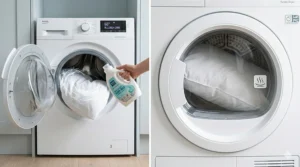
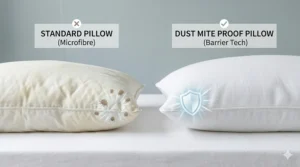
The good news: the fix is mechanical, not miraculous. Barrier fabric technology — the science behind quality dust mite proof pillows and encasements — works by physically blocking particles smaller than 10 microns from passing through the weave. At that pore size, neither mites nor their droppings can escape. Combine that with hot washing (60°C kills live mites; cooler temperatures just wash the allergen away temporarily), and you have a genuinely effective management strategy.
How to Choose a Dust Mite Proof Pillow in the UK: A Practical Decision Guide
Not every anti-allergy pillow is equal, and the label “hypoallergenic” is one of the most abused terms in the bedding industry. Here’s how to tell the difference between genuine protection and marketing fluff:
1. Look for independent certification. Allergy UK approval, OEKO-TEX® Standard 100, and British Standards compliance (e.g., BS 7177 for fire safety) are independently verified. A product simply claiming to be “anti-allergy” without external certification is making a promise, not a proof.
2. Understand the protection mechanism. There are two types — treated fill (biocides that inhibit mite colonisation) and barrier fabric (physical weave that blocks passage). Treated options are more comfortable but diminish over time. Barrier encasements are more durable but don’t replace the pillow itself. The best setups use both.
3. Consider washability at 60°C. According to Allergy UK, washing at 60°C is the temperature needed to kill mites. Many hollowfibre pillows can be washed at this temperature; memory foam covers typically cannot (30°C maximum). Check the care label before you buy.
4. Match support to sleeping position. An anti-allergy pillow that’s wrong for your sleeping position will be replaced quickly — defeating the purpose. Side sleepers need firmer, higher-loft options (Slumberdown firm or Panda). Back sleepers do well with medium support (Silentnight). Stomach sleepers need softer, flatter options.
5. Factor in the British climate of your home specifically. If you live in an older property with solid walls and limited ventilation — common in Victorian and Edwardian housing stock — your indoor humidity is likely higher, which means barrier encasements are more important than in a modern, well-ventilated new-build.
6. Don’t neglect the mattress and duvet. A dust mite proof pillow does the job it’s supposed to do. But as the NHS allergy guidance makes clear, mites live throughout your bedroom — in the mattress, duvet, and soft furnishings equally. A comprehensive approach covers all three sleeping surfaces.
Real UK Homes, Real Problems: Who Should Buy What
Knowing which pillow suits your specific situation is more useful than a generic ranking. Here are three profiles that cover most UK households:
The Commuter in a Central London Flat. You’re renting a one-bedroom flat, probably with double-glazed windows that haven’t been opened since 2019. Budget matters. Your allergy is moderate — enough to take antihistamines regularly, but not severe. The Silentnight Anti-Allergy Pack of 2, combined with a set of Utopia Bedding encasements, gives you a complete protection system for under £40. The encasements do the heavy lifting; the Silentnight pillows add treated fill as a secondary measure. Wash everything at 60°C every two weeks and you’re managing the problem properly.
The Family in a Semi-Detached in the Midlands. You have two kids, one of whom has asthma triggered by HDM. You need to equip three bedrooms simultaneously without spending a fortune. The BedStory 4 Pack for the children’s rooms, combined with Slumberdown Anti-Allergy for the adult bedroom, gives good coverage. Given the asthma factor, add Utopia encasements to the child’s mattress as well — the cost is minimal compared to the benefit.
The Serious Sufferer in a Victorian Terrace in Yorkshire. Your allergy is severe enough to have been diagnosed by an NHS allergy clinic. You wake up every morning with symptoms regardless of what you’ve tried before. This is the profile that justifies the investment in Panda Hybrid Bamboo Pillows, paired with Utopia encasements and a full set of allergen barrier mattress and duvet protectors. The upfront cost is higher, but the Panda’s 10-year guarantee and active airflow system — which prevents the warm, moist microclimate that mites depend on — makes this a long-term investment in your health rather than a regular replacement cycle.
Common Mistakes When Buying an Anti Dust Mite Pillow in the UK
Most people shopping for allergy bedding make at least one of these errors. None of them are obvious until someone points them out.
Confusing “hypoallergenic” with “anti-allergy.” Hypoallergenic means the pillow’s own materials are unlikely to trigger an allergic reaction — it says nothing about whether the pillow will resist dust mite colonisation over time. A feather pillow is decidedly not hypoallergenic; a standard synthetic pillow might be, but mites will still colonise it happily. You want anti-allergy (treated or barrier) rather than merely hypoallergenic.
Washing at 40°C and assuming that’s sufficient. This is perhaps the most common mistake. A 40°C wash cleans the fabric — it does not kill mites. They survive and recolonise within days. The NHS recommends 60°C as the minimum for killing mites; if your pillow’s care label only allows 40°C, pair it with an encasement that you can wash hotter, or put non-washable items in the freezer (at -17°C for 12 hours) to kill mites before washing at the lower temperature.
Buying a dust mite proof pillow and ignoring the mattress. The pillow is the closest allergen source to your airways, but the mattress contains far more mites by volume — potentially millions in an unprotected double mattress. A new anti-allergy pillow on an untreated mattress is like fitting a quality filter on one end of a draughty pipe. Address both simultaneously for meaningful symptom relief.
Overlooking the pillow protector for a non-washable premium pillow. If you invest in a Panda memory foam pillow and don’t add an encasement, the foam core — which cannot be machine washed — will accumulate allergens over time regardless of the bamboo cover. The barrier encasement is what makes a premium pillow a long-term investment rather than a luxury that slowly turns into an allergen reservoir.
Long-Term Cost and Maintenance: Getting the Most from Your Investment in GBP
A realistic budget calculation changes the value equation considerably.
A pair of Silentnight anti-allergy pillows at under £25, replaced annually, costs roughly £25 per year per sleeping surface. A pair of Panda Hybrid Bamboo pillows in the mid-£50s–£70s range, with a 10-year guarantee and realistic lifespan of five to seven years, costs between £8–£14 per year per sleeping surface once amortised. The premium option, counterintuitively, is often the cheaper long-term proposition — particularly when you factor in the reduced antihistamine expenditure and the improved sleep quality that compounds over time.
Maintenance costs are also worth factoring in. Treated hollowfibre pillows at the budget end need replacing every 12–18 months as the biocide treatment diminishes. Memory foam pillows need their covers washed regularly (bamboo covers at 30°C, generally), but the core lasts considerably longer. Barrier encasements, if washed at 60°C regularly, typically last two to three years before the zip and seams start to degrade — budget around £15–£20 every few years per bed as a running cost.
One often-overlooked consideration: VAT is already included in all Amazon.co.uk prices (UK VAT is 20%), so the price you see is the price you pay — unlike US Amazon pricing which excludes sales tax. A reassuringly honest thing about buying bedding in Britain.

FAQ: Dust Mite Proof Pillow Questions UK Buyers Actually Ask
❓ What is a dust mite proof pillow, and how does it work?
❓ Are dust mite proof pillows available on Amazon.co.uk with Prime delivery?
❓ How often should I wash an anti dust mite pillow in the UK?
❓ Will a dust mite proof pillow help with asthma as well as rhinitis?
❓ Is a dust mite resistant pillow cover the same as a dust mite proof pillow?
Conclusion: Make Tonight the Last Night You Wake Up Stuffy
There’s something quietly radical about a good night’s sleep. Not dramatic, not Instagram-worthy — just waking up able to breathe through your nose without a ritual of sneezing and eye-rubbing that takes a quarter of an hour to resolve. That’s what the right dust mite proof pillow can genuinely deliver.
The options reviewed here cover every budget and every severity of allergy. For most UK households, the most practical starting point is a Silentnight or Slumberdown anti-allergy pillow alongside a set of Utopia Bedding encasements — a combined outlay of under £50 that implements both protection mechanisms simultaneously. Those with more significant symptoms, or who simply want to make the investment once rather than repeatedly, will find the Panda Hybrid or Memory Foam Bamboo pillows justify their higher price with superior technology, longer lifespan, and the genuine comfort needed to make anti-allergy bedding something you want to sleep on rather than merely tolerate.
Whatever you choose, pair it with 60°C washing, a bedroom humidity below 50%, and a HEPA vacuum on the mattress and surrounding surfaces. The pillow is your most important first step. But it works best as part of a coherent approach — one that treats your bedroom not as a soft furnishing showroom, but as the one environment where your airways should be getting a proper rest.
✨ Don’t Miss These Exclusive Deals!
🔍 Ready to wake up breathing freely? Click on any highlighted product to check current pricing and availability on Amazon.co.uk — and start tonight’s sleep already winning.
Recommended for You
- Best CPAP Pillow for Side Sleepers UK 2026: Top 7 Picks
- Best CPAP Pillow UK 2026: 7 Top Picks for Deep, Mask-Friendly Sleep
- Best Wedge Pillow for Snoring UK: 7 Expert Picks (2026)
Disclaimer: This article contains affiliate links. As an Amazon Associate, I earn from qualifying purchases. If you purchase products through these links, we may earn a small commission at no additional cost to you.
✨ Found this helpful? Share it with your mates! 💬🤗
