
In This Article
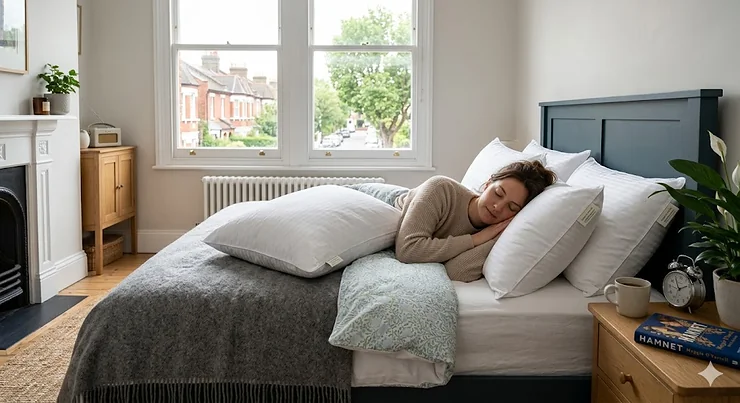
If you’ve ever woken up at 3 a.m. with a stuffed nose, itchy eyes, and the vague suspicion that your pillow is plotting against you — you’re not imagining things. The average pillow, after just two years of use, can contain up to a third of its weight in dead skin cells, dust mites, and their rather unpleasant droppings. Rather puts a damper on the whole “restful night” concept, doesn’t it?
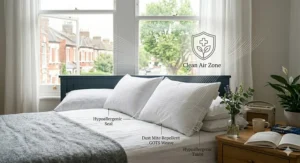
Choosing the right organic hypoallergenic pillow changes everything. Not the ordinary, vaguely-labelled “anti-allergy” sort found in supermarket sale bins — we’re talking genuinely organic, chemical-free, certified options that deal with allergens at source rather than masking them with a synthetic coating that washes out after six months. According to Allergy UK, over 20 million people in the UK suffer from at least one allergic condition, with bedroom allergens among the most common culprits. That’s a lot of unnecessarily terrible Tuesday mornings.
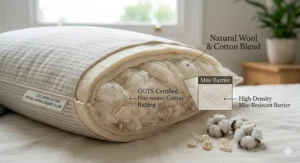
An organic hypoallergenic pillow uses materials like GOTS-certified cotton, natural latex, British wool, or buckwheat husks — none of which invite dust mites, mould spores, or synthetic off-gassing to the party. The key is certification: “natural” and “organic” are both terms that appear, legally unpoliced, on plenty of packaging that doesn’t quite earn either label.
This guide covers seven real products available on Amazon.co.uk right now, researched and rated for the specific realities of British life — damp weather, compact bedrooms, and the entirely reasonable desire to sleep on something that isn’t quietly making you ill.
Quick Comparison: Top Organic Hypoallergenic Pillows at a Glance
| Product | Fill Material | Key Certifications | Best For | Price Range |
|---|---|---|---|---|
| Woolroom Organic Washable Wool Pillow | British organic wool | GOTS, OEKO-TEX | Allergy sufferers, hot sleepers | £70–£90 |
| Woolroom Deluxe Customisable Wool Pillow | British wool | Allergy UK, OEKO-TEX | Adjustable comfort, all sleepers | £50–£70 |
| Woolroom British Wool Talalay Latex Pillow | Talalay latex + British wool | Allergy UK, OEKO-TEX, Cradle to Cradle | Premium support, side sleepers | £100–£150 |
| Panda Memory Foam Bamboo Pillow | 3rd-gen memory foam | OEKO-TEX Standard 100 | Neck/spine alignment, value shoppers | £40–£60 |
| Nod Off Organic Buckwheat Pillow | Organic buckwheat husks | Organic certified | Eco-conscious, cool sleepers | £40–£60 |
| Homescapes GOTS Organic Cotton Pillow | Organic cotton fill | GOTS | Budget buyers, sensitive skin | £25–£40 |
| Woolroom Classic Quilted Wool Pillow | British wool | Allergy UK approved | Firm support, no-fuss maintenance | £40–£55 |
The Global Organic Textile Standard (GOTS) — which you’ll see repeatedly on this list — is the benchmark that matters most here. It requires at least 70% organic fibres, prohibits hazardous chemicals across the entire supply chain, and is independently audited annually. If a pillow claims to be organic but doesn’t carry GOTS, OEKO-TEX, or an equivalent verified standard, treat that claim with healthy scepticism. The Woolroom Organic sits at the top of this table not by accident, but because it combines GOTS fill certification with independently verified Allergy UK approval — two separate standards, both earned.
💬 Just one click — help others make better buying decisions too! 😊
✨ Don’t Miss These Exclusive Deals!
🔍 Take your sleep to the next level with these carefully selected organic picks. Click any highlighted item to check current pricing and availability on Amazon.co.uk. Your best night’s sleep is closer than you think!
Top 7 Organic Hypoallergenic Pillows — Expert Analysis
1. Woolroom Organic Washable Wool Pillow (GOTS Certified)
The pillow for people who’ve done their research and refuse to compromise. The Woolroom Organic Washable Wool Pillow earns its top spot through rigorous certification and genuinely thoughtful construction.
The fill is 100% traceable British wool — meaning you can follow the supply chain back to the actual farm — encased in a 200-thread-count organic cotton quilted cover. Both fill and cover carry GOTS certification, and OEKO-TEX Standard 100 independently verifies that over 1,000 regulated substances are absent from every component. In practice: zero synthetic pesticide residues landing on your face for eight hours a night.
What sets wool apart for British sleepers is thermoregulation. British bedrooms swing between warm summer nights and draughty February mornings — wool actively wicks moisture and adapts to both extremes, something synthetic fills simply cannot do. UK reviewers consistently praise it for eliminating the “sweaty pillow flip” phenomenon entirely, which, if you’ve experienced it, you’ll know is not a minor quality-of-life issue.
Who is this for? Anyone with asthma, eczema, or documented dust mite sensitivity who wants the cleanest possible sleep surface. Also excellent for those in smaller flats where windows stay closed more often — reduced ventilation means allergens accumulate faster, making certified organic fill especially worthwhile.
UK buyers note: Machine washable on a gentle cycle at 40°C. Prime-eligible. Ships from and sold by WOOLROOM directly on Amazon.co.uk.
✅ Full GOTS certification across both fill and cover
✅ Traceable British wool from identified farms
✅ Adjustable fill via zip — customise firmness to preference
❌ Firmer feel than down or synthetic — takes a few nights to adjust
❌ Faint wool scent when new (dissipates within a week)
Price range: £70–£90 | Excellent long-term value given durability and certification depth.
2. Woolroom Deluxe Customisable Wool Pillow
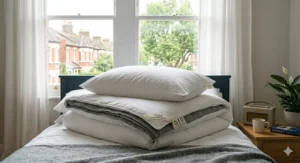
Think of this as the Organic’s slightly more accessible sibling — and a rather clever piece of bedding engineering in its own right. The Woolroom Deluxe Customisable Wool Pillow holds an exclusive Allergy UK Seal of Approval: not a rubber-stamp exercise, but a rigorous independent assessment confirming it resists dust mites, mould, and fungal growth in real-world conditions.
The construction centres on 100% traceable British wool inside a machine-washable certified organic cotton cover (standard UK size: 48×78 cm). Its defining feature is full adjustability — a zip lets you add or remove fill until the loft is exactly right. This sounds like a small thing. It isn’t. If you share a bed with someone who sleeps very differently from you — one of you a side sleeper, the other a back sleeper, for instance — adjustable fill genuinely solves the “we need completely different pillows” problem without buying two completely different pillows.
For British households in older terraced houses, where bedroom humidity fluctuates noticeably with the seasons, wool’s natural moisture management keeps the sleep surface consistently dry. Damp environments are where dust mites thrive. Eliminating their ideal habitat is far more effective than any chemical spray — and significantly more pleasant to sleep on.
UK customer reviews note the “sheep-to-sleep” quality narrative as more than marketing; several verified buyers report dramatic improvements in hay fever and night-time congestion within a fortnight of switching.
✅ Allergy UK certified — independent, respected UK accreditation
✅ Fully adjustable firmness — genuinely rare feature in this category
✅ Machine washable, sold directly by WOOLROOM on Amazon.co.uk
❌ Less filling on arrival than expected (by design — you customise it)
❌ Cover is certified organic cotton; fill is certified British wool, not full GOTS dual-certification
Price range: £50–£70 | Solid mid-range value for verified allergy protection.
3. Woolroom British Wool Talalay Latex Pillow
The most technically sophisticated pillow on this list — and it wears that distinction well without being smug about it. The Woolroom British Wool Talalay Latex Pillow combines a Talalay latex core with a quilted outer layer of 300 g/m² British wool wrapped in 200-thread-count organic cotton, and it’s handcrafted in the UK. That last detail is increasingly rare, and worth noting.
Talalay is the gold standard of natural latex processing: it produces a more consistent, breathable, and springier foam than the more common Dunlop method. Every core is individually washed, dried, and tested before assembly. The pillow holds Allergy UK approval, Cradle to Cradle certification (which evaluates recyclability at end of life — not many pillows plan that far ahead), and OEKO-TEX Standard 100. Standard UK size: 48×74 cm, available in 17 cm and 20 cm depth variants.
As the Sleep Foundation notes, latex’s consistent loft and responsive support make it particularly effective for maintaining cervical spine alignment through the night — something fibrefill options, which compress unevenly, struggle to match. For side sleepers with neck pain, the structured Talalay core provides exactly that: firm, consistent support that doesn’t flatten or drift to one side.
The practical upshot: the latex provides structure, the wool regulates temperature, and the organic cotton cover wicks moisture. Rather elegant engineering, honestly.
✅ Handcrafted in the UK — exceptional build quality, no import complications
✅ Talalay latex: most breathable, consistent natural latex available
✅ Triple certification: Allergy UK + Cradle to Cradle + OEKO-TEX
❌ Premium price point — the most expensive option on this list
❌ Heavier than fibrefill alternatives; the wool outer layer adds meaningful mass
Price range: £100–£150 | Built to last 10+ years — cost per night of sleep is actually quite modest over its lifespan.
4. Panda Memory Foam Bamboo Pillow
Not strictly an “organic” pillow in the GOTS sense — memory foam by definition involves chemical processing — but the Panda Memory Foam Bamboo Pillow earns its place here through OEKO-TEX Standard 100 certification, which independently verifies that every component, including foam, cover, thread, and dye, is free from more than 1,000 harmful substances. For buyers who want hypoallergenic assurance without the price of certified organic fill, this is the most compelling option on Amazon.co.uk.
The cover is 70% bamboo fibre, 30% polyester — silky, breathable, antibacterial, and naturally inhospitable to dust mites. The triple-layer 3rd-generation memory foam core (60×40×12 cm) contours to your head shape, promoting neutral spinal alignment. The 10-year guarantee and 30-night trial period are unusually generous commitments for this price bracket.
For urban UK sleepers in smaller bedrooms — a studio flat in Manchester, a terraced house in Leeds — where air quality matters and chemical off-gassing from synthetic bedding accumulates quickly, the OEKO-TEX verification provides genuine reassurance. The bamboo cover washes beautifully and softens further with each wash, a rare quality at this price.
UK buyers note: Prime-eligible on Amazon.co.uk. The cover is machine washable; the foam core should be spot-cleaned only.
✅ OEKO-TEX Standard 100 certified — verified chemical-free throughout
✅ Bamboo cover naturally antibacterial and dust-mite resistant
✅ Generous trial period and long guarantee for the price
❌ Memory foam is not an organic material — chemical processing is involved in manufacture
❌ Foam must not be machine washed — cover-only washing
Price range: £40–£60 | Best-value hypoallergenic pick for buyers not requiring full organic certification.
5. Nod Off Organic Buckwheat Pillow
Buckwheat pillows have been a staple of Japanese sleep culture for centuries, and for good reason. The Nod Off Organic Buckwheat Pillow brings that tradition to a UK market that’s only recently cottoned on — and does so with fully organic credentials: certified organic buckwheat husks, unbleached 100% cotton cover, zero chemical treatments anywhere in the process.
Here’s what most buyers overlook about buckwheat: the hard hulls create a natural airflow network inside the pillow that synthetic fills simply cannot replicate. This makes it exceptionally cool to sleep on — a genuine advantage during the increasingly warm British summer nights that recent climate trends have been delivering with irritating regularity. It’s also fully adjustable: removing a handful of husks softens and flattens the pillow, adding them firms it up.
The hypoallergenic properties aren’t marketing. The hard, dry surface of buckwheat hulls provides no food source or moisture retention for dust mites — they essentially can’t colonise it. The unbleached organic cotton cover adds another layer of assurance for chemically sensitive sleepers.
The honest caveat: there’s a gentle rustling sound when you move. Most sleepers tune it out within a week. Some never do. If you’re a particularly light sleeper — the kind who notices everything — try it for several nights before drawing conclusions.
✅ Natural resistance to dust mites — no chemical treatment needed or applied
✅ Exceptionally breathable — ideal for warm or hyperhidrotic sleepers
✅ Fully adjustable firmness; incredible longevity (husks last years)
❌ Rustling sound when moving — divisive for light sleepers
❌ Heavier than conventional pillows; buckwheat is genuinely dense
Price range: £40–£60 | Outstanding eco credentials at an accessible price point.
6. Homescapes GOTS Organic Cotton Pillow
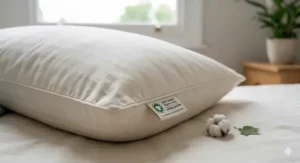
Sometimes simplicity is the right answer. The Homescapes GOTS Organic Cotton Pillow is for the buyer who doesn’t need Talalay engineering or traceable sheep — just a clean, certified, genuinely affordable organic pillow that does what it says. Available on Amazon.co.uk, GOTS certified, with organic cotton fill and cover throughout.
Organic cotton’s particular advantage is familiarity. It feels immediately recognisable — similar to conventional hollowfibre — washes without drama at 60°C (genuinely useful during a more acute allergy flare-up), and presents none of the adjustment period that latex or buckwheat require. For sensitive skin, particularly for children or those with eczema, unbleached undyed organic cotton is often the clinician’s first recommendation. The NHS guidance on allergic rhinitis consistently emphasises bedding hygiene as a primary environmental control — and washability at higher temperatures is a meaningful part of that.
UK buyers on tighter budgets, or furnishing a spare room, don’t need to sacrifice on certifications. This delivers GOTS-certified organic protection without asking for a significant outlay.
✅ GOTS certified — both fill and cover, rigorously verified
✅ Familiar feel — no adjustment period whatsoever
✅ Machine washable at 60°C — the highest-temperature option on this list
❌ Tends to flatten after 12–18 months — needs more regular replacement than wool or latex
❌ Less temperature-regulating than wool, bamboo, or buckwheat
Price range: £25–£40 | Best budget organic option for straightforward, certified allergy protection.
7. Woolroom Classic Quilted Wool Pillow
The understated workhorse of the Woolroom range. The Classic Quilted Wool Pillow does away with the zip and adjustability of the Deluxe and simply delivers a well-constructed, Allergy UK-approved British wool pillow at an accessible price. The quilted construction holds fill in place more consistently than loose-fill alternatives, making it a better choice for active sleepers who tend to thoroughly reshape their pillow through the night.
100% British wool fill, organic cotton quilted cover, medium-firm support. Standard UK size. Machine washable. Carries the Allergy UK Seal of Approval and OEKO-TEX Standard 100 certification. If the Deluxe feels like too much decision-making — all that adjusting, adding, removing fill — this is the no-fuss alternative that still delivers independently verified hypoallergenic protection.
For a family looking to replace multiple pillows at once without stretching the budget, this is the most logical entry point into genuinely certified hypoallergenic bedding from a British brand with an established track record.
✅ Allergy UK approved — independently verified allergy protection
✅ Quilted construction holds shape well through active sleeping
✅ Machine washable and Prime-eligible on Amazon.co.uk
❌ Not adjustable — fixed loft and firmness
❌ Wool-only feel may be firmer than some buyers expect from a standard pillow
Price range: £40–£55 | Excellent no-nonsense value from a trusted British brand.
How to Choose the Right Organic Hypoallergenic Pillow in the UK
Choosing well isn’t complicated, but it is specific. Here’s what actually matters — in order of priority.
- Identify your allergen trigger first. Dust mites? Mould spores? Chemical sensitivity? Latex protein allergy (rare but important to rule out)? Wool and buckwheat tackle dust mites naturally through their material properties. GOTS-certified cotton eliminates chemical exposure entirely. Knowing your specific enemy makes every subsequent decision much simpler.
- Match fill material to sleep position. Side sleepers need more loft and firm support — latex or firm wool works best. Back sleepers benefit from medium loft — adjustable wool pillows are ideal here. Stomach sleepers (no judgement, but do reconsider) need low, soft fill — the Homescapes cotton or a well-depleted buckwheat option.
- Verify certifications — don’t just trust the label. The UK’s Trading Standards framework requires honest product descriptions, but “organic” and “natural” remain legally ambiguous terms in bedding. Look specifically for GOTS, OEKO-TEX Standard 100, GOLS (for latex), or Allergy UK Seal of Approval. Each is independently audited and publicly verifiable.
- Prioritise washability. British homes run more humid than continental European equivalents. Regular washing — every 2–3 months minimum — is essential for allergy management. Wool pillows typically wash at 40°C; organic cotton at 60°C; Panda bamboo (cover only). Check before purchasing.
- Think long-term. A quality latex or wool pillow lasts 10+ years with proper care. A cheap cotton fill lasts 12–18 months. Over a decade, investing more upfront is almost always the better financial decision.
- Budget realistically for certification. Organic certification costs manufacturers money — audited supply chains aren’t cheap to maintain. Under £40 is achievable with the Homescapes. £70–£90 gets you exceptional quality with Woolroom Organic. Beyond £100 is premium territory worth considering only if structured support and longevity are your priorities.
- Check Prime eligibility. Most Woolroom products and the Panda ship from their own Amazon storefronts with Prime eligibility — useful when you need next-day delivery during an allergy flare-up and aren’t inclined to wait three days.
Real-World UK Scenarios: Which Pillow for Which Sleeper?
The London flat-dweller with hay fever and a cat: Enclosed space, limited ventilation, pet dander circulating freely. The Woolroom Organic Washable Wool Pillow is the right call — GOTS certified, washable, and wool’s natural structure actively resists both dust mites and the mould spores that thrive in humid city flats. Prime next-day delivery takes the edge off a particularly bad pollen day.
The Birmingham family replacing three pillows at once: Practicality wins. The Homescapes GOTS Organic Cotton Pillow at the £25–£40 range lets you kit out a whole household without sacrificing GOTS credentials. Wash at 60°C for maximum allergen removal and plan to replace every 18 months — it’s still cheaper long-term than one latex option for the whole family.
The retired couple in the Cotswolds — one with neck pain, one who sleeps warm: Two different problems, one household. For the neck pain sleeper: Woolroom British Wool Talalay Latex Pillow — the structured Talalay core provides consistent cervical alignment without collapse. For the warm sleeper: Nod Off Organic Buckwheat Pillow — breathable, cool, and naturally adjustable. Both available on Amazon.co.uk with standard delivery.
The eczema sufferer starting from scratch: Begin simple and verified. The Homescapes GOTS Organic Cotton Pillow — unbleached, undyed, certified organic — is the gentlest possible starting point for highly reactive skin. No novel materials, no adjustment period, just clean cotton.
Caring for Your Organic Pillow in the British Climate
The British climate does your bedding no particular favours. Here’s how to keep your organic hypoallergenic pillow performing at its best in conditions that range from “damp drizzle” to “quite dramatic damp drizzle.”
Wash regularly. Every 2–3 months minimum. In higher-humidity homes — ground-floor flats, terraced houses with limited through-ventilation — every 6–8 weeks is better. Pillow covers should be washed fortnightly regardless.
Dry thoroughly. Non-negotiable. A partially damp wool or cotton pillow in an unheated British bedroom is essentially a mould incubator with a pillowcase on it. Use a tumble dryer on low heat or position near (not directly on) a radiator. Give the pillow a firm shake once dry to redistribute fill.
Air on dry days. On the rare occasions British weather obliges, hang your pillow outside on a breezy, dry afternoon for an hour or two. Natural sunlight kills dust mites, and fresh air removes accumulated moisture from any bedding. Even a single hour on the washing line makes a measurable difference — particularly useful for buckwheat and wool pillows that shouldn’t be machine washed as frequently.
Store thoughtfully in compact spaces. If storing spare pillows under a bed or in a fitted wardrobe (the British reality for most homes), use breathable cotton bags rather than plastic. Plastic traps moisture and creates exactly the humid microclimate you bought organic to avoid.
Know when to replace. Do the fold test: fold the pillow in half, let go. If it stays folded, it’s done its time. Organic latex: 10+ years. Organic wool: 8–12 years. Buckwheat husks: replace every 5 years (the case itself lasts much longer). Organic cotton fill: 12–18 months. Memory foam: 3–5 years.
Organic vs Synthetic “Anti-Allergy” Pillows: What the Label Doesn’t Say
This distinction matters more than most buying guides acknowledge. There’s an important difference between an organic hypoallergenic pillow and a synthetic “anti-allergy” pillow — and it’s one that genuinely affects long-term allergy management.
Synthetic anti-allergy pillows typically use a tightly woven microfibre cover that physically blocks dust mites from penetrating the fill. They work reasonably well when new. But the protective cover degrades with washing, the synthetic fill is a hospitable food source for any mites that do get in, and chemical treatments applied to some “anti-allergy” hollowfibre fills wash out after a few cycles. You’re buying diminishing returns at a fixed price.
Organic hypoallergenic pillows work through material properties rather than coatings. Wool, buckwheat, and latex are naturally inhospitable to dust mites not because of what’s been applied to them, but because of what they inherently are — low moisture retention, hard or dense surfaces, natural antimicrobial compounds. The protection doesn’t degrade because it was never applied in the first place. As Which? consistently advises UK consumers, independently verified certifications are the only reliable indicators of genuine allergy protection in bedding — something worth keeping in mind when any product describes itself as “hypoallergenic” without naming a certifying body.
The practical difference: synthetic anti-allergy protection typically degrades meaningfully within 6–12 months. Organic alternatives maintain their properties for the life of the pillow. For chronic allergy sufferers who wash bedding frequently, organic is almost always the smarter long-term investment — even at a higher upfront cost.
| Feature | Organic Hypoallergenic Pillow | Synthetic Anti-Allergy Pillow |
|---|---|---|
| Allergen resistance | Intrinsic to material | Applied coating — degrades with washing |
| Chemical presence | Verified absent (GOTS/OEKO-TEX) | May include flame retardants, dyes, binders |
| Lifespan | 5–15 years depending on fill | 1–3 years typically |
| Environmental impact | Sustainably sourced, biodegradable | Petroleum-derived; non-biodegradable |
| UK certification available | GOTS, Allergy UK, OEKO-TEX | Varies — often no independent verification |
| Best for | Chronic allergy sufferers, sensitive skin | Occasional allergy concerns, budget priority |
The table tells a fairly clear story: organic options offer structural advantages that synthetic alternatives cannot replicate, particularly over time. Budget buyers who choose organic cotton over synthetic anti-allergy fill at a similar price point are almost always making the better decision for long-term allergy control.
Common Mistakes When Buying an Organic Hypoallergenic Pillow in the UK
Trusting “natural” without a certification. “Natural” has no legal definition in UK bedding. “Organic” is similarly unprotected without a named standard behind it. Always look for GOTS, OEKO-TEX, GOLS, or Allergy UK Seal of Approval — not the product description alone.
Ordering US-specification products. Several highly reviewed organic pillows — Avocado, Saatva, PlushBeds — are widely covered online but ship primarily to North America. They either don’t appear on Amazon.co.uk or attract post-Brexit import duties that push the total cost well above UK equivalents. Stick with products confirmed available on Amazon.co.uk.
Ignoring the cover material. A wool fill with a polyester cover is not an organic pillow. Allergens accumulate in synthetic cover fabric regardless of what’s inside. Verify that both fill and cover carry certification — GOTS confirmation should cover both.
Expecting instant comfort from a new material. Natural latex and buckwheat feel noticeably different to the synthetic pillows most people have slept on for years. Give your new organic hypoallergenic pillow at least 7–10 nights before judging it — your neck muscles are adjusting to proper support, and that takes a short while.
Overlooking UK sizing. Standard UK pillow size is 48×74 cm or 48×78 cm. Several “organic” options sold via UK marketplaces are actually US Queen size (51×66 cm or similar) — they’ll sit awkwardly in standard British pillowcases. Check dimensions on the product listing before purchasing.
FAQ: Organic Hypoallergenic Pillows in the UK
❓ What does GOTS certified mean for a pillow?
❓ Are organic hypoallergenic pillows available with next-day delivery in the UK?
❓ Can I wash an organic wool pillow in a standard washing machine?
❓ Is natural latex safe if I have a rubber latex allergy?
❓ How do organic pillows compare to standard anti-allergy pillows from UK supermarkets?
Conclusion
The best organic hypoallergenic pillow for you depends on who you are and how you sleep — but the good news is that the UK market in 2026 has genuinely excellent options across every budget and sleep style. Start with the Woolroom Organic Washable Wool Pillow if certification depth and long-term value are your priorities. Choose the Woolroom Talalay Latex Pillow if you need structured neck support alongside allergy protection. The Panda Bamboo Pillow punches well above its price bracket for verified chemical-free comfort. And if you simply need something clean, affordable, and certifiably organic right now, the Homescapes GOTS Cotton Pillow does exactly that without fuss.
One thing’s certain: your current pillow, if it’s more than two years old and not certified organic, is almost certainly not contributing to your sleep quality the way it could. Sometimes the simplest upgrade is also the most impactful — and swapping to a genuine organic hypoallergenic pillow is one you’ll notice within a week.
✨ Don’t Miss These Exclusive Deals!
🔍 Click any highlighted product above to check current pricing and availability on Amazon.co.uk. All listed products are Prime-eligible — often with next-day delivery. Sleep better, starting tonight.
Recommended for You
- Best Anti Allergy Treated Pillow UK 2026: 7 Expert Picks
- 7 Best Dust Mite Proof Pillows UK 2026 — Sleep Without Sneezing
- Best CPAP Pillow for Side Sleepers UK 2026: Top 7 Picks
Disclaimer: This article contains affiliate links. As an Amazon Associate, I earn from qualifying purchases. If you purchase products through these links, we may earn a small commission at no additional cost to you.
✨ Found this helpful? Share it with your mates! 💬🤗
