
In This Article
Anyone who has driven past junction 10 on a motorway with a child slumped sideways, head lolling into the door handle every time you brake, knows the exact sound a small skull makes against a window. It is not a pleasant sound. It is also entirely avoidable, which is the annoying part.

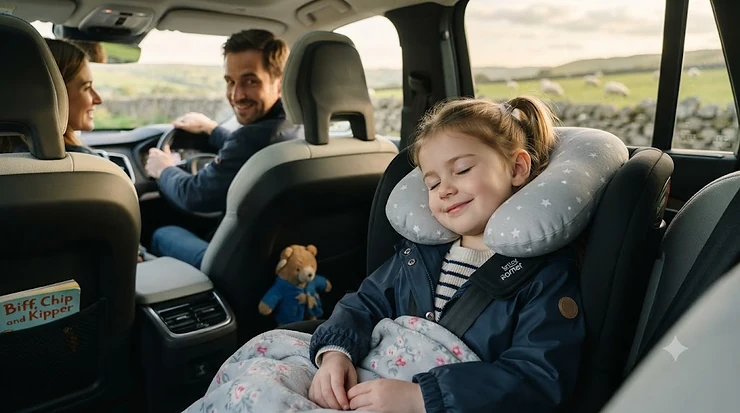
A car travel pillow for kids is a small, purpose-shaped cushion — usually a horseshoe, a wraparound collar, or a chin-supporting curved design — that keeps a child’s head and neck stable and comfortable while they nap in a car seat or booster. Unlike a rolled-up cardigan or a spare jumper (the traditional British solution to everything), it is engineered specifically to stop the head tipping forward onto the chest or sideways into a seatbelt, both of which wake children up and, over a long journey, genuinely irritate the neck.
This matters more than it might sound. Family road trips across the UK routinely run two, three, even five hours, and a child who cannot get comfortable will not sleep — which means everyone in the front seats will not get any peace either. We have spent time digging through real product listings, aggregated review sentiment, and the actual UK regulations that govern how children travel in cars, so that what follows is grounded in genuine research rather than recycled marketing copy. Below you will find seven real products, honestly compared, plus practical guidance on car seat comfort, child neck support, and the wider category of road trip essentials that make long drives survivable for the whole family. Under UK law, children must use an appropriate car seat or booster until they are 12 years old or 135cm tall, whichever comes first — so any comfort accessory you choose needs to work alongside that seat, not against it.
Quick Comparison Table
For anyone who wants the short version before diving into the detail, here is how the seven pillows stack up at a glance.
| Product | Support Style | Best Age Range | Price Range | Best For |
|---|---|---|---|---|
| Trunki Yondi | Chin rest + neck wrap | 3–10 years | £12–£18 | Best For: everyday comfort with character appeal |
| Trunki SnooziHedz | Inflatable pillow + blanket | 2–8 years | £14–£20 | Best For: combined nap and cosy blanket set |
| BCOZZY Kids Chin Supporting Pillow | Patented double chin support | 3–7 years (Small) | £15–£21 | Best For: upright sleepers who slump forward |
| INFANZIA Kids Chin Supporting Pillow | U-shaped foam with chin bar | 2–8 years | £9–£13 | Best For: budget-conscious first-time buyers |
| Proglobe Junior Travel Neck Pillow | Ergonomic memory foam | 4–13 years | £12–£17 | Best For: older kids and coach or plane crossover use |
| SKYTRAX Certified Kids Pillow | Memory foam with snap buttons | 3–10 years | £10–£15 | Best For: adjustable fit as your child grows |
| stocaggio 2-in-1 Deformable Pillow | Soft U-shape, dual mode | 2–7 years | £9–£14 | Best For: toddlers who also want a cuddle toy |
Looking at the spread, there is a clear pattern: cheaper pillows (INFANZIA, stocaggio) rely on simpler foam-fill construction and suit toddlers who nap intermittently, while the mid-to-premium options (BCOZZY, Trunki Yondi, Proglobe) use denser, shaped foam that holds its form on a three-hour motorway stretch. None of the seven claims to be a safety device, and none should be marketed as one — they are comfort accessories that sit on top of a properly fitted, legally compliant car seat, never a substitute for one.
💬 Just one click — help others make better buying decisions too!😊
Top 7 Car Travel Pillows for Kids: Expert Analysis
We picked these seven because between them they cover budget, mid-range and premium price points, several genuinely different support mechanisms, and real availability rather than one-off novelty listings. Here is the honest breakdown of each.
1. Trunki Yondi — chin-supporting neck wrap with character charm
The Trunki Yondi wraps snugly around a child’s neck like a scaled-down horseshoe pillow, but the clever bit is the raised chin section at the front, which stops the classic “head drops onto chest” slump that happens the second a toddler nods off in a booster seat.
Built from a plush polyester outer with a lightly padded fill, the Trunki Yondi is soft enough to sit comfortably against bare skin in summer, and the snap-button fastening means it can hang from a car seat headrest, a rucksack, or a pushchair handle when it is not in use — a small detail that stops it becoming yet another item lost down the back seat. Character options (Bert the dog, Betsy the elephant, Felix the fox) give it playground cachet that a plain grey neck cushion simply does not have.
Based on the spec comparison with rival chin-support designs, what stands out about the Trunki Yondi is how deliberately it is scaled down for small necks rather than being a shrunk adult pillow — the curve sits higher and tighter, which matters because a loose neck pillow on a small child tends to slide down and stop doing its job within twenty minutes. It suits toddlers and younger primary-age children best; older kids with longer necks may find the fit slightly snug.
Reviewers consistently report that the character design genuinely encourages reluctant nappers to accept the pillow, since it is styled as a toy first and a travel aid second. A recurring theme in user feedback is that the fabric holds up well to machine washing, though a handful of reviewers note the zip on the character face can be a weak point with heavy daily use.
Pros:
- ✅ Raised chin support genuinely stops forward head-drop
- ✅ Snap-button strap doubles as a hanging loop for storage
- ✅ Character design encourages reluctant toddlers to use it
Cons:
- ❌ Snug fit may feel tight on longer-necked older children
- ❌ Character zip detailing reported as a wear point over time
At around £12–£18, the Trunki Yondi sits comfortably mid-pack, and given the specific chin-support engineering, it represents solid value for families who do one or two long trips a month rather than daily nursery runs.

2. Trunki SnooziHedz — inflatable pillow and blanket combo for proper naps
Where the Trunki Yondi is a neck wrap, the Trunki SnooziHedz is a different proposition entirely: a soft character-shaped pouch that unzips to reveal an inflatable pillow insert and a fleece blanket tucked inside, connected by what Trunki calls the “Trunki Grip” so the blanket cannot slide off a sleeping child’s lap mid-journey.
The inflatable core means the pillow itself packs down flat for the boot, then blows up in seconds when you actually need it — genuinely useful for families who do not want a permanently bulky cushion rattling around the car between trips. The blanket has a small internal pocket sized for a comforter or small soft toy, which stops favourite teddies migrating to the footwell every time the car brakes.
What most buyers overlook about this model is that it is really two products bundled as one: a nap pillow for the head, and a proper blanket for warmth, which together do more to help a child actually fall asleep than a neck pillow alone. Reviewers consistently note that it works especially well on cooler evening drives home from grandparents’ houses, when temperature as much as head position is what keeps kids awake and grizzling.
Aggregated feedback does flag that the zip mechanism on some character designs is not the most robust for daily heavy use, and a few reviewers mention the pillow and blanket run slightly smaller than the product photography suggests, so it suits younger children (roughly 2–8) better than pre-teens.
Pros:
- ✅ Inflatable insert packs flat, inflates only when needed
- ✅ Integrated blanket with pocket keeps comforters secure
- ✅ Trunki Grip stops the blanket sliding off sleeping laps
Cons:
- ❌ Zip quality reported as inconsistent on some character variants
- ❌ Runs smaller in real life than promotional photos imply
Priced around £14–£20, the Trunki SnooziHedz earns its place for families whose road trips regularly stretch into evening drives home, where warmth matters as much as neck angle.
3. BCOZZY Kids Chin Supporting Travel Pillow — the patented double-support design
The BCOZZY Kids Chin Supporting Travel Pillow takes a genuinely different engineering approach: instead of a simple horseshoe, it uses a patented curved wraparound shape with soft “arms” that cradle both the chin and the sides of the head, whichever direction a child slumps.
Made from breathable microfleece and microsuede over a soft bounce-back fill, it is fully machine washable — a detail that matters enormously once you consider how often small children eat biscuits, dribble, or are sick on long journeys. It comes in a Small size for ages 3–7 and a Medium for 8–12, meaning families with children spanning several years apart do not need to buy two completely different pillow types.
On paper, this dual-support structure means it does not just stop the head falling forward, it also catches sideways lean towards the window — the other classic sleeping position that causes a stiff neck by the services stop at Watford Gap. Reviewers consistently describe it as noticeably more effective for children who fall properly, deeply asleep rather than dozing lightly, since the chin cradle keeps working even in a slack, fully-relaxed sleeping posture.
A common complaint in user reviews is that, because it wraps fully around, some children find it a little warm on long summer journeys with the air conditioning off, and the adjustable strap takes a moment of fiddling to get right the first time.
Pros:
- ✅ Patented curved design catches both forward and sideways slump
- ✅ Fully machine washable microfleece cover
- ✅ Two sizes cover ages 3 right through to 12
Cons:
- ❌ Can feel warm on hot journeys without air conditioning
- ❌ Adjustable strap needs a bit of trial and error to fit
At roughly £15–£21, the BCOZZY Kids Chin Supporting Travel Pillow sits at the premium end of this list, and for families who do genuinely long journeys — think Cornwall from Scotland rather than the school run — the extra engineering is arguably worth the difference.
4. INFANZIA Kids Chin Supporting Travel Neck Pillow — the sensible budget entry
Not every family needs to spend £20 on a pillow their child might use for one summer before growing out of it, and the INFANZIA Kids Chin Supporting Travel Neck Pillow is built for exactly that reality. It is a simple U-shaped foam pillow with a front chin bar, sold at a genuinely low price point without pretending to be anything more elaborate than it is.
The foam fill is softer and less structured than the memory foam options further down this list, which means it moulds around a small neck reasonably well but will compress and flatten faster with heavy daily use. It is a straightforward design — no inflation, no character branding, no fancy strap system — which is precisely what makes it a sensible “let’s just try this” purchase for parents who are not yet sure whether their particular child will accept a neck pillow at all.
Based on the spec comparison with pricier alternatives, what the INFANZIA pillow gives up in longevity and structured support, it makes up for in accessibility: it is light enough for even a toddler to hold and inspect before agreeing to wear it, which anyone who has negotiated with a two-year-old about clothing will recognise as a genuinely useful feature.
Reviewers consistently note it as good value for occasional trips, though a recurring theme is that the foam softens noticeably after a few months of regular use, and it is less effective for children who move around a lot in their sleep.
Pros:
- ✅ Genuinely low price point for first-time buyers
- ✅ Lightweight and unintimidating for toddlers to accept
- ✅ Simple design with nothing complicated to adjust
Cons:
- ❌ Foam softens and loses shape faster than memory foam rivals
- ❌ Less effective for children who shift position frequently
At around £9–£13, the INFANZIA Kids Chin Supporting Travel Neck Pillow is the logical starting point if you are not certain your child will tolerate a neck pillow, and do not want to gamble £20 finding out.
5. Proglobe Junior Travel Neck Pillow — ergonomic memory foam for older kids
Once children move past the toddler years, their support needs change, and the Proglobe Junior Travel Neck Pillow is aimed squarely at that older bracket, with a stated fit for ages 4 through 13 — genuinely useful if you have a tween who still needs help nodding off on a five-hour drive to a festival or a ferry port.
It uses proper memory foam rather than loose polyester fill, which means it holds its shape under sustained pressure far better than budget alternatives, springing back into form after every journey instead of gradually flattening into a pancake by month three. The ergonomic curve is cut slightly wider than the toddler-focused options on this list, reflecting the simple fact that an eight-year-old’s neck is a different shape to a three-year-old’s.
What most buyers overlook about this model is its crossover usefulness: because the shape and sizing suit older children, it works just as well on a coach trip, a long-haul flight, or a train as it does strapped into a booster seat, so it earns its keep well beyond car journeys alone. Reviewers consistently praise the washable cover and the fact that the foam does not develop the slightly chemical smell some cheaper memory foam products arrive with.
A common complaint in user reviews is that, being firmer than a fleece-fill pillow, some younger or more sensitive children find it a little stiff to begin with, before it softens in with use.
Pros:
- ✅ True memory foam holds shape far longer than loose fill
- ✅ Sized properly for older children rather than shrunk adult stock
- ✅ Doubles up for coach, train and flight use, not just cars
Cons:
- ❌ Firmer initial feel takes some getting used to
- ❌ Less snug fit for children under about four years old
Priced around £12–£17, the Proglobe Junior Travel Neck Pillow is worth prioritising if your children are past the toddler stage and you want one pillow that works across every kind of family journey, not only the car.

6. SKYTRAX Certified Kids Safe Memory Foam Travel Neck Pillow — adjustable comfort that grows with your child
The SKYTRAX Certified Kids Safe Memory Foam Travel Neck Pillow pairs a cartoon-friendly cover — unicorn, dinosaur and other prints — with genuine memory foam filling and an adjustable snap-button closure, which lets you loosen or tighten the fit as your child grows across a couple of years rather than needing a size change every twelve months.
The washable soft cover is a sensible practical touch given how often car snacks end up smeared across a child’s neck cushion, and the memory foam core gives it noticeably more structure than the pure-fleece options on this list, so it holds its position rather than sliding down as a child’s head tips forward.
Based on the spec comparison, what stands out here is the adjustability: most kids’ travel pillows are a fixed loop size, which means they either fit now and will not in a year, or they are loose enough to slip off entirely. The snap-button design solves that specific, common frustration directly, which is why it functions well as a pillow you buy once rather than replace annually.
Reviewers consistently report that the cartoon prints are a genuine selling point for getting reluctant toddlers to wear it in the first place, and that the memory foam retains its shape well after repeated washing. A recurring theme in feedback is that the adjustable snaps, while useful, can occasionally dig in slightly if fastened too tightly against a smaller neck.
Pros:
- ✅ Adjustable snap fastening grows with your child over time
- ✅ True memory foam holds shape better than basic fill
- ✅ Fun cartoon designs help win over reluctant toddlers
Cons:
- ❌ Snap fastenings can dig in if over-tightened
- ❌ Character prints may feel babyish to children over about eight
At around £10–£15, the SKYTRAX Certified Kids Safe Memory Foam Travel Neck Pillow offers strong value precisely because the adjustability extends its useful life well beyond a single growth stage.
7. stocaggio 2-in-1 Deformable Kids Neck Pillow — the cuddle toy that also works as a pillow
Rounding out the list, the stocaggio 2-in-1 Deformable Kids Neck Pillow takes a softer, more playful approach: a plush animal-print U-shaped cushion designed to double as a comfort toy for play time and a neck pillow for travel time, which matters for toddlers who form strong attachments to specific soft objects.
Its “deformable” construction means the filling shifts and moulds under gentle pressure rather than springing back rigidly, giving it a floppier, cuddlier feel than the firmer memory foam entries on this list. That softness is exactly what makes it appealing as a genuine plaything rather than purely a travel accessory a child tolerates because a parent insists.
Honestly, this is not the pillow to reach for on a genuinely long, hot motorway slog where structural support matters most — the BCOZZY or Proglobe options do that job better. But for shorter regular trips, nursery runs, or as the “transitional object” that also happens to support a nodding head, its dual identity as toy-and-pillow is a genuinely clever piece of design thinking, and reviewers consistently note that children are more likely to actually keep it on than with stricter, more structured pillows.
A recurring theme in feedback is that, because the fill is softer, it offers noticeably less firm support on longer stretches, and the plush animal fabric, while soft, is not always machine washable on a standard cycle — check the care label before assuming it goes straight in with school uniforms.
Pros:
- ✅ Doubles as a comfort toy children willingly keep hold of
- ✅ Soft, deformable fill is gentle against sensitive young skin
- ✅ Playful animal designs suit toddlers and younger children
Cons:
- ❌ Less structured support than firmer memory foam rivals
- ❌ Care instructions vary — not always fully machine washable
At around £9–£14, the stocaggio 2-in-1 Deformable Kids Neck Pillow is best thought of as a comfort-first pick for toddlers rather than a heavy-duty support device for gruelling cross-country drives.
Getting Set Up Right: A Practical Usage Guide
Buying the right pillow is only half the job — how you actually fit and introduce it matters just as much, and this is the part most product listings skip entirely.
Start the first attempt at home, not on the motorway. Let your child wear the pillow around the house or in front seat trials on the driveway for ten minutes, so the first time they experience the sensation is not also the first time they are stuck in a booster seat with nowhere to go. Fit it after the harness or seatbelt is fastened, never before, and never let the pillow’s strap or fastening sit under or interfere with any part of the harness webbing — its job is comfort, not restraint, and it should never compromise how the car seat’s own straps sit against the body.
For the first thirty days, expect some trial and error: children commonly reject a pillow the first two or three times before deciding it is acceptable, particularly if it is a new sensation around the neck. Wash it early — a pillow that already smells vaguely of home is more likely to be accepted than one straight out of plastic packaging. Rotate between two pillows if your child has one for the car and one for flights or trains, since damp or slightly grubby foam left in a hot car boot between trips can start to smell and put a child off entirely.
Maintenance is simple but easy to forget: check the washing instructions before the first wash (memory foam inserts often need removing before the cover goes in the machine), air-dry rather than tumble-dry foam-filled pillows to protect their shape, and inspect straps and snap fastenings every few months for wear, since these are the components most likely to fail with regular use.

Real Families, Real Journeys: Matching the Pillow to the Trip
Every family’s road trip looks different, so here is how three common scenarios play out in practice.
Consider a family doing the twice-yearly six-hour drive from the Midlands to Cornwall with two children, aged four and nine. The younger one still naps reliably and slumps forward hard when she does, so a chin-supporting design like the BCOZZY Kids Chin Supporting Travel Pillow or the Trunki Yondi genuinely earns its cost here — the structured chin cradle matters on a journey this long. The nine-year-old, meanwhile, is better served by the Proglobe Junior Travel Neck Pillow, since its sizing and firmer memory foam suit an older child’s longer neck, and it will do double duty on the coach trip to France planned for the school summer holidays.
Now picture a family doing a regular ninety-minute Friday-evening drive to grandparents, with a toddler who is usually fighting sleep by the second half of the journey. Here, a lighter, cheaper option like the INFANZIA Kids Chin Supporting Travel Neck Pillow or the toy-like stocaggio 2-in-1 Deformable Kids Neck Pillow makes more sense than premium memory foam — the trip is short, the budget priority is lower, and a toddler is more likely to accept something that also functions as a familiar soft toy.
Finally, think about a family on a tight budget doing occasional day trips, unsure whether their strong-willed five-year-old will tolerate any neck pillow at all. Here, starting with the SKYTRAX Certified Kids Safe Memory Foam Travel Neck Pillow — inexpensive, adjustable, and dressed up with a fun cartoon print — is a sensible low-risk way to test the waters before committing to a pricier option.
How to Choose a Car Travel Pillow for Kids
If you only read one section properly, make it this one — these seven criteria cover almost every decision that actually matters.
- Match support style to sleeping habit. Children who slump forward need chin support (BCOZZY, Trunki Yondi); children who lean sideways benefit more from a fuller wraparound collar.
- Check the age and neck-size fit. A pillow that is too large will not stay in position; too small and it will not support anything, so check stated age ranges rather than guessing.
- Prioritise washability. Car journeys involve snacks, spills and the occasional bit of travel sickness — a machine-washable cover is not a luxury, it is essential.
- Consider foam type versus soft fill. Memory foam holds its shape for longer journeys and years of use; softer fleece fill is gentler and more toy-like but compresses faster.
- Think about crossover use. If your family also flies or takes coaches, a pillow like the Proglobe that works across transport types offers better value than a car-only design.
- Factor in appeal, not just engineering. The best-designed pillow is useless if your child refuses to wear it — character prints and soft textures genuinely affect real-world uptake.
- Set a realistic budget for growth. Children’s neck sizes and preferences change; an adjustable design (SKYTRAX) or a genuinely low-cost option (INFANZIA) may suit better than a premium pillow they will outgrow in a year.
Car Travel Pillow vs Traditional Alternatives
Before neck pillows became widely available, parents relied on rolled-up jumpers, folded towels, or nothing at all. It is worth being honest about how these stack up.
| Method | Neck Support | Stays In Place | Washability | Cost |
|---|---|---|---|---|
| Car travel pillow (e.g. Trunki Yondi, BCOZZY) | Purpose-shaped, consistent | Generally good with proper fit | Usually machine washable | £9–£21 |
| Rolled-up jumper or towel | Inconsistent, shifts easily | Poor — slides during braking | Whatever’s already in the wash pile | Free |
| No support at all | None | N/A | N/A | Free |
| Adult-sized travel pillow | Oversized, poor fit for small necks | Poor — too loose | Varies | £8–£25 |
The written comparison here matters more than the table itself: a rolled towel might feel like a free, sensible stopgap, but it has no shape memory, meaning it flattens and shifts within minutes of a child falling properly asleep, right when support is needed most. Adult travel pillows, meanwhile, are simply the wrong scale — the loop sits too large around a small neck, which paradoxically makes them less safe to wear near a seatbelt than a properly fitted kids’ design, since loose fabric can bunch awkwardly against the belt path. A purpose-built car travel pillow for kids costs a modest amount once and solves the problem consistently, which is difficult to argue against once you have done the six-hour drive with the towel-and-safety-pin approach at least once.
✨ Ready to sort out sibling squabbles over who gets the comfy pillow?
🚗💤 Compare the full line-up above and pick the one that matches how your child actually sleeps — check current pricing and availability before your next trip.
Common Mistakes When Buying a Car Travel Pillow for Kids
Even sensible, well-researched parents fall into a few predictable traps here.
The first is buying based on looks alone. A gorgeous cartoon print means nothing if the shape does not suit how your particular child slumps — a unicorn-print pillow with the wrong support style will sit in the boot unused just as readily as a plain grey one. The second mistake is ignoring the size guide entirely; a pillow rated for ages 8–12 will swim on a three-year-old and provide almost no functional support, however soft it feels.
A third common error is assuming a more expensive pillow is automatically better. As the Which? guide to child car seat rules makes clear in a related context, the correct fit for your child’s actual size and stage matters more than price point when it comes to in-car comfort and safety accessories — the same logic applies here. Finally, many parents forget to check whether the pillow’s strap or fastening could ever sit under or interfere with the seatbelt or harness webbing; any accessory that alters how the restraint sits against the body should be avoided, regardless of how comfortable it looks.
Car Seat Comfort: Getting the Fit Right
Car seat comfort is about more than the pillow alone — it is the whole system working together, and a brilliant travel pillow cannot fix a badly angled headrest or a seat reclined too far upright for genuine sleep.
Start with the booster or car seat’s built-in recline angle. Most modern high-back boosters allow a small amount of recline specifically for comfort on long journeys; check your seat’s manual, because a seat left bolt upright makes any neck pillow work twice as hard to hold a sleeping head in place. Next, check headrest height — the top of the headrest should sit roughly level with the top of your child’s ears, not their shoulders, since a headrest set too low pushes the neck pillow’s support point in the wrong place entirely.
Temperature affects comfort more than most parents expect: a child who is slightly too warm fidgets and resists settling regardless of how good the pillow is, so light, breathable pillow covers matter as much on car seat comfort as the shape underneath. Finally, remember that car seat comfort accessories, including neck pillows, sit on top of the restraint system rather than replacing any part of it — the RoSPA car seat safety guide is clear that the seat and harness fit itself is what protects a child in a collision, and comfort accessories should never be positioned in a way that loosens or repositions the actual restraint straps.
Child Neck Support: What the Research Actually Says
Child neck support is not simply a comfort nicety — it reflects real anatomical differences between children and adults that are worth understanding properly.
A child’s head is proportionally larger and heavier relative to their body than an adult’s, and their neck muscles and ligaments are still developing, which is precisely why unsupported sleep in a seated position causes more noticeable discomfort in children than in adults doing the same thing. This is also, separately, part of the underlying reasoning behind why UK law requires proper child restraint systems in the first place — children’s bones, joints and proportions are meaningfully different from a scaled-down adult’s, which is why standard adult seatbelts alone are considered inadequate for younger passengers.
It is worth being precise here: a neck pillow addresses comfort and sleep quality during upright travel, not the structural crash protection that a properly fitted, weight- or height-appropriate car seat provides — those are two entirely separate jobs, and no neck pillow marketed for children claims otherwise, nor should any parent treat one as a safety device. What a well-designed child neck support pillow genuinely does is reduce the repeated small movements and awkward angles that build up into a stiff, achy neck by the end of a long journey, and helps children actually reach and stay in restful sleep rather than the fitful dozing that leaves everyone grumpy at the services.
Road Trip Essentials: Building the Full Comfort Kit
A travel pillow rarely works in isolation — the families who report the smoothest long journeys tend to build a small, consistent kit of road trip essentials around it rather than relying on one item to solve everything.
A lightweight, breathable travel blanket pairs naturally with a neck pillow, particularly for evening or early-morning drives when the temperature swings noticeably. A window shade reduces the low sun glare that keeps children blinking awake just as they are drifting off, which matters more than parents often expect on long east-west motorway stretches. A small, spill-resistant snack pot and refillable water bottle round out the basics, since hunger and thirst undo even the best-fitted pillow within minutes.
For journeys over about two hours, a simple activity case — even just a few favourite small toys or a tablet with downloaded shows — helps bridge the awake portion of the trip before the pillow’s job even begins, since an overstimulated, wound-up child will fight sleep regardless of how comfortable their neck is. Building this small kit once, and keeping it topped up in the boot, does more for overall journey comfort than any single purchase, the travel pillow included.
Safety, Regulations and Compliance Guide
It is worth being direct about where neck pillows sit relative to UK regulation, because there is genuine confusion among parents on this point.
Car travel pillows for kids are comfort accessories and are not regulated as safety equipment, unlike the car seat or booster itself, which must meet either ECE R44/04 or the newer R129 i-Size standard to be legal for use on UK roads. This means there is no official kitemark or CE-style safety certification specific to neck pillows in the way there is for the car seat underneath — manufacturer claims about “kids safe” materials generally refer to fabric and filling safety standards (such as flammability and chemical content regulations for children’s products) rather than any crash-protection rating.
Practically, this means the pillow should always be treated as secondary to correct car seat fitting. According to NHS guidance on car seat safety, UK law requires babies and children to use an appropriate car seat until they are 12 years old or 135cm tall, and only EU-approved seats carrying the correct ECE label may be used. Fit the car seat correctly first, following the manufacturer’s instructions and the harness routing exactly as designed, and only then add a neck pillow as a comfort layer on top — never let a pillow’s strap, buckle, or bulk interfere with how the harness or seatbelt sits against your child’s body.
Long-Term Cost and Maintenance
Thinking about total cost of ownership rather than sticker price alone changes the maths on several of these pillows.
A £10 budget pillow that needs replacing every six months because the foam has flattened works out more expensive over two years than a £20 memory foam option that holds its shape and simply gets washed and reused. Machine-washable covers reduce ongoing cost too, since a pillow that can be freshened up rather than replaced when it starts smelling of car journeys and biscuit crumbs earns its price back quickly.
| Pillow | Approx. Price | Typical Lifespan | Cost Per Year (2-year use) |
|---|---|---|---|
| INFANZIA Kids Chin Supporting Pillow | £9–£13 | 6–12 months (foam softens) | Higher — likely needs replacing |
| BCOZZY Kids Chin Supporting Pillow | £15–£21 | 2+ years with washing | Lower — better long-term value |
| Proglobe Junior Travel Neck Pillow | £12–£17 | 2+ years, crossover use | Lower — spreads cost across transport types |
The analysis here is straightforward: for families who travel occasionally, the cheaper options remain perfectly sensible, since the pillow will likely be outgrown before it wears out anyway. For families doing frequent long journeys, spending slightly more upfront on a memory foam design like the BCOZZY Kids Chin Supporting Travel Pillow or the Proglobe Junior Travel Neck Pillow genuinely reduces cost per year of actual use, not just the headline price on the listing.
Frequently Asked Questions
❓ What age can a child use a car travel pillow?
❓ Is a neck pillow safe to use with a car seat harness?
❓ How do I stop my child's travel pillow sliding down?
❓ Can travel pillows be washed?
❓ Do car travel pillows replace the need for a proper car seat?
Conclusion
There is no single “best” car travel pillow for kids, and honestly, anyone claiming otherwise has not actually compared how differently children sleep. A toddler who slumps forward the second their eyes close needs the structured chin cradle of something like the BCOZZY Kids Chin Supporting Travel Pillow or the Trunki Yondi; an older child heading off on a coach trip as well as car journeys is better served by the firmer, more versatile Proglobe Junior Travel Neck Pillow; and a cautious first-time buyer testing whether their child will tolerate a neck pillow at all should start with something low-risk like the INFANZIA Kids Chin Supporting Travel Neck Pillow or the toy-like stocaggio 2-in-1 Deformable Kids Neck Pillow.
What matters most, across all seven options, is fitting the pillow correctly on top of a properly installed, legally compliant car seat, matching the support style to how your own child actually sleeps, and being realistic about how long any given pillow needs to last before it is outgrown or worn out. Get those three things right, and the rest of the journey — the actual driving part — becomes noticeably more peaceful for everyone in the car.
✨ Don’t Miss These Exclusive Deals!
🔍 Give your next road trip the head start it deserves. Click through to check current pricing and availability on any of the seven picks above, and turn those long motorway stretches into genuinely restful naps your kids will thank you for.
Recommended for You
- Travel Pillow Under £20: 7 Best Budget Picks for Flights 2026
- Leg Spacer Pillow for Back Pain: 7 Genuinely Useful Picks (2026)
- Bolster Pillow for Support: 7 Best Picks Compared for 2026
Disclaimer: This article contains affiliate links. As an Amazon Associate, I earn from qualifying purchases. If you purchase products through these links, we may earn a small commission at no additional cost to you.
✨ Found this helpful? Share it with your friends! 💬🤗
