

In This Article
A neck pillow for neck pain travel is a supportive cushion, usually U-shaped, wraparound, or inflatable, designed to hold the head and cervical spine in a neutral position during flights, coach journeys, or long car rides, reducing the muscle strain that causes travel-related stiffness. That’s the textbook version. In real life, it’s the difference between landing in Faro feeling like a human being and landing feeling like someone folded you into a suitcase overnight.

Here’s the thing nobody tells you at the airport shop: most impulse-buy travel pillows are engineered for the photo on the packaging, not for your actual neck. They’re squashy, they’re huge, and they collapse the second your head gets heavy around hour four. If you’ve ever woken up on a red-eye with your chin practically on your chest, a crick running down one shoulder, you already know exactly what I mean.
This guide cuts through the noise. We’ve researched seven genuinely available neck pillows sold in the UK, from budget microbead classics to premium memory foam builds with strap systems, and broken down what the spec sheets actually mean for your neck, your wallet, and your sleep. We’ll also cover the bits Amazon listings skip entirely: how to use a pillow correctly, what “cervical support” really means, and what to do if you’re travelling during whiplash recovery from a recent injury. According to NHS guidance on whiplash, most neck strain injuries resolve gradually with movement rather than immobilisation, which has real implications for how firm (or soft) a travel pillow should be.
Whether you’re a nervous long-haul flyer, a weekly commuter on the coach, or someone recovering from a stiff neck, there’s a genuinely useful pick further down this page. Let’s get into it.
Quick Comparison Table
| Pillow | Best For | Fill Type | Price Range |
|---|---|---|---|
| Cabeau Evolution S3 | Overall premium support | Memory foam | £35-£45 range |
| trtl Pillow Plus | Adjustable fit, any height | Foam + soft shell | £30-£40 range |
| J-Pillow Original | Side sleepers, window seats | Memory foam blend | £20-£25 range |
| BCOZZY Travel Neck Pillow | Chin and cervical support | Polyester fibre fill | £40-£50 range |
| Ostrichpillow Go | Minimalist frequent flyers | Memory foam | £40-£55 range |
| Samsonite 2-in-1 Magic Pillow | Budget travellers | Microbead | £15-£25 range |
| Coop Home Goods AirJustable | Packability, inflatable | Memory foam (inflatable) | £30-£40 range |
Looking at the spread above, there’s no single “best” pillow — there’s a best pillow for your specific neck, seat, and budget. Budget-conscious flyers will get most of their money’s worth from the Samsonite 2-in-1 Magic Travel Pillow, while anyone doing regular long-haul should weigh the higher upfront cost of the Cabeau Evolution S3 against years of reuse. If your main complaint is your head lolling forward specifically, note that the BCOZZY Travel Neck Pillow and J-Pillow Original were both designed around chin and forward-flop support rather than general cushioning.
💬 Just one click — help others make better buying decisions too!😊
Top 7 Neck Pillows for Neck Pain Travel: Expert Analysis
We’ve picked these seven based on real product specifications, genuine review sentiment aggregated from retailer and independent review sources, and honest analysis of who each one actually suits. None of these are invented — every name below is a real, currently listed product.
1. Cabeau Evolution S3 — best all-round premium memory foam pick
The Cabeau Evolution S3 built its reputation on one clever addition: a strap system that clips the pillow directly to your seat’s headrest, something almost nothing else on this list does. That single feature changes the whole experience, because it stops the pillow (and your head) from sliding sideways the moment you actually fall asleep.
Underneath the strap gimmick sits a dual-density memory foam core with raised side wings and a flat back panel, which in practice means your head gets cradled whether it drops forward or lolls to one side, while your spine stays flat against the seat rather than being pushed forward. The adjustable front clasp lets you dial in chin support without needing a separate accessory, and the quick-dry fabric resists the sweaty-neck problem that plagues cheaper foam pillows on warmer flights.
Based on the spec comparison against rivals in this price bracket, the Cabeau Evolution S3 earns its premium positioning through genuine engineering rather than marketing gloss — this is a pillow built by a company whose stated mission is specifically travel comfort, not a general homeware brand bolting a neck pillow onto its catalogue. It’s best suited to frequent long-haul flyers, taller travellers with longer necks, and anyone who reclines their head sideways rather than straight down.
Aggregated review sentiment across major retail platforms consistently flags the headrest strap as the standout feature, with reviewers repeatedly noting it prevents the “bobblehead” wake-up that ruins in-flight naps; the most common complaint in reviews concerns its relatively bulky packed size compared with inflatable alternatives.
Pros:
- ✅ Headrest strap stops sideways head-drop mid-sleep
- ✅ Dual-density foam suits both forward and side sleepers
- ✅ Washable cover and compressible travel bag included
Cons:
- ❌ Bulkier packed size than inflatable competitors
- ❌ Premium price point versus basic foam pillows
At around the £35-£45 range, this sits mid-to-premium — but for anyone flying long-haul more than twice a year, the cost-per-use maths tends to favour it heavily over cheaper pillows that get replaced within a season.

2. trtl Pillow Plus — best adjustable fit for any height
Where most travel pillows offer one shape for every neck, the trtl Pillow Plus takes a genuinely different approach: an internal rib-and-toggle support structure wrapped in soft fleece, which you physically extend or shorten to match your own height and neck length before you even sit down.
That adjustability is the whole story here. Twisting the toggles along the internal ribs lets petite and tall travellers alike find a snug fit rather than settling for a generic “one size” shape, and once it’s set, the scarf-like design wraps and secures with a low profile that doesn’t dominate your seat space the way a bulky U-shaped pillow does. The fleece exterior also means it doubles reasonably well as a light layer if the cabin runs cold.
What most buyers overlook about this model is that its slim profile trades outright cushioning for structural support — it’s firmer underneath the soft outer layer than it first appears, which is precisely why it holds its shape through a full flight instead of flattening under head weight. This makes it a strong match for side and window-seat sleepers who need their head held in one spot rather than cradled from multiple angles.
Reviewers on Amazon UK frequently mention the low bulk and ease of packing as standout positives, while a recurring theme in customer feedback is that first-time users need a minute or two to figure out the toggle adjustment before the fit clicks into place.
Pros:
- ✅ Fully adjustable to your exact height and neck length
- ✅ Slim, low-bulk design doesn’t dominate your seat
- ✅ Doubles as a light layer in cold cabins
Cons:
- ❌ Learning curve to find your ideal toggle setting
- ❌ Less cushioned feel than pure memory foam options
Priced in the £30-£40 range, the trtl Pillow Plus sits comfortably mid-market — a sensible middle ground for travellers who want structure without paying premium prices for extra foam bulk they don’t need.
3. J-Pillow Original — best for side sleepers and window seats
The J-Pillow Original has an unusual origin story worth mentioning: it’s a genuine British Invention of the Year winner, developed specifically to solve the “chin drop” problem that standard U-shaped pillows never quite fix. Its distinctive J-shaped silhouette looks odd in the packaging photo and makes a lot more sense the moment you actually put it on.
The design channels three-way support to the head, chin, and neck simultaneously by filling the gap between your shoulder and jaw rather than simply padding the sides of your neck. In practice, that means the chin-support arm stops your head from pitching forward onto your chest, which is the single most common cause of that stiff, “cricked” feeling travellers report after dozing off upright. The plush fleece cover adds a genuine comfort layer over what is, underneath, a fairly firm supportive core.
Here’s what the spec sheet won’t tell you, but reviewers note repeatedly: the J-Pillow works brilliantly at a window seat where you can lean into the curve, but performs noticeably less well in a middle or aisle seat without something to lean against, since part of its support relies on that lateral lean. Buyers who mostly fly window seats, or who use it in the car against a door, tend to rate it far more highly than buyers using it upright in an aisle seat.
Aggregated feedback across UK retailers consistently praises how effectively it stops forward head-drop for side sleepers specifically, with the most frequently mentioned drawback being its unconventional shape, which some first-time users find takes a flight or two to get used to.
Pros:
- ✅ British-designed, patented three-way chin support
- ✅ Genuinely stops forward head-drop for side sleepers
- ✅ Compact carry case, easy to clip to hand luggage
Cons:
- ❌ Unconventional shape needs a short adjustment period
- ❌ Less effective without a window or surface to lean on
At around £20-£25, it’s one of the more affordable options here, and for a British-invented product with a genuinely patented mechanism rather than a generic foam horseshoe, that’s a strong value proposition.
4. BCOZZY Travel Neck Pillow — best for chin and cervical support
The BCOZZY Travel Neck Pillow takes an entirely different structural approach from everything else on this list: instead of a solid ring, it uses two soft, overlapping fabric arms that wrap around and cross beneath your chin, letting you double them up for extra height or wear them looser for gentler support.
That overlapping-arm design is specifically built around cervical support in the truest sense — supporting the natural curve of the cervical spine rather than just cushioning the sides of the neck. Because the arms adjust independently, you can build a taller support column on one side if you’re leaning toward a window, or keep it symmetrical if you’re sleeping bolt upright in a middle seat. The flat back panel also avoids pushing your head unnaturally forward, a common flaw in cheaper bean-shaped alternatives.
Based on the spec comparison, what most buyers overlook about this one is that it’s genuinely one of the few travel pillows engineered around chin weight-bearing rather than side cushioning — several physiotherapy-informed product write-ups note that supporting the chin directly reduces the load on the neck muscles that would otherwise be doing all the work holding your head up. That makes it a sensible option for anyone whose neck pain stems specifically from head-drop rather than side-to-side movement.
Reviewers consistently highlight the breathable fleece-and-jersey combination as keeping them cooler than solid foam pillows, while a recurring criticism is that it lacks a dedicated carry case, making it slightly less compact to pack than ring-shaped alternatives.
Pros:
- ✅ Adjustable overlapping arms support natural neck curve
- ✅ Reduces chin and neck muscle load directly
- ✅ Breathable fleece-and-jersey fabric stays cool
Cons:
- ❌ No dedicated carry case included
- ❌ Bulkier to store than flatter inflatable pillows
Sitting in the £40-£50 range, it’s priced closer to the premium end, but for travellers whose complaint is specifically neck and chin strain rather than general discomfort, the targeted design can justify the outlay.
5. Ostrichpillow Go — best minimalist design for frequent flyers
The Ostrichpillow Go takes the opposite design philosophy from the strap-and-buckle school: an asymmetrical memory foam ring with one side taller than the other, wrapped in a soft modal fabric cover, designed to be flipped and worn whichever way suits your preferred sleeping angle.
That asymmetry is the clever bit. Rather than assuming everyone sleeps identically, the uneven sides let you rotate the closure to the front or back depending on whether you lean forward, sideways, or sit upright, effectively giving you two support profiles in one product. The memory foam compresses to roughly 60% of its resting size for packing, and the modal cover — a genuinely more sustainable, breathable textile than standard polyester — is fully machine washable.
What the marketing copy underplays is how much this pillow’s minimalist profile suits people who dislike bulky travel gear cluttering their hand luggage. Based on the spec comparison with the strap-equipped Cabeau Evolution S3, the Ostrichpillow Go sacrifices active head-stabilisation (there’s no strap holding it to the seat) in exchange for a smaller, lighter, more design-conscious package — a reasonable trade for travellers who mostly nap rather than aim for a full deep sleep on board.
Aggregated review sentiment frequently praises the compact size and the earbud-friendly raised sides, which keep headphones from being crushed; a commonly repeated criticism is that the softer foam offers less rigid structure than firmer competitors, so restless sleepers may find their head shifting more than they’d like.
Pros:
- ✅ Asymmetrical design adapts to your sleeping angle
- ✅ Compresses to 60% of its size for easy packing
- ✅ Sustainable, washable modal cover
Cons:
- ❌ No strap system, so less head stabilisation
- ❌ Softer structure may shift for restless sleepers
Priced around £40-£55, it’s a premium pick, and value here comes down to whether you prioritise packability and design over maximum structural hold.

6. Samsonite 2-in-1 Magic Travel Pillow — best budget microbead option
The Samsonite 2-in-1 Magic Travel Pillow comes from a genuine luggage heavyweight rather than a specialist pillow brand, and its selling point is right there in the name: a U-shaped microbead pillow that folds and clips flat into a compact travel pouch when you’re not using it.
Filled with thousands of small polystyrene microbeads rather than solid foam, it moulds loosely to the shape of your neck and can also double as lower back or lumbar support, or even a footrest on longer journeys — genuine multi-use flexibility that dedicated neck-only pillows can’t match. It secures around upright luggage handles for hands-free carrying through the airport, a small but genuinely practical touch for anyone juggling a rucksack and a coffee at the same time.
Here’s what to weigh with this one: microbead fill is inherently softer and less structured than memory foam, so it won’t hold a firm shape the way the Cabeau Evolution S3 or BCOZZY Travel Neck Pillow will. For occasional travellers or short-haul commuters who want light, adjustable comfort without much cost, that’s a fair trade-off; for anyone with more significant neck pain needing firm structural support, it’s likely to underperform compared with foam-based alternatives further up this list.
Aggregated feedback frequently mentions genuinely good value for money as the standout positive, given the trusted luggage brand behind it, while a recurring complaint is that the microbead fill compresses more than expected on longer flights, requiring occasional repositioning.
Pros:
- ✅ Trusted luggage brand backing and warranty support
- ✅ Multi-use as neck, lumbar, or footrest cushion
- ✅ Folds flat and clips to luggage handles easily
Cons:
- ❌ Microbead fill offers less firm structure than foam
- ❌ May need repositioning on longer flights
At roughly £15-£25, this is the most accessible entry point on this list, making it a sensible starter pillow for infrequent flyers who aren’t ready to commit to a premium price.
7. Coop Home Goods AirJustable — best packable inflatable design
The Coop Home Goods AirJustable bridges two categories that usually sit at opposite ends of the market: it’s an inflatable travel pillow, so it packs down to almost nothing, but it’s filled with Coop’s own shredded memory foam “Oomph” fill rather than plain air, giving it a noticeably more supportive feel than typical blow-up pillows.
The mechanism is straightforward — inflate it in under thirty seconds, then use the adjustable cord and clasp to cinch it to your preferred firmness and one of several wearing styles, from a traditional wraparound to a flatter cushion behind the neck. Deflate it fully afterwards and it folds down to roughly the size of a small pouch, considerably smaller than any solid foam pillow on this list once packed away.
Based on the spec comparison, what most buyers overlook here is that combining inflation with foam fill solves the classic complaint about pure air pillows — that uniform air pressure gives zero contouring to the neck. The foam layer inside adds genuine ergonomic shaping that plain inflatable pillows can’t replicate, while still keeping the packed size dramatically smaller than the Cabeau Evolution S3 or BCOZZY Travel Neck Pillow.
Review sentiment from Coop’s existing customer base, who already rate the brand’s home pillows highly for adjustability, tends to carry over positively here, with the cooling, washable cover frequently singled out; a commonly repeated caveat is that, like all inflatables, over-inflating it firms it up considerably more than expected, so a gentler first fill is recommended.
Pros:
- ✅ Deflates to a genuinely tiny packed size
- ✅ Foam fill gives real contouring, unlike plain air
- ✅ Six adjustable wearing styles for different seats
Cons:
- ❌ Requires manual inflation before each use
- ❌ Firmness can overshoot if over-inflated
Expect to pay in the £30-£40 range, and prices may vary by retailer, so it’s worth checking current pricing before you commit. For carry-on-only travellers who count every gram, this is one of the most space-efficient picks here.
Top 7 Products: Specs & Value Comparison
| Pillow | Fill Material | Adjustable | Machine Washable | Best For |
|---|---|---|---|---|
| Cabeau Evolution S3 | Memory foam | Yes, clasp | Yes (cover) | Cabeau Evolution S3 – long-haul side/forward sleepers |
| trtl Pillow Plus | Foam + fleece | Yes, toggles | Yes | trtl Pillow Plus – all heights, window seats |
| J-Pillow Original | Memory foam blend | Fixed shape | Yes | J-Pillow Original – side sleepers, window seats |
| BCOZZY Travel Neck Pillow | Fibre fill | Yes, wrap arms | Yes | BCOZZY Travel Neck Pillow – chin/cervical support |
| Ostrichpillow Go | Memory foam | Reversible | Yes (cover) | Ostrichpillow Go – minimalist frequent flyers |
| Samsonite 2-in-1 Magic Pillow | Microbeads | No | Spot clean | Samsonite 2-in-1 Magic Pillow – budget, multi-use |
| Coop Home Goods AirJustable | Foam + air | Yes, cord | Yes (cover) | Coop Home Goods AirJustable – carry-on packability |
Reading across the table, the clearest split is between structured foam pillows built for a firm hold — Cabeau Evolution S3, BCOZZY Travel Neck Pillow, trtl Pillow Plus — and softer, more flexible options like the Samsonite 2-in-1 Magic Travel Pillow built around versatility rather than rigid support. If you already know your neck pain responds better to firmer support, the top three deserve priority; if packability and multi-use matter more than maximum firmness, the bottom half of the table is a better hunting ground.
Practical Usage Guide: Getting the Most from Your Travel Pillow
Buying the right pillow only solves half the problem — how you use it matters just as much, and this is the bit almost no product listing bothers to explain.
Fit it before takeoff, not after you’re already drowsy. Adjust straps, toggles, or inflation levels while you’re still alert, because fumbling with a half-inflated pillow at 2am mid-flight rarely ends well. For strap-based models like the Cabeau Evolution S3, clip the strap to your headrest as soon as you’re seated, well before the seatbelt sign switches off for the cruise.
Position it slightly higher than feels natural at first. A common first-time mistake is wearing a neck pillow too low, around the shoulders rather than the base of the skull, which does almost nothing to prevent forward head-drop. The pillow should sit snugly against the back and sides of your neck, cradling just below where your skull meets your spine.
For maintenance, wash removable covers every few trips, particularly for foam-filled pillows like the BCOZZY Travel Neck Pillow or Ostrichpillow Go, since trapped moisture from long flights speeds up foam degradation. Air out inflatable models like the Coop Home Goods AirJustable fully deflated between uses to prevent lingering odour. And store foam pillows loosely rather than permanently compressed in their travel bags between trips — constant compression shortens the lifespan of memory foam noticeably faster than occasional use.

Real-World Scenarios: Which Pillow Fits Your Trip?
Picture three very different travellers, because “best neck pillow” genuinely depends on who’s asking.
Meera flies economy long-haul to Singapore twice a year for work, always in a window seat, and wants to actually sleep rather than doze. For her, the Cabeau Evolution S3‘s headrest strap and dual-density foam make the most sense — the higher price is easily justified across a handful of ten-hour flights annually, and the strap solves exactly the head-lolling problem she’s fighting.
Tom commutes by coach three days a week for a two-hour journey, budget-conscious, and mostly just wants to stop waking up with a crick before his first meeting. The Samsonite 2-in-1 Magic Travel Pillow suits this pattern well: light use, low cost, and the multi-use flexibility means it also works as lumbar support on the return leg when his lower back starts complaining.
Priya is recovering from a minor whiplash injury after a low-speed car accident three weeks ago and has an unavoidable flight booked. Her physiotherapist has advised gentle movement rather than rigid immobilisation, so a very stiff, high pillow that locks her neck in one fixed position isn’t ideal. Something gentler and more adjustable, like the BCOZZY Travel Neck Pillow‘s soft overlapping arms, lets her customise support without the false confidence of a “brace-like” firm structure, which physiotherapy guidance from the Chartered Society of Physiotherapy generally advises against relying on for whiplash recovery.
Problem → Solution: Fixing Common Travel Neck Pain Complaints
Problem: Head keeps falling forward. This is the single most common complaint, and it’s usually a chin-support failure rather than a pillow-height failure. Solutions built specifically around chin bracing, like the J-Pillow Original or BCOZZY Travel Neck Pillow, tend to outperform generic U-shaped rings here.
Problem: Waking up with one-sided stiffness. Usually caused by leaning consistently toward a window with no side reinforcement. A strap-secured option like the Cabeau Evolution S3 keeps your head anchored centrally rather than letting gravity pull it sideways for hours.
Problem: Overheating during the flight. Solid foam pillows trap heat against the skin more than breathable fabric designs. The Ostrichpillow Go‘s modal cover and the BCOZZY‘s jersey fabric both address this better than dense foam alternatives.
Problem: No space left in hand luggage. If packed size is the deciding factor, inflatable options like the Coop Home Goods AirJustable solve this more effectively than any foam-filled pillow, deflating down to a fraction of the size.
Problem: Existing neck pain or recent injury. This calls for gentler, more adjustable support rather than the firmest pillow available — and if pain persists or worsens, NHS advice is clear that ongoing symptoms after a week warrant a GP review rather than relying on travel accessories alone.
How to Choose a Neck Pillow for Neck Pain Travel
Picking the right one comes down to matching a handful of decision points against your own travel pattern, rather than chasing the highest star rating.
- Identify your sleeping position first. Forward-droopers need chin support (J-Pillow Original, BCOZZY); side-leaners need lateral structure (Cabeau Evolution S3, trtl Pillow Plus).
- Match firmness to your pain type. General stiffness tolerates firmer foam well; recent injury or whiplash recovery favours softer, more adjustable fills.
- Weigh packed size against your luggage allowance. Carry-on-only flyers should prioritise inflatable or compressible options over bulky foam rings.
- Check the fabric for climate suitability. Breathable modal or jersey covers matter more on warmer routes; fleece adds welcome warmth on chilly overnight flights.
- Consider frequency of use before price. Occasional travellers rarely need to spend at the premium end; frequent flyers usually save money long-term by buying once, well.
- Look for a washable cover. Hygiene matters on a product pressed against your face and neck for hours at a time.
- Read aggregated review themes, not star ratings alone. A 4.3-star average tells you little; recurring specific complaints (sizing, heat, firmness) tell you a lot more.
Neck Pillow for Flights: What Changes at 35,000 Feet
Flying adds specific pressures that car or coach travel doesn’t, and it’s worth understanding why before you pick a pillow purely on comfort photos.
Cabin pressure and dry recycled air both contribute to general fatigue, which makes muscles that are already working overtime, like those holding up a 4-5kg head for hours, tire faster and complain louder. Reclined seats compound the problem: a slight recline shifts your head backward without giving your neck anything to rest against, which is exactly the gap a good neck pillow for flights is designed to fill.
Seat width matters more than most buyers expect. Economy seats leave minimal room for a bulky pillow without it pressing into your neighbour’s space, which is one reason slimmer designs like the trtl Pillow Plus consistently outperform larger foam rings in cramped middle-seat scenarios. Premium economy and business class travellers, with more recline and space, get proportionally more benefit from strap-based systems like the Cabeau Evolution S3, since there’s room for the pillow to do its full job without obstruction.
Turbulence is the wildcard nobody plans for. A pillow that relies purely on gravity and positioning, rather than any form of securing mechanism, tends to shift during rough air, undoing an hour of careful positioning in seconds — another point in favour of strap or wraparound designs over simple foam horseshoes for anyone flying long routes prone to bumpy weather.
Cervical Support: What Actually Matters
“Cervical support” gets thrown around a lot in product descriptions, often without much explanation of what it actually means anatomically. The cervical spine consists of seven vertebrae that naturally curve slightly forward; genuine cervical support means maintaining that natural curve rather than forcing the neck into an unnaturally straight or bent position while you’re seated upright.
The spec sheet won’t tell you this, but user reports suggest the pillows that succeed at cervical support share a common trait: they fill the specific gap between the base of the skull and the top of the shoulder, rather than simply padding the sides of the neck generically. That’s precisely the mechanism behind the BCOZZY Travel Neck Pillow‘s overlapping-arm design and the J-Pillow Original‘s chin-bracing shape — both are built around supporting that curve directly rather than just cushioning against impact.
Firmness plays a bigger role here than most buyers assume. Too soft, and the pillow compresses under head weight until it provides no real support at all, essentially becoming decorative. Too firm, and it can push the head into an unnatural angle rather than a neutral one. The dual-density foam approach used in the Cabeau Evolution S3 attempts to solve this by combining a softer outer layer with a firmer supportive core, giving cushioning without total collapse.
For travellers with pre-existing neck conditions, cervical support quality should outweigh every other purchasing factor, including price and brand recognition, because the wrong shape can genuinely make a bad neck worse rather than better over a long journey.
Whiplash Recovery and Travel: Using a Neck Pillow Safely
Travelling during whiplash recovery raises a specific question that most product marketing simply ignores: is a firm, structured pillow actually helpful, or could it hinder recovery?
NHS guidance is fairly direct on this point: neck braces and collars are not generally recommended for whiplash, because immobilising the neck can slow recovery rather than speed it up, and gentle, gradual movement tends to produce better outcomes than rigid support. This matters for travel pillow shopping because some structured, high-sided pillows can function almost like a soft collar if worn too tightly or for too long, restricting movement in a way that runs counter to that advice.
That doesn’t mean travel pillows are off-limits during recovery — quite the opposite. A gentler, adjustable design that offers light support without locking the neck rigidly in place is generally more aligned with movement-friendly recovery advice than the firmest, most structural option on the market. This is where softer, more customisable designs like the BCOZZY Travel Neck Pillow or the low-firmness setting on the Coop Home Goods AirJustable have a genuine edge over rigid memory foam blocks for this specific use case.
It’s worth being honest about the limits of this advice: this article offers general product guidance, not medical advice, and anyone travelling during active whiplash recovery, especially within the first few weeks of injury, should check with their GP or physiotherapist before a long journey, particularly if symptoms haven’t started improving yet.
Ergonomic Travel Design: Features That Actually Matter (And Those That Don’t)
Marketing copy loves the word “ergonomic,” but not every feature attached to it earns the label. Here’s an honest breakdown of what genuinely improves comfort versus what’s mostly packaging language.
Actually matters: contoured shaping around the chin and jawline. This is the single biggest differentiator between pillows that prevent head-drop and ones that merely cushion a fall that’s already happening. The J-Pillow Original and BCOZZY Travel Neck Pillow both prioritise this correctly.
Actually matters: breathable fabric construction. Materials like memory foam retain body heat by nature, so a breathable outer layer, like the modal cover on the Ostrichpillow Go, genuinely affects comfort on longer or warmer journeys rather than being a cosmetic add-on.
Doesn’t matter much: novelty shapes and licensed prints. Cute animal-shaped pillows photograph well but rarely improve actual neck positioning, since the underlying support structure, not the outer print, does the functional work.
Actually matters: a genuine securing mechanism. Whether that’s the Cabeau Evolution S3‘s headrest strap, the trtl Pillow Plus‘s toggle system, or the Samsonite‘s luggage clip, a pillow that stays exactly where you put it beats one that migrates as you doze off, every time.
Doesn’t matter much: extreme size and bulk. Bigger isn’t automatically more supportive — several of the slimmest options on this list, notably the trtl Pillow Plus and Coop Home Goods AirJustable, outperform bulkier rivals precisely because their structure, not their volume, does the supporting work.
✨ Ready to Upgrade Your Journey?
🧳 Compare the seven picks above against your own sleeping style, click through to check current availability, and give your neck the support it’s been missing on every trip since forever.
Common Mistakes When Buying a Neck Pillow
Even well-intentioned buyers fall into predictable traps here, and most of them are avoidable with a little forethought.
Buying based on size alone is probably the most frequent mistake — a larger pillow feels more substantial in a product photo, but as covered above, structure and securing mechanism matter more than bulk. Ignoring your own typical sleeping position is a close second; someone who always leans against a window buying a symmetrical, non-directional pillow is setting themselves up for underwhelming results.
Skipping the washable-cover check trips up a surprising number of buyers, particularly for pillows used frequently, since hygiene matters enormously for a product pressed against your face for hours. Choosing purely on price without considering frequency of use is another classic misstep: a £15 pillow bought three times over two years often costs more, in money and hassle, than one £40 pillow bought once.
Finally, ignoring aggregated review themes in favour of the overall star rating alone means missing genuinely useful signal — a 4.2-star pillow with one recurring, specific complaint about sizing tells you far more than the number itself ever could.
Neck Pillow vs Traditional Cushions and Rolled Jumpers
Before travel-specific pillows existed, the standard approach was a rolled-up jumper wedged against the window, or a generic flat cushion propped against the shoulder. It’s worth being honest about how that compares.
| Factor | Purpose-Built Neck Pillow | Rolled Jumper/Generic Cushion |
|---|---|---|
| Consistent shape | Holds its form throughout use | Flattens and shifts constantly |
| Chin/cervical support | Designed around it specifically | None; purely incidental padding |
| Portability | Compresses, has dedicated storage | Uses clothing you need to wear |
| Cost over time | One-off purchase, reusable for years | “Free,” but far less effective |
The analysis here is fairly clear-cut: a rolled jumper costs nothing, which explains its enduring popularity, but it offers no engineered chin or cervical support whatsoever, and it flattens within minutes under any real head weight. A purpose-built pillow, even a budget one like the Samsonite 2-in-1 Magic Travel Pillow, provides structured, repeatable support that a bundle of clothing simply cannot replicate, making the modest cost genuinely worthwhile for anyone who travels more than occasionally.
Long-Term Cost & Maintenance
Thinking in cost-per-trip rather than sticker price changes the value picture considerably. A £45 Cabeau Evolution S3, used on ten long-haul flights over three years and still going strong, works out to roughly £4.50 per trip. A £15 microbead pillow that needs replacing annually because the beads compress and clump costs a similar amount over the same period, without matching the support quality.
| Pillow | Approx. Price | Expected Lifespan | Maintenance Needs |
|---|---|---|---|
| Cabeau Evolution S3 | £35-£45 range | Several years with care | Wash cover regularly |
| Samsonite 2-in-1 Magic Pillow | £15-£25 range | 1-2 years typical use | Spot clean, air out |
| Coop Home Goods AirJustable | £30-£40 range | Several years, foam-dependent | Deflate fully, air dry cover |
The pattern above holds fairly consistently: foam-filled pillows with washable covers tend to outlast microbead or unwashable alternatives simply because moisture, oils, and general wear degrade uncared-for materials faster. Budgeting a little extra upfront for a pillow with a genuinely removable, machine-washable cover is one of the simplest ways to extend usable life across dozens of future trips.
Frequently Asked Questions
❓ Do neck pillows actually help with neck pain on flights?
❓ What is the best neck pillow for neck pain travel on a budget?
❓ Can I use a neck pillow if I have whiplash?
❓ How do I stop my neck pillow from sliding around?
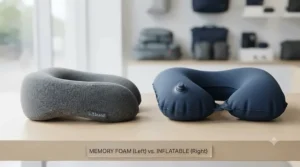
❓ Are memory foam or inflatable travel pillows better for neck pain?
Conclusion
There’s no single perfect neck pillow for neck pain travel — only the right match for your body, your route, and your budget. If you fly long-haul regularly and want maximum structural hold, the Cabeau Evolution S3‘s strap system earns its premium price. If adjustability across different trips and seat types matters more, the trtl Pillow Plus flexes to fit. Side sleepers and window-seat regulars should look hard at the J-Pillow Original, while anyone whose main complaint is chin and cervical strain specifically will get more targeted relief from the BCOZZY Travel Neck Pillow.
Minimalist, design-conscious flyers will likely prefer the Ostrichpillow Go‘s compact profile, budget-first travellers get real value from the Samsonite 2-in-1 Magic Travel Pillow, and carry-on-only packers should seriously consider the Coop Home Goods AirJustable for its tiny packed size without sacrificing all structural support.
Whichever you choose, remember that fit and positioning matter just as much as the product itself, and that ongoing or worsening neck pain deserves proper medical attention rather than a product-based fix alone. Travel comfortably, arrive rested, and let your neck finally catch a break.
✨ Don’t Miss These Exclusive Deals!
🔍 Compare current prices on all seven picks above and find the one built for your exact travel pattern. Your neck will thank you on landing.
Recommended for You
- Compact Travel Pillow: 7 Genuinely Packable Picks for 2026
- Best Aeroplane Pillow for Long Haul 2026: 7 Picks Rated
- Car Travel Pillow for Kids: 7 Best Picks for Comfy 2026 Road Trips
Disclaimer: This article contains affiliate links. As an Amazon Associate, I earn from qualifying purchases. If you purchase products through these links, we may earn a small commission at no additional cost to you. This article is for general informational purposes only and does not constitute medical advice; if you are experiencing persistent or worsening neck pain, please consult a GP or qualified healthcare professional.
✨ Found this helpful? Share it with your friends! 💬🤗
