
In This Article
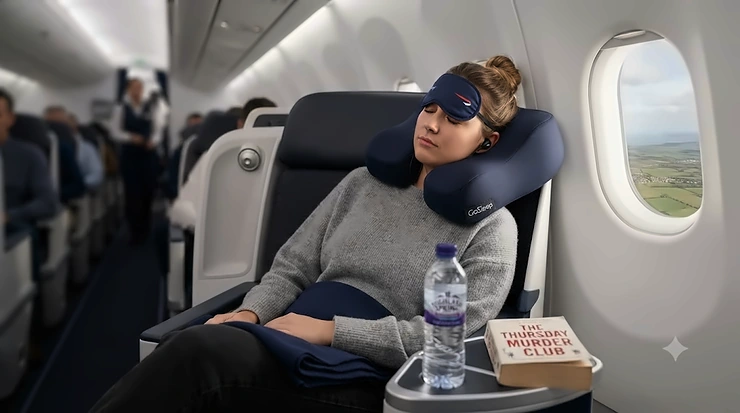
If you’ve ever woken up mid-flight with your head lolling into the aisle, dribble on your chin and a crick in your neck that lasts three days, you already know the problem with most travel pillows: they’re designed by someone who sleeps bolt upright, chin tucked, hands folded like a Victorian portrait. Real people don’t sleep like that. Most of us tip sideways the second our eyes close, which is precisely why a generic travel pillow for side sleepers so often fails — it was never built for the angle your head actually wants to go.
Side sleeping on the move is its own particular challenge. You need something that fills the gap between your ear and your shoulder, resists the wobble of turbulence or a rattling train carriage, and doesn’t turn into a sweaty lump three hours into a long-haul. A travel pillow for side sleepers, in short, is a compact, portable neck cushion engineered specifically to support the head when it leans left or right rather than drooping forward — usually via a curved, wraparound or wedge-shaped design rather than the flat, symmetrical U-shape most airlines hand out.
This guide walks through seven genuinely good options — memory foam, inflatable and microbead — with honest analysis of who each one suits, backed by real specs and aggregated review sentiment rather than marketing fluff. Sustained poor neck positioning is also something the NHS advises against when it comes to preventing stiffness, so getting this right matters for more than just comfort. Let’s find the one that actually fits how you sleep.
Quick Comparison Table
| Product | Type | Price Range | Best For |
|---|---|---|---|
| J-Pillow Ultimate Travel Pillow | Fibre-filled, 3-prong | £25-£35 | Best overall for side sleepers |
| Cabeau Evolution S3 | Memory foam, strapped | £35-£45 | Premium neck support |
| Trtl Pillow Plus | Wrap-style, internal frame | £45-£55 | Adjustable, packable premium pick |
| Ostrichpillow Light | Microbead donut wrap | £35-£45 | Window seat comfort |
| Samsonite 2-in-1 Magic Pillow | Microbead, convertible | £15-£20 | Best budget pick |
| AirComfy Inflatable Daydreamer | Inflatable | £20-£25 | Best inflatable travel pillow |
| Bcozzy Chin & Neck Support | Fibre-filled wrap | £20-£30 | Budget-friendly all-rounder |
Looking at the spread above, there’s a clear pattern: the pillows built around a curved or wraparound shape (J-Pillow, Trtl Pillow Plus, Bcozzy) consistently outperform flat, symmetrical designs for side sleepers, because they physically bridge the ear-to-shoulder gap rather than just cushioning the back of the neck. Price doesn’t map neatly onto comfort here, either — the budget Samsonite 2-in-1 scores well specifically because its microbead fill moulds to an angle rather than fighting it. If packed size is your priority over plush comfort, the inflatable option earns its place for cutting bulk to almost nothing.
💬 Just one click — help others make better buying decisions too!😊
Top 7 Travel Pillows for Side Sleepers: Expert Analysis
1. J-Pillow Ultimate Travel Pillow — best overall shape for side sleepers
The J-Pillow earned its “British Invention of the Year” nod for a reason: its unusual three-pronged shape looks baffling out of the box but solves the side-sleeping problem better than almost anything else on this list. One arm cradles the chin, one supports the side of the face, and the third wraps behind the neck, so your head has somewhere to go no matter which way it drifts.
Specs-wise, it’s polyester-fibre filled rather than foam, weighs around 225g, and is fully machine washable — cover and filling both, which is rare in this category. That washability matters practically: a pillow you actually keep clean is a pillow you’ll keep using, not one that quietly grows unpleasant in a cupboard. Because the support comes from shape rather than mechanical tension, there are no straps or toggles to fiddle with at 2am.
Based on the design comparison against U-shaped competitors, the J-Pillow is best suited to window-seat travellers who commit to leaning one direction for most of a flight, rather than aisle-seat passengers who shift position constantly — its static geometry doesn’t self-correct the way an adjustable wrap does. Reviewers consistently report that it’s the most comfortable option for genuine side-leaning sleep, though a recurring complaint is that its shape doesn’t pack down flat, so it takes up more suitcase space than a compressible alternative.
Pros:
- ✅ Purpose-built three-arm shape genuinely supports side-leaning heads
- ✅ Fully machine washable, cover and fill
- ✅ Lightweight at roughly 225g, easy to clip to a bag
Cons:
- ❌ Awkward, bulky shape that resists flat packing
- ❌ Can interfere with glasses arms when lying on your side
At around £25-£35, the J-Pillow sits in the mid-range and, based on the aggregated review sentiment and its dedicated side-sleeper geometry, represents strong value for anyone who leans rather than nods.

2. Cabeau Evolution S3 — best premium memory foam pick
The Cabeau Evolution S3 takes the opposite engineering approach to the J-Pillow: instead of a clever shape doing the work, it uses dual-density memory foam and a genuine strap system that clips around the aircraft or train headrest, physically anchoring your head in place.
The raised side contours are the key detail for side sleepers — they cradle the jawline so your head doesn’t slide off the front edge of the pillow the way it can with flatter designs, while the flat back keeps your spine from being pushed forward against the seat. The quick-dry, moisture-wicking fabric is a genuinely practical touch for long-haul cabins, where recycled air makes most fabrics feel clammy by hour six.
What most buyers overlook about this model is that the strap system is doing more work than the foam itself. Based on the spec comparison with strapless rivals, the S3’s advantage isn’t softness — it’s stability, which is exactly what stops a side-leaning head from sliding and waking you every twenty minutes. Aggregated review sentiment across major retailers consistently praises the support “orthopedic expert” positioning claim, and it has held the top or near-top spot in independent testing roundups for several consecutive years. A common complaint in user reviews is that headphones become awkward with the raised sides pressed against your ears.
Pros:
- ✅ Adjustable seat straps stop head-bob far better than strapless designs
- ✅ Raised jawline contours suit side sleepers specifically
- ✅ Quick-dry fabric copes well with long-haul cabin conditions
Cons:
- ❌ Bulkier around the ears, so over-ear headphones feel cramped
- ❌ Softness relies partly on the strap being attached to a seat
Priced in the £35-£45 range, the Cabeau Evolution S3 is a strong pick for anyone who flies long-haul regularly enough that the extra spend pays for itself in actual sleep.
3. Trtl Pillow Plus — best adjustable, low-bulk premium option
The Trtl Pillow Plus looks nothing like a conventional travel pillow, and that’s the whole point. Instead of a foam ring around your neck, it’s a soft fabric wrap concealing a semi-rigid internal support frame with three toggle-adjustable height settings, worn scarf-style rather than clamped around the throat.
That internal frame is the standout feature: it holds the head at a fixed, chosen angle regardless of how much you shift, which is exactly what side sleepers need since a floppy pillow simply collapses the moment gravity takes over. At roughly 255g it’s genuinely light, and because there’s no bulky foam ring behind your neck, you can lean directly against a headrest or window without a pillow-shaped lump getting in the way.
Here’s what to weigh before buying: the wrap-around fit takes real practice. Reviewers consistently note a “learning curve” in the first couple of uses before the tightness feels natural rather than constricting, and petite users sometimes find the support frame overwhelming until it’s dialled down. Once adjusted correctly, though, aggregated sentiment is strongly positive on side and upright support specifically — testers repeatedly single it out as effective for cramped economy seats where recline is minimal.
Pros:
- ✅ Three-position adjustable frame locks head angle precisely
- ✅ Far more compact than foam U-shaped pillows
- ✅ Works without pressing against a headrest, unlike bulkier designs
Cons:
- ❌ Noticeable learning curve to get the wrap tension right
- ❌ Can feel constricting for anyone who dislikes fabric near the throat
At around £45-£55, this sits at the top of the price range covered here, but based on the value analysis against bulkier premium foam rivals, its packed size and adjustability justify the premium for frequent flyers who travel light.
4. Ostrichpillow Light — best for window seat comfort
The Ostrichpillow Light takes a genuinely different route: a soft, coated-microbead donut that wraps around the neck like a scarf but can also be pulled up to double as a padded eye mask, blocking light entirely when you lean into a window.
This dual function is what makes it worth including. Window seat comfort isn’t only about neck support — it’s about having somewhere soft and stable to rest against a cold, curved cabin wall or a train window that vibrates with every bit of track noise. The microbead fill inside the donut moulds around whatever surface you press it against, effectively turning the window itself into part of your pillow. An integrated drawstring lets you adjust the snugness, and the reversible cover means one pillow gives you two colourways for the price of one.
The spec sheet won’t tell you this, but user reports suggest the light- and sound-blocking effect is the feature people rave about most — several reviewers describe falling asleep within moments of putting it on, an effect that owes as much to the psychological cue of “lights out” as to the physical cushioning. Based on the honest trade-off here, don’t expect the structured neck support of a foam pillow with straps; this is a softer, cosier option better suited to travellers who want to disappear into their own space than to those who need rigid head-drop prevention.
Pros:
- ✅ Doubles as an eye mask, genuinely useful for window-seat naps
- ✅ Microbead fill moulds around uneven surfaces like windows
- ✅ Reversible cover for two looks in one purchase
Cons:
- ❌ Less structured neck support than foam or strapped alternatives
- ❌ Can feel warm on longer flights due to the enclosing wrap
Around £35-£45, the Ostrichpillow Light is a niche but genuinely well-reasoned pick for anyone whose idea of travel comfort is blocking the world out entirely.
5. Samsonite 2-in-1 Magic Travel Pillow — best budget pick
Don’t let the modest price fool you: the Samsonite 2-in-1 Magic Travel Pillow punches well above its cost bracket. It converts between a U-shaped neck pillow and a flat rectangular lumbar cushion, and the microbead fill inside is dense enough to hold shape but loose enough to mould around an ear, a pair of glasses, or a set of over-ear headphones without complaint.
What most buyers overlook about this model is the dual-texture cover — one side is a cool, slick spandex-like fabric, the other a warm brushed fleece, so you can flip it depending on how stuffy or chilly the cabin gets. The convertibility also means it earns its keep beyond the flight itself: as a lumbar cushion on a long coach journey, or lower-back support at a desk, it doesn’t become dead weight in your bag the moment you land.
Based on the spec comparison with pricier memory foam rivals, the trade-off is firmness consistency: microbeads can feel slightly too firm for some and slightly too soft for others, whereas foam has a more predictable, uniform give. Reviewers consistently describe the moulding effect as “Goldilocks” — not perfect for everyone, but adaptable enough that most people land somewhere comfortable. For a first-time travel pillow buyer unsure whether they’ll use one enough to justify a premium spend, this is the sensible place to start.
Pros:
- ✅ Converts from neck pillow to lumbar cushion in seconds
- ✅ Reversible warm/cool fabric suits changeable cabin temperatures
- ✅ Microbeads mould around glasses and headphones comfortably
Cons:
- ❌ Firmness is less consistent than foam for some sleepers
- ❌ Less structured side support than dedicated side-sleeper shapes
At roughly £15-£20, the Samsonite 2-in-1 is the clear value pick on this list, and honestly a sensible entry point before spending more on a specialist design.
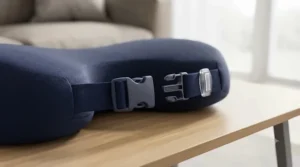
6. AirComfy Inflatable Daydreamer — best inflatable travel pillow
If packed size is your single biggest concern, the AirComfy Inflatable Daydreamer solves the problem that memory foam simply can’t: when deflated, it folds down to roughly the size of a smartphone, making it the only entry here that genuinely disappears into a coat pocket rather than clipping awkwardly to the outside of a bag.
The built-in pump is the detail that separates a decent inflatable travel pillow from an annoying one — no fumbling to blow it up by mouth in a queue, and no risk of light-headedness from over-exertion at altitude. Once inflated, an internal valve lets you fine-tune firmness rather than being stuck with a single fixed loft, which matters more for side sleepers than it sounds: too firm and it feels like resting your head on a football, too soft and it collapses under any real weight.
Here’s the honest trade-off, and it’s worth being upfront about it: inflatable pillows as a category tend to divide opinion more sharply than foam ones. Reviewers consistently note that PVC or TPU construction, however well made, can’t replicate the give of foam against skin, and a small but vocal segment of aggregated feedback describes plastic-feeling contact points after extended wear. On the other hand, for weekend trips, gap-year backpacking, or anyone who simply hates carrying a bulky pillow through security, the packed size advantage is difficult to overstate.
Pros:
- ✅ Deflates to pocket size, the most packable option on this list
- ✅ Built-in pump avoids awkward manual inflation
- ✅ Adjustable firmness via internal valve, unlike fixed-loft designs
Cons:
- ❌ Plastic-feeling texture reported by some reviewers on longer flights
- ❌ Less forgiving than foam if firmness isn’t dialled in correctly
Priced around £20-£25, the AirComfy Inflatable Daydreamer is the pillow to pack when suitcase space, not comfort ceiling, is the deciding factor.
7. Bcozzy Chin & Neck Supporting Pillow — best budget wraparound alternative
Rounding out the list, the Bcozzy Chin & Neck Supporting Pillow takes a similar wraparound philosophy to the pricier Trtl, but executes it with soft, fully collapsible fibre fill rather than an internal frame, at a noticeably lower price point.
The wrap-style design means it supports from multiple angles simultaneously — front, side and back — rather than the single flat cushioning zone of a traditional U-pillow. For side sleepers specifically, this translates to a genuine gap-filler: because the fabric loops around and can be pulled snug, it holds position on a leaning head even without the mechanical tension of a support frame. It’s fully collapsible for packing, folding flatter than the J-Pillow while offering more all-round coverage than the Samsonite.
Based on the aggregated review sentiment against its premium wrap-style rival, the Bcozzy trades a small amount of structured firmness for a significantly lower price and a softer, more forgiving feel against the skin — reviewers frequently describe it as the “cosy” option rather than the “supportive” one, which is either exactly what you want or precisely what you don’t, depending on how firm you like your neck support.
Pros:
- ✅ Wraps around from multiple angles, unlike single-zone U-pillows
- ✅ Fully collapsible fibre fill packs flatter than shaped foam
- ✅ Noticeably cheaper than comparable wrap-style premium pillows
Cons:
- ❌ Less firm structural support than internal-frame alternatives
- ❌ Fibre fill can compress unevenly after repeated long trips
At around £20-£30, the Bcozzy is a smart middle ground for anyone who likes the wraparound concept but isn’t ready to spend Trtl money to try it.
✨ Don’t Miss These Exclusive Deals!
🔍 Take your travel comfort to the next level with any of the picks above. Click through to check current pricing and availability before your next trip — a genuinely supportive travel pillow for side sleepers is one of the cheapest upgrades you can make to how you feel after landing.
Setting Up Your Travel Pillow for Maximum Support
Buying the right pillow only solves half the problem — how you use it determines whether you actually sleep or just doze fitfully. Start by positioning it before you take off, not once your eyes are already heavy: strapped foam pillows like the Cabeau need the straps clipped snugly to the headrest wings while you’re still upright, since fumbling with buckles half-asleep rarely ends well. For wrap-style pillows such as the Trtl or Bcozzy, aim for “snug, not strangled” — tight enough that your head can’t slide, loose enough that you’re not aware of fabric against your throat when you swallow.
A common first-30-days mistake is inflating an air pillow to maximum firmness, assuming more support equals more comfort. In practice, slightly underinflated gives better contouring for a leaning head; you want give, not rigidity. Wash removable covers after every two or three uses — cabin air is dry and recirculated, and fabric against your face for six hours picks up more than you’d think. Finally, angle matters more than most people realise: rotate a J-shaped or wraparound pillow so the thickest padding sits precisely where your ear meets your shoulder, not centred on the back of your neck, since that’s the actual gap a side sleeper needs filled.
Who Should Buy Which Pillow: Three Traveller Profiles
If you’re a long-haul commuter flying transatlantic three or four times a year on a reasonable budget, the Cabeau Evolution S3 or Trtl Pillow Plus make the most sense — the extra spend is easily justified by frequency of use, and both hold up to repeated washing and packing far better than a single-season budget pillow would.
If you’re a once-or-twice-a-year holiday flyer trying to keep costs down, the Samsonite 2-in-1 or Bcozzy are the sensible calls. Neither will feel like a downgrade on short-haul or coach journeys, and the lower price means you’re not agonising over a pillow that spends most of the year in a drawer.
If you’re a light-packing backpacker or weekend-tripper who measures every gram in a carry-on bag, the AirComfy Inflatable Daydreamer is the obvious pick — nothing else here disappears into a jacket pocket the way an inflatable does, and for occasional use, the trade-off in plushness is a fair one.
How to Choose a Travel Pillow for Side Sleepers
What is a travel pillow for side sleepers? In short, it’s a compact neck cushion shaped specifically to support the head when it leans sideways rather than drooping forward — typically via a curved, wraparound or three-pronged design instead of a flat, symmetrical U-shape.
- Identify your dominant lean. Most people favour one side; buy a pillow whose thickest padding suits that side rather than assuming symmetrical designs will work equally well both ways.
- Decide between structure and softness. Strapped or framed pillows (Cabeau, Trtl) hold a fixed angle; fibre or microbead designs (J-Pillow, Bcozzy) mould more but offer less rigid control.
- Check your seat type. Window-seat travellers benefit from designs like the Ostrichpillow that use the window itself as extra support; aisle-seat travellers need more self-contained structure.
- Weigh packed size against comfort. Inflatables win on space, foam wins on plushness — decide which constraint actually applies to your trip.
- Consider fabric for your climate. Quick-dry or mesh fabrics suit warm cabins and hot sleepers; fleece-lined designs suit those who run cold.
- Factor in washability. A pillow you can actually clean gets used for years; one you can’t tends to get replaced within a season.
- Match spend to frequency. Occasional flyers rarely need to spend at the premium end; frequent flyers usually save money long-term by doing so.
Based on this framework, most side sleepers land on either a shaped fibre pillow or a strapped foam design — the two approaches that most directly address lateral head drop rather than the forward nod a standard U-pillow is built for.
Memory Foam vs Inflatable Travel Pillows: Which Wins for Side Sleepers?
This is the comparison most buyers actually agonise over, so it deserves a straight answer rather than a diplomatic dodge.
| Factor | Memory Foam | Inflatable |
|---|---|---|
| Packed size | Bulkier, doesn’t compress fully | Pocket-sized when deflated |
| Contouring | Slow-recovery mould to head shape | Firm, adjustable via valve |
| Durability | Foam can flatten over years of use | Prone to punctures or valve wear |
| Warmth | Retains heat, can feel warm | Cooler, plastic surface |
| Side-sleeper support | Generally stronger, gradual give | Can feel rigid until firmness tuned |
Based on the spec comparison above, memory foam wins on raw comfort for side sleepers because its slow-recovery give genuinely contours to the ear-and-jaw area over a few minutes of contact, whereas inflatable pillows only offer as much cushioning as the air pressure you choose — get that wrong and it either feels like a brick or collapses entirely. What most buyers overlook, though, is that inflatable pillows win decisively on the metric that matters most for occasional travellers: packed size. If you fly twice a year and hate wasted suitcase space, the comfort gap is a fair trade. If you fly often enough that comfort compounds trip after trip, foam is worth the extra bulk.
Foam Density Explained: The Number Nobody Explains
Product listings love to throw around phrases like “high-density memory foam” without ever saying what that actually means for your neck at 3am over the Atlantic. In practice, memory foam density refers to how much the material weighs per cubic foot, and it’s a reasonably reliable proxy for how slowly and predictably the foam recovers its shape after pressure is removed.
Lower-density foam (roughly under 3lb/ft³) feels immediately soft but tends to bottom out under sustained head weight, meaning a side sleeper can end up resting closer to the pillow’s inner frame than intended by the third hour of a flight. Higher-density foam (4lb/ft³ and above, which is roughly where the Cabeau Evolution S3 sits) takes marginally longer to contour but holds that shape far more consistently across a long-haul sit, which is exactly the predictability side sleepers need since any collapse translates directly into the head sliding downward mid-nap.
Here’s what the spec sheet won’t tell you: higher density also tends to retain more body heat, which is the trade-off nobody advertises. If you’re a hot sleeper, a lower-density foam or a fibre-fill design like the J-Pillow may actually serve you better despite the marginally less consistent support — comfort is rarely a single-axis decision, and density is only one variable in a system that also includes fabric breathability and overall shape.
How Your Sleep Position Affects the Right Travel Pillow Shape
Sleep position isn’t just a preference — it changes which physical points on your body need support, and travel pillows that ignore this basic fact are why so many people own one gathering dust in a drawer. Back sleepers need support directly behind the neck, keeping the chin level; side sleepers need the gap between ear and shoulder filled, which is a completely different geometry, closer to a wedge than a horseshoe.
This is precisely why flat, symmetrical U-pillows so often disappoint side sleepers specifically: they were designed around back-sleeping ergonomics and simply repurposed for everyone else. A genuine travel pillow for side sleepers instead concentrates its bulk laterally rather than centrally, which is the defining design difference across every product reviewed above — the J-Pillow’s third arm, the Trtl’s adjustable frame, the Ostrichpillow’s donut wrap are all, in different ways, solving for the same lateral gap. If you’re unsure which category you fall into, pay attention to which way your head naturally tips within the first ten minutes of dozing off on a sofa at home; that’s a far more reliable guide than any product description.
Window Seat Comfort: Getting the Most From Your Pillow
Window seats offer a genuine comfort advantage most people underuse: a stable, if occasionally cold, surface to lean directly against. The trick is treating the window as part of your support system rather than fighting it with a pillow designed purely for freestanding use.
Pillows with a soft, mouldable outer layer — the Ostrichpillow Light in particular — genuinely benefit from this setup, since the microbead fill compresses into whatever gap exists between your head and the curved cabin wall. A folded jumper or thin blanket between pillow and window helps with the cold-glass sensation on night flights, and reclining the seat back even slightly changes the angle enough to shift pressure away from the neck and onto the shoulder instead, which most side sleepers find more comfortable over several hours. Aisle-seat travellers don’t get this advantage, which is exactly why a more self-contained, structured pillow like the Cabeau or Trtl tends to serve that seating position better.
Common Mistakes When Buying a Travel Pillow for Side Sleepers
The single biggest mistake is buying based on brand recognition rather than shape logic — a well-known name doesn’t guarantee a design suited to lateral head support, and several popular symmetrical U-pillows are genuinely built around back-sleeping ergonomics. A second common error is ignoring packed size until the pillow is already clipped awkwardly to the outside of a carry-on at the gate; if overhead space is tight, that’s a comfort cost paid before the flight even starts.
Buyers also frequently skip washability entirely, only to discover a fibre-fill pillow can’t go in the machine after a few sweaty long-hauls. And a subtler mistake: assuming a firmer pillow is always more supportive. As covered above, over-firm inflatables and dense foam can both feel worse than a well-chosen medium option if they don’t match how your specific lean actually presses against the material.
FAQ
❓ What is the best travel pillow for side sleepers?
❓ Is memory foam or inflatable better for a travel pillow?
❓ How do I stop my head falling forward when I sleep sitting up?
❓ Are inflatable travel pillows comfortable enough for long flights?
❓ What foam density should I look for in a travel pillow?
Conclusion
There isn’t a single “best” travel pillow for side sleepers, and honestly, any article claiming otherwise is skipping the part where different journeys need different trade-offs. What the research does show clearly is that shape matters more than price: a well-designed £25 fibre pillow that actually fills the ear-to-shoulder gap will out-perform a £50 symmetrical foam ring every single time, because it’s solving the problem side sleepers actually have rather than the one back sleepers do.
If you fly often enough that comfort compounds trip after trip, the Cabeau Evolution S3 or Trtl Pillow Plus are worth the spend. If you’re an occasional traveller trying to avoid overspending on gear you’ll use twice a year, the Samsonite 2-in-1 or Bcozzy do the job without the premium price tag. And if suitcase space is your real constraint, the AirComfy Inflatable Daydreamer solves a problem none of the foam options can. Whichever you choose, the underlying goal is the same one the NHS advice on neck positioning points to: keep your head roughly level with your spine, rather than tipped at an angle for hours on end, and you’ll land feeling far less like you fought your own pillow the whole way there. That matters even more on long-haul routes, where poor in-flight rest compounds the effects of jet lag once you actually arrive.
Recommended for You
- 7 Best Neck Pillow for Neck Pain Travel in 2026 (UK Guide)
- Compact Travel Pillow: 7 Genuinely Packable Picks for 2026
- Best Aeroplane Pillow for Long Haul 2026: 7 Picks Rated
Disclaimer: This article contains affiliate links. As an Amazon Associate, I earn from qualifying purchases. If you purchase products through these links, we may earn a small commission at no additional cost to you.
✨ Found this helpful? Share it with your friends! 💬🤗
