
In This Article
It starts innocently enough. A nudge in the ribs. A politely passive-aggressive “did you know you were snoring last night?” And before long, you’re sleeping in separate rooms, Googling “how to stop snoring at 2am,” and ordering gadgets that look like medieval dental instruments. Sound familiar?

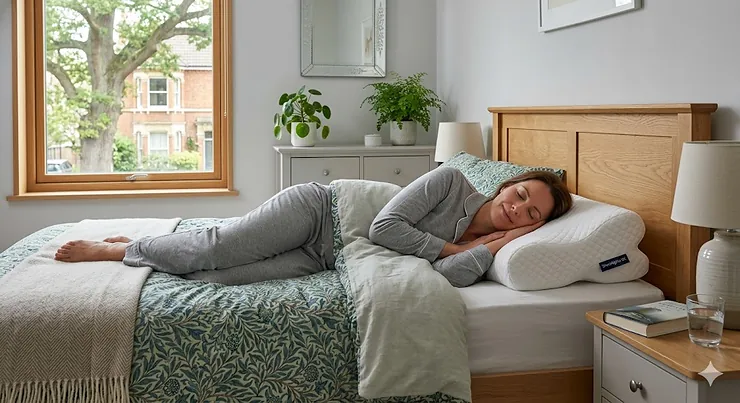
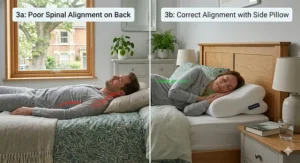
Here’s the good news: for a significant number of snorers, the problem isn’t your nose, your throat, or your genes — it’s simply the position you sleep in. According to research cited by the British Snoring & Sleep Apnoea Association, snoring and apnoea events are consistently more frequent and more severe when lying on your back (the supine position). Gravity does its worst, pulling the tongue and soft palate backwards into the throat, narrowing the airway, and producing that characteristic rumble that could rattle the windows of a semi-detached in Bolton.
The solution can be elegantly low-tech: a positional therapy pillow for snoring — a specially designed pillow that subtly repositions your head, neck, or upper body while you sleep, nudging you away from the snoring-prone supine position. According to the NHS guidance on snoring, nearly a quarter of UK adults are regular snorers, making this one of the most underappreciated sleep problems in the country.
This guide cuts through the noise (pun absolutely intended) and takes you through seven of the best positional therapy pillows available on Amazon.co.uk right now — with honest analysis, real-world context, and practical advice tailored to British buyers. No fluff. No hype. Just better sleep.
💬 What is a positional therapy pillow for snoring? A positional therapy pillow for snoring is a specially contoured or wedge-shaped pillow designed to keep the sleeper’s head, neck, or upper body in a position that reduces airway obstruction. By discouraging back sleeping or elevating the torso, these pillows aim to decrease or eliminate snoring caused by the supine sleep position.
Quick Comparison: Top 7 Positional Therapy Pillows for Snoring UK 2026
| Pillow | Type | Best For | Price Range (GBP) | Prime Eligible |
|---|---|---|---|---|
| Silentnight Luxury Anti-Snore | Contoured foam | Back & side sleepers | £20–£35 | ✅ Yes |
| Derila Ergo Memory Foam | Butterfly contour | Side sleepers, hot sleepers | £35–£55 | ✅ Yes |
| Putnams Bed Wedge Pillow | Wedge incline | Severe snorers + acid reflux | £45–£75 | ✅ Yes |
| TEMPUR Original SmartCool | Viscometric foam | Premium, all positions | £80–£130 | ✅ Yes |
| Z-hom Cervical Memory Foam | Ergonomic wave | Combination sleepers | £25–£40 | ✅ Yes |
| Levitex Sleep Posture Pillow | Latex support | NHS-recommended, neck pain | £60–£90 | ✅ Yes |
| Groove Memory Foam Pillow | Contoured spinal | Back sleepers, posture-focused | £30–£50 | ✅ Yes |
The table above reveals something useful: there’s a positional therapy pillow for snoring at every price point, from sensible to splurge. The real insight isn’t the price, though — it’s the type. Wedge pillows (like the Putnams) work by elevating the whole upper body; contoured pillows work by keeping the head turned slightly to one side. If you’re a confirmed back sleeper who barely moves all night, a wedge is your best bet. If you toss and turn, a contoured cervical design like the Derila or Z-hom will serve you better without feeling like you’ve been propped up in a hospital bed.
💬 Just one click — help others make better buying decisions too! 😊
✨ Don’t Miss These Exclusive Deals!
🔍 Take your sleep to the next level with these carefully selected products. Click on any highlighted item to check current pricing and availability on Amazon.co.uk. These picks will help you find exactly what you need!
Top 7 Positional Therapy Pillows for Snoring: Expert Analysis
1. Silentnight Luxury Anti-Snore Pillow
If you’re a first-timer dipping your toes into the world of positional sleep therapy, the Silentnight Luxury Anti-Snore Pillow is the obvious starting point. It’s produced by Britain’s most trusted sleep brand — over 75 years in the business — and the design is refreshingly no-nonsense: an ergonomically shaped foam core sits at the centre, surrounded by soft hollowfibre, gently cradling the head and neck into a position that encourages easier breathing.
The foam core is the key. It creates a subtle resistance that keeps your head from lolling backwards into the snoring-prone supine position during lighter sleep stages. The pillow is hypoallergenic, which matters for the substantial chunk of the British population who share their bedroom with dust, damp, and occasionally a cat. It’s medium support, making it suitable for both back and side sleepers.
What most UK buyers don’t know: this pillow was independently tested by the British Snoring & Sleep Apnoea Association and reportedly reduced snoring by around 50% in users — a respectable figure for a pillow in this price range. It won’t work miracles if your airway anatomy is the primary culprit, but for positional snorers, it’s rather effective.
UK customers regularly mention it’s easy to slip into a standard pillowcase and doesn’t announce itself as a “medical” pillow to houseguests. It comes with a two-year manufacturer’s guarantee.
✅ Trusted British brand with long-standing reputation
✅ Hypoallergenic — ideal for allergy sufferers in damp UK homes
✅ Works well with standard UK pillowcases
❌ Foam core can feel warm in summer months
❌ Less dramatic elevation than wedge-style options
Price range: around £20–£35 on Amazon.co.uk. An excellent entry point — very much worth its price for anyone who suspects their snoring is position-related.
2. Derila Ergo Memory Foam Pillow
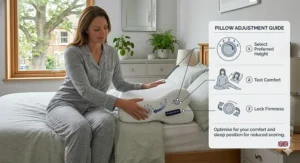
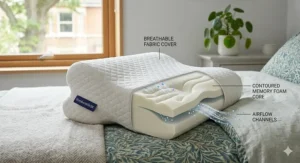
The Derila Ergo is the one that gets talked about in UK sleep forums, and for good reason. Its distinctive butterfly shape is immediately recognisable — wider at the sides, lower in the centre, with a raised surround that cradles the skull like a firm but forgiving hammock. The 13 cm loft is particularly well-suited to side sleepers, filling that awkward gap between shoulder and ear without over-elevating the neck.
Memory foam means the Derila responds to your body temperature, slowly conforming to your unique head shape over the first few nights. There’s a real-world benefit to this that the spec sheet glosses over: the pillow essentially trains itself to your preferred sleeping position over time. For side sleepers who tend to drift towards their back during REM sleep, the raised centre section provides just enough resistance to discourage the roll.
The cooling design is genuinely useful in the UK context. British bedrooms aren’t known for being freezing — particularly in modern terraced houses with poor insulation, where summer nights can be stifling. The Derila’s cover is designed with breathability in mind, and customers consistently report sleeping cooler than on standard memory foam.
The compact dimensions make it easier to travel with — handy if you’re the sort of person who books a Premier Inn and spends three nights fighting a pillow that might as well be a bag of semolina.
✅ Butterfly shape naturally discourages back sleeping
✅ Cooling design — practical for UK summers
✅ Compact for travel; fits standard luggage
❌ Higher loft not ideal for stomach sleepers
❌ Proprietary shape means standard pillowcases won’t fit neatly
Price range: £35–£55 on Amazon.co.uk. Mid-range value, and among the better choices for dedicated side sleepers.
3. Putnams Bed Wedge Pillow
Few pillows make as dramatic an impression as the Putnams Bed Wedge Pillow, and that’s rather the point. This isn’t subtle positional encouragement — it’s full elevation of the upper torso on a gentle incline, shifting you from flat-on-your-back to a supported, slightly reclined position that gravity simply cannot use against your airway.
Putnams is a British family-run manufacturer based in Cornwall, and all their products are made in the UK — something increasingly rare and, frankly, rather commendable. The foam is firm but not punishing, and the incline is gradual enough that most users adapt within a few nights. This pillow genuinely earns its reputation: it was cited as the top pick in Good Housekeeping‘s 2025 anti-snore pillow tests.
The dual benefit for acid reflux and snoring simultaneously is the detail that makes this stand out. A substantial proportion of snorers also suffer from GERD or acid reflux — conditions that independently worsen when lying flat. The Putnams addresses both without requiring separate solutions. That’s genuinely clever design.
Storage in a smaller British flat is the honest caveat here. This is a large wedge and won’t tuck under a standard pillow when guests arrive. Factor that in if you’re in a studio in Birmingham or a two-bed terraced house in Leeds with limited bedroom storage.
✅ Addresses both snoring and acid reflux simultaneously
✅ British-made — supports domestic manufacturing
✅ Dramatic results for severe positional snorers
❌ Large footprint — awkward for smaller UK bedrooms and storage
❌ Adjustment period of several nights required
Price range: £45–£75 on Amazon.co.uk. Mid-to-premium pricing, but the dual functionality makes it exceptional value for the right buyer.
4. TEMPUR Original SmartCool Pillow
The TEMPUR Original SmartCool is the one you buy when you’ve tried everything else and decided you’re done compromising on sleep. Originally developed from NASA material — the kind of provenance that gets rolled out so often it risks becoming cliché, but in this case, it genuinely explains TEMPUR’s behaviour — the viscometric foam responds to both body temperature and weight, moulding with unusual precision to your cervical anatomy.
For positional snoring, TEMPUR’s contoured design keeps the head in a slightly elevated, forward-tilted position that maintains cervical alignment and reduces the likelihood of the tongue collapsing backwards. Multiple UK sleep clinics reportedly recommend TEMPUR pillows for patients managing mild snoring and OSA alongside other therapies. Academic research on sleep positioning suggests that maintaining proper cervical alignment can reduce airway obstruction meaningfully — and TEMPUR is arguably the gold standard for doing that passively while you sleep.
The SmartCool variant addresses the main complaint about TEMPUR’s original foam: heat retention. The open-cell structure improves airflow, which matters particularly in British homes that can get surprisingly warm in July and August.
The price is undeniably steep. But TEMPUR pillows last considerably longer than budget alternatives — expect 5–7 years with proper care — and the cost-per-night, amortised over that lifespan, begins to look rather reasonable.
✅ Outstanding cervical support and alignment
✅ SmartCool technology reduces heat retention
✅ Long lifespan — good value over time
❌ Premium price; significant upfront investment
❌ Heavier than standard pillows — less convenient for travel
Price range: around £80–£130 on Amazon.co.uk. Expensive, but genuinely worth it for chronic positional snorers who’ve exhausted cheaper options.
5. Z-hom Cervical Memory Foam Pillow
The Z-hom Cervical Memory Foam Pillow is the unsung workhorse of the anti-snore pillow world, and it deserves considerably more attention than it typically receives. Its wave-shaped ergonomic profile — higher on both ends, lower in the middle — accommodates both side and back sleepers within a single design. This flexibility is the core selling point: for combination sleepers who cycle through positions during the night, no single-purpose pillow is ever going to do the full job.
The memory foam quality is solid for the price, with adequate density to maintain support throughout the night without bottoming out. The dual-height design means taller or broader-shouldered UK buyers can simply flip the pillow to access the higher side, filling the gap between mattress and ear more completely.
It’s not going to match TEMPUR’s precision or the Putnams’ elevation drama. But for the snorer who moves around, the Z-hom adapts quietly and without fuss — rather like a reliable hatchback compared to a sports car. It does the job, it fits in any parking space, and you won’t cry if it gets a bit scuffed.
✅ Versatile dual-height design suits multiple sleep positions
✅ Accessible price without sacrificing foam quality
✅ Straightforward adaptation period
❌ Less dramatic positional intervention than wedge designs
❌ May compress faster than premium foam over time
Price range: £25–£40 on Amazon.co.uk. Outstanding value for combination sleepers and those new to positional therapy.
6. Levitex Sleep Posture Pillow
The Levitex Sleep Posture Pillow is backed by credentials that set it apart in a crowded market. Founded by posture expert James Leinhardt, who has spent years working directly with NHS trusts and social care organisations across the UK, Levitex occupies that rare territory between clinical credibility and genuine consumer comfort.
The pillow uses latex foam rather than memory foam — a meaningful distinction. Latex has a unique open-cell structure that enhances natural airflow, so it runs cooler than standard memory foam variants. It also maintains its shape more consistently over time, which matters for positional therapy: a pillow that flattens by 3am has lost much of its therapeutic value. The contoured profile gently guides the head and neck into optimal alignment, reducing the likelihood of airway collapse.
For UK buyers with neck or shoulder pain alongside snoring — a common combination, particularly in office workers spending eight hours a day hunched over keyboards in draughty Manchester office blocks — the Levitex addresses both complaints with equal effectiveness. The range comes in multiple sizes (small through extra large) based on your shoulder-to-head measurement, which is a more precise fit than most competitors offer.
✅ Backed by NHS-engaged posture expertise
✅ Latex foam runs cooler and maintains shape longer than memory foam
✅ Multiple sizes available for precise fit
❌ Higher price bracket than mid-range options
❌ Latex may not suit those with latex sensitivities
Price range: £60–£90 on Amazon.co.uk. A serious investment, but the clinical backing and latex construction justify the premium for buyers with complex needs.
7. Groove Memory Foam Ergonomic Pillow
The Groove Memory Foam Pillow rounds out this list as the option for back sleepers with a specific focus on spinal alignment. While other pillows in this list prioritise side-sleeping encouragement or dramatic wedge elevation, the Groove takes a more architectural approach: by supporting the natural curvature of the cervical spine from the base of the skull to the upper thoracic region, it maintains the head in a slightly forward-tilted position that prevents the classic airway-closing backward drop.
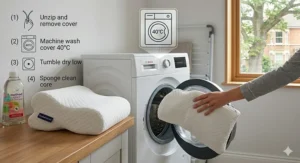
The medium-firm rating is well-calibrated — firm enough to maintain position throughout the night without that unnerving mid-sleep subsidence you sometimes get with cheaper foam. The breathable, hypoallergenic cover is removable and machine-washable (at 30°C), which is a practical consideration in UK homes where bedrooms are prone to the sort of ambient dampness that makes regular washing rather essential.
For the back sleeper who genuinely cannot break the habit — and plenty can’t, despite their best intentions — the Groove offers a more realistic solution than a wedge you’ll shove aside by midnight. It works with your natural position rather than fighting it.
✅ Ideal for confirmed back sleepers who can’t change position
✅ Hypoallergenic cover — machine washable at 30°C
✅ Good spinal alignment reduces overall snoring tendency
❌ Less effective for positional snorers who need lateral sleep encouragement
❌ Limited size options compared to some competitors
Price range: £30–£50 on Amazon.co.uk. A well-executed mid-range option that punches above its weight for back sleepers.
How to Choose a Positional Therapy Pillow for Snoring in the UK: A Practical Framework
Choosing the right positional sleep pillow doesn’t require a medical degree, but it does require a moment’s honest self-reflection. Work through these questions in order:
1. Identify your snoring trigger position. Are you consistently worse on your back? Video yourself sleeping if you’re unsure (there are apps for this), or ask your partner. If back sleeping is the primary culprit, you’re a positional snorer — and these pillows are designed specifically for you.
2. Know your dominant sleep position. Side sleepers need higher-loft contoured designs (Derila, Levitex). Back sleepers who want to stay on their back need cervical alignment support (Groove, TEMPUR). Back sleepers who want to stop being back sleepers need wedge elevation or wave-profile designs (Putnams, Z-hom).
3. Consider any secondary conditions. Acid reflux alongside snoring? The Putnams Wedge addresses both. Neck pain? Levitex or TEMPUR. Hot sleeper? Derila or Levitex latex. Allergies exacerbated by British damp? Silentnight’s hypoallergenic construction is the safe choice.
4. Set a realistic budget in GBP. Under £35: Silentnight or Z-hom. £35–£60: Derila or Groove. £60–£90: Levitex or Putnams. £80+: TEMPUR. All are available on Amazon.co.uk with Prime delivery — most arrive next day.
5. Give it at least two weeks. No positional therapy pillow works on night one. Your body has spent years developing sleep habits; give it a fortnight before passing judgement.
6. Rule out sleep apnoea first. If your snoring is accompanied by gasping, choking, or daytime exhaustion, consult your GP before purchasing anything. The NHS snoring guidance recommends medical assessment for persistent, loud snoring. Obstructive Sleep Apnoea (OSA) is a medical condition requiring proper diagnosis — a pillow is not a treatment for OSA.
How Positional Therapy Actually Works: The Science in Plain English
The mechanism is almost embarrassingly simple once you understand it. When you lie on your back, gravity pulls the tongue and soft palate downwards and backwards, towards the rear of the throat. The airway narrows. As you breathe, the surrounding tissue vibrates against the narrowed passage — and there’s your snoring. Research cited by Wikipedia’s overview of sleep position confirms that positional obstructive sleep apnoea (POSA) accounts for 56–75% of regular OSA patients, with supine avoidance forming a central pillar of treatment.
A positional therapy pillow for snoring intervenes at the source. Either it elevates the upper torso (wedge-style), reducing the gravitational pull on airway soft tissue, or it keeps the head slightly turned to one side (contoured cervical designs), preventing the tongue from falling backwards entirely. A clinical study published in Scientific Reports confirmed that a head-positioning pillow designed to avoid the supine position meaningfully reduced snoring sounds in patients with mild-to-moderate positional OSA over consecutive nights of use.
What the spec sheets don’t tell you: the pillow works best in concert with sleep hygiene. Alcohol within two hours of bedtime dramatically relaxes the pharyngeal muscles, worsening snoring regardless of your position. Weight — even a modest increase — raises tissue density around the airway. A positional therapy pillow is a meaningful tool, but it’s part of a wider picture.
Comparison: Positional Therapy Pillow vs Traditional Alternatives for Snoring
| Approach | How It Works | Effectiveness | Cost (GBP) | Comfort | Best For |
|---|---|---|---|---|---|
| Positional therapy pillow | Repositions head/torso | Good for positional snorers | £20–£130 | High | Mild-moderate snoring |
| Mandibular advancement device | Positions jaw forward | Good for mild OSA | £25–£150 | Moderate | Jaw-related snoring |
| Nasal strips/dilators | Opens nasal passages | Limited — nasal only | £5–£20 | High | Nasal congestion snoring |
| CPAP machine | Continuous air pressure | Excellent for OSA | £400–£900 | Low initially | Moderate-severe OSA |
| Lifestyle changes alone | Weight/alcohol reduction | Varies significantly | Minimal cost | N/A | All snorers |
The table illustrates a truth often glossed over by gadget sellers: positional therapy pillows are most effective for a specific type of snorer — those whose problem is position-dependent. For snorers with a structural airway issue or clinically diagnosed OSA, a pillow is a complement, not a replacement, for medical therapy. The British Snoring & Sleep Apnoea Association recommends personalised assessment to identify the specific type of snoring before choosing any intervention. As a first step, though, a pillow is considerably less invasive and considerably less expensive than most alternatives.
Real-World Scenarios: Which Pillow for Which British Sleeper?
The London Commuter, 38: Lives in a one-bed flat in Clapham with a partner who’s been subtly threatening to move to the sofa. Back sleeper who consumes a glass or two of wine in the evenings and notices he’s worse after late nights. Limited storage space. Budget: up to £50. Best pick: Silentnight Luxury Anti-Snore — affordable, compact, hypoallergenic (useful in London’s dusty rental stock), and effective for mild positional snoring. If it doesn’t fully solve the problem, the Z-hom Cervical is the sensible step up.
The Manchester Suburb Couple, late 40s: Both snore. She has acid reflux. He runs hot and hates memory foam. They have a proper bedroom in a four-bed semi and can accommodate a larger pillow without it being an issue. Budget: £60–£90 each. Best picks: Putnams Wedge for her (addresses both reflux and snoring), Levitex for him (latex runs cooler, excellent alignment, clinically credible).
The Edinburgh Retiree, 64: Snoring has worsened post-retirement. Suspects neck stiffness is contributing. Wants something well-made and long-lasting rather than cheap-and-cheerful. Sleeps on his side and back interchangeably. Budget: no hard limit, but wants value. Best pick: TEMPUR Original SmartCool — the precision fit justifies the price over a 5–7 year lifespan, and the SmartCool technology handles Scotland’s surprisingly variable bedroom temperatures.
Common Mistakes When Buying a Positional Snoring Pillow in the UK
Buying for your partner, not yourself. Positional therapy is personal. What resolves your partner’s back-sleeping snore may do nothing for your side-sleeping rattle. Identify your own snoring pattern first.
Judging it after one night. Memory foam in particular takes several nights to adapt to a new user. Your neck muscles need time to adjust to the new geometry. A week is a fair minimum; two weeks gives you a reliable verdict.
Ignoring loft height. Taller people and those with broader shoulders need a higher loft to achieve proper alignment. The Levitex range’s multiple sizes exist precisely because a 5’6″ person and a 6’2″ person have genuinely different requirements.
Assuming it will fix OSA. This bears repeating. A positional therapy pillow can meaningfully reduce snoring caused by sleep position. It will not treat moderate or severe obstructive sleep apnoea. If your snoring is accompanied by gasping, witnessed breathing pauses, or significant daytime sleepiness, see your GP. A referral to an NHS sleep clinic costs nothing and could identify a condition requiring proper medical care.
Overlooking washing instructions. British bedrooms accumulate dust mites and moisture. A pillow you can’t wash regularly — or whose cover can’t be removed — will degrade in hygiene terms fairly quickly. Check washing instructions before you buy, and factor this into your decision.
✨ Ready to Find Your Perfect Sleep Solution?
🔍 Check out these top-rated positional therapy pillows for snoring on Amazon.co.uk. Click on any highlighted product to view current availability, Prime delivery options, and the latest pricing.
Features That Actually Matter (And Those That Don’t)
Matters enormously:
- Pillow loft (height): Wrong loft height is the single most common reason positional pillows fail. Too low and the head tilts back; too high and it tilts too far forward.
- Foam density and type: Cheap foam compresses over time, losing its therapeutic value. CertiPUR or OEKO-TEX certifications indicate quality control — worth checking.
- Washability: In UK conditions, a non-washable pillow is a regrettable investment.
- Shape matching your sleep position: Contoured for side/combination sleepers; wedge for back elevation; cervical wave for all-position support.
Doesn’t matter as much as marketed:
- Thread count of the pillowcase: Irrelevant to snoring outcomes. Nice to have; not a purchasing criterion.
- “Clinical trial” claims with no published methodology: Many anti-snore products cite “clinical studies” without naming the institution, sample size, or methodology. Look for independently published research where possible.
- Aromatherapy infusions: Lavender-scented foam is pleasant but has no meaningful impact on positional snoring.
- Smart technology in budget models: Sensor pillows that claim to monitor snoring and automatically adjust exist — but in the sub-£100 range, the technology is rarely reliable enough to trust. Spend that money on quality foam instead.
FAQ
❓ Does a positional therapy pillow for snoring actually work?
❓ How long does it take for a positional snoring pillow to work in the UK?
❓ Can I use a positional sleep pillow with a CPAP machine?
❓ Are positional therapy pillows available on Amazon.co.uk with Prime delivery?
❓ Is snoring a sign I should see my GP rather than buy a pillow?
Conclusion: Small Adjustment, Big Difference
Here’s the thing about snoring — and specifically about positional snoring: it’s one of the few genuinely common sleep problems where a relatively modest, low-risk intervention can make a real and immediate difference to quality of life. Not just your quality of life, but your partner’s. And possibly your relationship’s.
A positional therapy pillow for snoring works because it addresses the mechanics of the problem directly. No medication. No surgery. No mouth guard that makes you feel like a rugby player. Just a well-designed piece of foam that changes the angle at which you breathe.
For most UK buyers, the Silentnight Luxury Anti-Snore is the sensible starting point — trusted brand, reasonable price, proven performance. Side sleepers with a budget for something more refined should look seriously at the Derila Ergo or Levitex. And anyone whose snoring is complicated by acid reflux, or who wants the most dramatic positional intervention available, should put the Putnams Bed Wedge firmly on their shortlist.
Do check with your GP if you have any concerns about sleep apnoea before spending money on pillows. The NHS guidance is clear that persistent, loud snoring with daytime symptoms warrants medical assessment — and a sleep clinic referral on the NHS is, of course, free.
✨ Don’t Miss These Exclusive Deals!
🔍 Click on any highlighted pillow in this guide to check current pricing and Prime delivery availability on Amazon.co.uk. A better night’s sleep is closer than you think.
Recommended for You
- Best Elevated Head Pillow for Snoring UK 2026 — 7 Expert Picks That Actually Work
- Cheap vs Expensive Orthopaedic Pillow: 7 Best UK Picks (2026)
- Best Budget Orthopaedic Pillow UK 2026: 7 Affordable Picks Worth Buying
Disclaimer: This article contains affiliate links. As an Amazon Associate, I earn from qualifying purchases. If you purchase products through these links, we may earn a small commission at no additional cost to you.
✨ Found this helpful? Share it with your mates! 💬🤗
