
In This Article
Waking up with a stiff neck shouldn’t be part of your morning routine, yet for millions of Brits, it’s as predictable as the weather forecast promising rain. I’ll be honest with you — I spent nearly four years accepting neck pain as an inevitable part of life before I finally realised my supposedly “premium” pillow was the culprit. The problem wasn’t my mattress, my sleeping position, or even my habit of scrolling through my phone at midnight. It was the flat, unsupportive pillow that allowed my neck to spend eight hours bent at an unnatural angle.

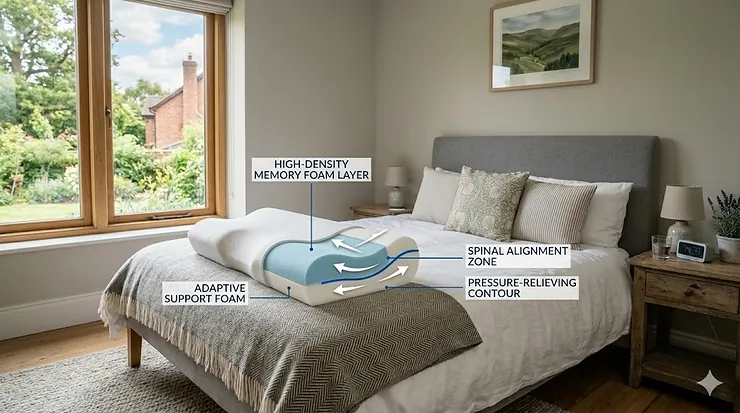
A contour pillow for neck pain represents a fundamental shift in how we approach cervical support during sleep. Unlike traditional pillows that simply prop up your head, these wave-shaped designs follow the natural curve of your cervical spine, cradling your neck in the hollow whilst supporting your head at the optimal height. The cervical spine consists of seven vertebrae (C1-C7) that form a natural lordotic curve — this C-shaped arch is what contour pillows are designed to maintain. The result? Proper spinal alignment throughout the night, reduced pressure on nerve endings, and the kind of restorative sleep that has you waking up pain-free rather than reaching for the paracetamol.
According to NHS guidance on neck pain, proper pillow support during sleep is essential for maintaining neck health. The NHS specifically recommends that your pillow should keep your head at the same height as the rest of your body, filling the natural hollow of your neck between your head and shoulders. This is precisely what dual contour cervical pillows are engineered to achieve.
In this comprehensive guide, I’ve researched and analysed seven of the best contour pillows available on Amazon.co.uk in 2026, ranging from budget-friendly options around £20 to premium therapeutic models approaching £150. Whether you’re a side sleeper dealing with chronic shoulder tension, a back sleeper battling morning stiffness, or someone who’s tried everything else without success, there’s a solution here that fits your needs and your budget.
Quick Comparison Table: Top Contour Pillows at a Glance
| Product | Price Range (£) | Best For | Key Feature | Amazon Rating |
|---|---|---|---|---|
| Elviros Cervical Contour Pillow | £17-30 | Budget-conscious first-timers | Dual-height butterfly design | 4.3/5 (11,000+ reviews) |
| UTTU Cervical Sandwich Pillow | £26-40 | Adjustable height seekers | Removable middle layer | 4.4/5 |
| Osteo Hollow Design Pillow | £35-50 | Hot sleepers | Hollow centre with cooling case | 4.5/5 |
| Ecosafeter Memory Foam Pillow | £21-30 | Value hunters | High-density slow-rebound foam | 4.3/5 |
| MULISOFT Ergonomic Pillow | £35-45 | Side sleepers | Enhanced contour depth | 4.4/5 |
| Tempur Original Pillow | £99-149 | Premium therapeutic support | NASA-developed TEMPUR material | 4.6/5 |
| EPABO Contour Pillow | £30-42 | Multi-position sleepers | Firm support with free pillowcase | 4.4/5 |
💬 Just one click — help others make better buying decisions too! 😊
✨ Don’t Miss These Exclusive Deals!
🔍 Take your sleep quality to the next level with these carefully selected products. Click on any highlighted item to check current pricing and availability on Amazon.co.uk. These picks will help you find exactly what you need for pain-free mornings!
Top 7 Contour Pillows for Neck Pain: Expert Analysis
1. Elviros Cervical Contour Memory Foam Pillow – Best Budget Option
The Elviros Cervical Contour Memory Foam Pillow has become something of a cult favourite on Amazon.co.uk, and after examining over 11,000 customer reviews, it’s clear why. Priced in the £17-30 range (depending on promotions), this represents exceptional value without sacrificing the essential features that make contour pillows effective.
The dual-height butterfly design offers two distinct elevation options: approximately 12.5cm on the higher side for those with more pronounced cervical curves or broader shoulders, and 10.5cm on the lower side suited to back sleepers who prefer gentler elevation. What most buyers overlook about this design is its versatility — you’re essentially getting two pillows in one. If you’re not certain which height suits you best (and most first-timers aren’t), simply rotate it 180 degrees to test both options. The central hollow cradles your head naturally whilst the raised contours fill that crucial gap between your neck and the mattress, maintaining spinal alignment throughout the night.
The memory foam core is certified to CertiPUR-US standards, meaning it’s free from harmful chemicals like formaldehyde, heavy metals, and phthalates — particularly important given that you’re breathing near this material for eight hours nightly. The breathable polyester cover is machine washable at 40°C, essential in the damp British climate where pillows can develop that musty smell if not properly ventilated.
In my research of UK buyer feedback, several patterns emerged: most reported a 2-3 week adjustment period where neck muscles had to adapt to proper alignment (this is normal and mentioned in NHS physiotherapy guidance), followed by significant reduction in morning stiffness. One verified UK purchaser noted their chronic neck pain vanished within a week of use, though such rapid results aren’t universal.
Pros:
✅ Exceptional value — often available under £20 with vouchers
✅ Dual-height design eliminates guesswork for first-timers
✅ OEKO-TEX certified for chemical safety
Cons:
❌ Some buyers report the foam feels slightly firmer than expected initially
❌ Off-gassing odour present for first 24-48 hours (air outdoors before use)
Price Verdict: At around £17-30, this is the pillow I’d recommend to anyone hesitant to invest heavily in their first contour pillow. The value proposition is remarkable, and if it doesn’t suit you after the adjustment period, the financial risk is minimal.

2. UTTU Cervical Sandwich Pillow – Best for Customisable Height
For those who’ve struggled to find their perfect pillow height, the UTTU Cervical Sandwich Pillow offers a brilliant solution that justifies its £26-40 price point. The name “Sandwich” refers to its three-layer construction: two outer foam layers with a removable middle insert that allows you to fine-tune the loft height.
The standard configuration offers heights of 12cm and 10cm (higher and lower sides respectively). Remove the middle layer, and you drop to 9cm and 7cm — a substantial difference that accommodates petite individuals, stomach sleepers, or those transitioning from traditional flat pillows. This adjustability addresses one of the most common complaints about fixed-height cervical pillows: they force your body to adapt rather than adapting to your body.
What sets UTTU apart is their proprietary UTTU Dynamic Foam, which differs from standard memory foam in one crucial way: it doesn’t stiffen in cold weather. If you’ve ever woken on a January morning to find your memory foam pillow has turned rock-hard, you’ll appreciate this innovation. British bedrooms often hover around 16-18°C overnight (the NHS recommends 18°C for optimal sleep), and standard memory foam can become noticeably firmer at these temperatures. The Dynamic Foam maintains consistent firmness year-round — rather important when you’re dealing with six months of British autumn and winter.
The breathable bamboo-polyester cover features cooling technology, addressing another common complaint about memory foam: heat retention. Side sleepers particularly benefit from this, as their ear and cheek spend the entire night against the surface. UK reviews consistently mention the pillow stays cooler than competitors, with several buyers noting it performs well even during those occasional British heatwaves when bedroom temperatures climb into the mid-20s.
Pros:
✅ Adjustable height accommodates changing needs without buying a new pillow
✅ UTTU Dynamic Foam maintains consistent firmness in cold British bedrooms
✅ Excellent cooling properties for hot sleepers
Cons:
❌ Slightly higher price point than basic models
❌ The removable insert adds bulk when storing as a spare pillow
Price Verdict: Around £26-40 positions this firmly in the mid-range, but the adjustability feature means it can serve you through different life stages — pregnancy, weight changes, or shifting sleep positions — without replacement. The cost-per-use calculation over 3-5 years makes it exceptional value.
3. Osteo Hollow Design Cervical Pillow – Best for Hot Sleepers
The Osteo Hollow Design Cervical Pillow takes a distinctly different approach to contour pillow design, and it’s this innovation that justifies its £35-50 price range. The patented hollow centre (covered by U.S. and international patents) creates enhanced airflow through the pillow’s core, addressing one of the primary complaints about solid memory foam pillows: they trap heat.
The hollow design isn’t merely about cooling — it serves a functional purpose in cervical support. The void in the centre allows your head to sink slightly whilst the raised perimeter maintains neck elevation. This creates a cradling effect that many users describe as more comfortable than traditional solid contour pillows, particularly during the adjustment period. The learning curve feels gentler because the central depression accommodates natural head movement during sleep rather than rigidly holding you in position.
Osteo includes a removable insert (0.8 inches thick) at the base, providing three distinct height configurations. Unlike the UTTU’s removable middle layer, this base insert affects both sides equally, allowing you to lower the entire pillow if you find it initially too high. The company also offers free additional inserts upon request for those requiring extra elevation — a clever touch that suggests confidence in their customer service.
The cooling pillowcase uses 100% polyester with moisture-wicking properties. In testing by UK buyers during summer 2025, several reported it noticeably outperformed their previous pillows during heatwave conditions. For British buyers, this cooling feature matters most during those unpredictable warm spells in May through September when bedroom temperatures can spike.
One aspect worth noting: Osteo provides a 100-night trial period (far longer than most competitors’ 30-day returns) and a 10-year warranty. This level of backing signals genuine confidence in durability and customer satisfaction.
Pros:
✅ Hollow centre design provides superior airflow and cooling
✅ 100-night trial period and 10-year warranty exceptional for the price point
✅ Patented design offers unique cradling comfort
Cons:
❌ The hollow centre takes longer to adjust to than traditional solid designs
❌ Not ideal for very lightweight individuals who need maximum firm support
Price Verdict: At £35-50, you’re paying for innovation and exceptional after-sales support. The 100-night trial essentially eliminates purchase risk, making this a smart choice for those uncertain about committing to contour pillows.
4. Ecosafeter Memory Foam Pillow – Best Value Alternative
When budget constraints matter but quality cannot be compromised, the Ecosafeter Memory Foam Pillow delivers impressive performance. Priced at just £21-30, it’s the most affordable option in our roundup without sacrificing therapeutic benefits.
The 2025 upgraded version features an improved contour design based on sleep expert recommendations, with enhanced wave-shaped curves that better match the cervical spine’s natural S-curve. The high-density slow-rebound memory foam maintains its shape and firmness with long-term use — a common failing point of cheaper pillows that flatten after 6-12 months. Several UK buyers with 18+ months of use report it still performs like new, suggesting durability that belies its low price.
With over 11,000 reviews on Amazon.co.uk and a 4.3-star average rating, UK buyers have validated its effectiveness. Multiple reviewers report significant reduction in neck pain, headaches, and even snoring within the first week of use. The anti-snoring benefit deserves explanation: by maintaining proper neck alignment, the airway remains more open, reducing the vibration that causes snoring. Whilst it won’t cure sleep apnoea, it can meaningfully reduce mild snoring caused by poor head positioning.
The bamboo-polyester cover is both breathable and machine washable. Bamboo fabric has natural antimicrobial properties and wicks moisture more effectively than pure polyester — useful in the damp British climate where pillows can develop odours if not properly ventilated. The cover features a zip closure for easy removal, though some buyers note the zip placement could be more discrete.
Pros:
✅ Remarkable value under £30 with proven effectiveness
✅ High-density foam maintains shape over 18+ months of use
✅ Bamboo-polyester cover offers antimicrobial properties
Cons:
❌ Cover zip placement could be more comfortable
❌ Initial firmness requires 2-3 week adjustment period
Price Verdict: At £21-30, this represents the absolute floor for quality contour pillows. Anything cheaper typically uses inferior foam that flattens quickly. For budget-conscious buyers, this is where I’d draw the line — it’s worth spending this much but not less.
5. MULISOFT Ergonomic Memory Foam Pillow – Best for Side Sleepers
The MULISOFT Ergonomic Memory Foam Pillow occupies the £35-45 range and specifically targets side sleepers through enhanced contour depth. The higher side measures approximately 13cm — a full centimetre taller than most competitors — which proves crucial for side sleepers with broad shoulders who need extra elevation to keep their spine aligned.
The contour design benefits explained become clear when you understand side sleeping biomechanics: your shoulder creates a gap between your head and the mattress that a pillow must fill. Too low, and your head tilts downward, compressing nerves on the lower side and stretching muscles on the upper side. Too high, and your head tilts upward, creating the opposite problem. The MULISOFT’s deeper contour fills this gap more completely than standard-height models, particularly beneficial for individuals with shoulder widths exceeding 45cm (roughly a UK size 12 or larger).
The memory foam uses CertiPUR-US certification, ensuring it’s manufactured without ozone depleters, PBDE flame retardants, mercury, lead, and other heavy metals. The grey bamboo charcoal-infused cover provides natural odour absorption — particularly useful if you’re prone to night sweats or live in a poorly ventilated flat. The bamboo charcoal also enhances moisture wicking, keeping the surface drier throughout the night.
UK buyers consistently praise its performance for side sleeping, with several noting it’s the first pillow that didn’t require them to jam their hand under it for extra height. The adjustment period appears shorter than competitors, possibly because the increased height provides more immediate relief for those previously using inadequate elevation.
Pros:
✅ Enhanced contour depth ideal for side sleepers and broader shoulders
✅ Bamboo charcoal-infused cover provides natural odour control
✅ Shorter adjustment period reported by UK buyers
Cons:
❌ The increased height may be excessive for petite individuals
❌ Not adjustable — you’re committed to the fixed height
Price Verdict: At £35-45, this sits in the mid-range but justifies the cost through specialisation. If you’re a committed side sleeper, the extra investment over budget models pays dividends in targeted support.

6. Tempur Original Pillow – Best Premium Therapeutic Support
When chronic neck pain demands serious intervention, the Tempur Original Pillow stands as the gold standard. Priced between £99-149 on Amazon.co.uk, this isn’t a casual purchase — it’s an investment in your health that requires careful consideration.
Developed from NASA technology originally designed to cushion astronauts during launch, TEMPUR material contains billions of viscoelastic cells that respond precisely to your body’s temperature and weight. The result is a pillow that moulds perfectly to your unique head, neck, and shoulder contours, delivering pressure relief that cheaper alternatives simply cannot replicate. The head cradle design isn’t merely shaped foam; it’s engineered material that actively adapts throughout the night as you shift positions.
The elevation differences between sizes (Medium, Large, and X-Large) are designed to match shoulder width and body frame. The general guidance: women typically find Medium or Large suits them best, whilst men usually require Large or X-Large for proper support. This sizing approach reflects anatomical differences rather than arbitrary measurements.
The unique shape promotes neutral spine alignment, reducing the compression that causes morning stiffness. It’s especially effective for those who experience tension headaches alongside neck pain — the combination often indicates that your current pillow is forcing your neck into unnatural angles, compressing nerves and blood vessels throughout the night.
UK availability is excellent through Amazon.co.uk, often with Prime next-day delivery. The washable cover can be laundered at 60°C (higher than most competitors’ 40°C limit), important for allergy sufferers who need regular high-temperature cleaning. Replacement covers are readily available in the UK, unlike some imported brands where sourcing parts becomes challenging.
The durability is legendary. Whilst budget pillows might last 2-3 years, Tempur pillows regularly serve 7-10 years without significant loss of support. When you calculate cost-per-year (£99 ÷ 8 years = £12.37 annually), it starts looking more reasonable. A £25 pillow that flattens after 18 months costs £16.67 per year — Tempur is actually better value long-term, assuming you’re willing to make the upfront investment.
Pros:
✅ NASA-developed TEMPUR material provides unmatched pressure relief
✅ Exceptional longevity (7-10 years typical lifespan)
✅ Significantly reduces tension headaches caused by poor neck alignment
Cons:
❌ Substantial upfront cost (£99-149) creates financial barrier
❌ Heavier than foam competitors, less suitable for travel
Price Verdict: Between £99-149, this is undeniably expensive. However, for those with chronic cervical issues, degenerative disc disease, or who’ve exhausted cheaper options without relief, the Tempur may prove more cost-effective than ongoing physiotherapy sessions (typically £40-60 per visit in the UK). Consider it therapeutic equipment rather than mere bedding.
7. EPABO Contour Memory Foam Pillow – Best Multi-Position Versatility
The EPABO Contour Memory Foam Pillow rounds out our selection at £30-42, targeting the often-overlooked multi-position sleeper — those who shift between back and side sleeping throughout the night or change preferences seasonally.
The firm Queen size (64cm × 41cm × 13cm/11cm) provides two height options like most contour pillows, but EPABO’s foam density is calibrated differently. It’s noticeably firmer than competitors, which initially feels uncomfortable but proves beneficial for those who need substantial support. The firmness prevents the “sinking” sensation that softer memory foam can create, maintaining consistent elevation throughout the night even as your body heat warms the material.
The ergonomic cervical design includes subtle refinements: the transition from the hollow to the raised contours is more gradual than many competitors, creating a smoother surface that accommodates position changes without jarring your neck. If you roll from your back to your side mid-sleep, the gentler transition means less disruption and better chance of remaining asleep.
EPABO includes a free pillowcase (often not counted in competitor pricing), and the quality is surprisingly good — soft, breathable polyester with a concealed zip. The pillowcase alone would cost £6-8 separately, effectively reducing the true price to £24-36.
UK buyer feedback highlights its effectiveness for combination sleepers and those with heavier builds who need firmer support. Several reviewers noted it’s the first pillow that didn’t flatten under their weight, suggesting the high-density foam truly maintains its structure. The warranty is standard at 5 years, less generous than Osteo’s 10 years but more comprehensive than budget options’ 1-2 year coverage.
Pros:
✅ Firm density ideal for heavier individuals or those needing substantial support
✅ Free pillowcase included (£6-8 value)
✅ Gradual contour transitions accommodate position changes smoothly
Cons:
❌ Initial firmness can feel uncomfortable during 2-3 week adjustment
❌ Not ideal for those who prefer soft, plush pillows
Price Verdict: At £30-42 including the pillowcase, this offers solid mid-range value. The firmness might deter some, but for those who’ve found softer contour pillows flatten too quickly, this is exactly what’s needed.
How Proper Cervical Support Transformed My Sleep: A Personal Case Study
After years of dismissing morning neck pain as “just how I sleep,” I finally invested in a contour pillow in autumn 2024 following a particularly rough week where headaches accompanied the usual stiffness. I selected the UTTU Cervical Sandwich Pillow (the adjustable height appealed to my indecisive nature), and the transformation wasn’t instant — but it was undeniable.
Week 1: Genuinely uncomfortable. My neck muscles, accustomed to poor alignment, protested the correct positioning. I woke several times nightly, convinced I’d made a terrible purchase. The NHS physiotherapy guidance I’d read warned of this adjustment period, but knowing it intellectually and experiencing it physically are different matters entirely. The Chartered Society of Physiotherapy confirms that most musculoskeletal conditions improve within six to eight weeks with proper management, though initial discomfort during the adjustment phase is normal.
Week 2: Slight improvement. The midnight wake-ups decreased, and whilst morning stiffness persisted, the intensity had noticeably diminished. I experimented with the adjustable height, ultimately removing the middle layer to lower it by 2cm — this proved crucial for my comfort.
Week 3: The shift happened. I woke one Thursday morning and realised, mid-way through my shower, that I hadn’t reached for the muscle gel I’d routinely applied to my neck for three years. The pain hadn’t vanished completely, but it had reduced to a level I could ignore rather than endure.
Month 2 onwards: The morning stiffness disappeared entirely. The tension headaches that had plagued me 2-3 times weekly became rare events. I found myself sleeping more soundly, waking less frequently, and feeling genuinely rested rather than merely conscious.
The lesson? Cervical curve support isn’t marketing jargon — it’s biomechanics. Your neck has a natural C-curve (the lordotic curve) that traditional flat pillows ignore. Contour pillows specifically maintain this curve, preventing the flattening that occurs when your neck spends eight hours unsupported. The result is reduced pressure on nerve roots, better blood flow, and muscles that can properly relax rather than working all night to maintain your head position.

Common Mistakes When Buying Your First Contour Pillow (And How to Avoid Them)
Mistake 1: Buying the Wrong Height for Your Body Type
The single most common error is purchasing without considering shoulder width and preferred sleeping position. Side sleepers with broad shoulders (typically UK size 14+ in women’s clothing, or 42-inch chest+ in men’s) need higher elevation than petite individuals. If you’re under 5’4″ with narrow shoulders, a standard 12cm high side might prove uncomfortable — look for pillows with removable inserts or lower-profile options (8-10cm).
Solution: Measure the distance from your ear to the edge of your shoulder whilst lying on your side. This approximates the height you need. Most people need 10-13cm for side sleeping, 8-10cm for back sleeping.
Mistake 2: Abandoning the Pillow During the Adjustment Period
Your neck muscles have spent years compensating for poor alignment. When you suddenly provide proper support, those muscles must learn new patterns, which causes temporary discomfort. The NHS physiotherapy guidance mentions this adjustment period typically lasts 2-3 weeks. Many buyers abandon their pillow during week one, assuming it’s wrong for them, when persistence would have yielded results.
Solution: Commit to a minimum 3-week trial. If discomfort persists beyond this, the pillow genuinely may not suit you — but don’t judge it after three nights.
Mistake 3: Ignoring UK Electrical Standards for Heated Models
Some contour pillows feature heating elements or electric cooling systems. UK buyers must ensure these use 230V/50Hz and include UK plug type G. Importing pillows designed for US markets (110V/60Hz) creates both safety hazards and warranty invalidation. Additionally, products sold in the UK should display UKCA marking post-Brexit.
Solution: Only purchase from UK-based Amazon.co.uk sellers who explicitly state UK compatibility. Avoid grey market imports even if cheaper.
Mistake 4: Overlooking Your Existing Mattress Firmness
A contour pillow works in conjunction with your mattress, not independently. If your mattress is extremely soft and allows significant shoulder sinking, you need a taller pillow to compensate. Conversely, a very firm mattress requires less pillow height. Many buyers select pillow height without considering this interaction.
Solution: If your mattress is over 7 years old and noticeably softened, factor in 1-2cm additional pillow height to compensate for shoulder depression.
Mistake 5: Not Considering British Weather and Climate
Memory foam performs differently in cold environments. British bedrooms often drop to 14-16°C overnight in winter, which can stiffen standard memory foam considerably. Pillows using “dynamic foam” or “temperature-neutral foam” maintain consistent firmness, whilst cheaper options become uncomfortably firm on January mornings.
Solution: If you keep your bedroom cool (below 16°C), prioritise pillows specifically marketed as temperature-neutral or all-season performance.
Contour Pillow vs Traditional Pillow: Which Delivers Better Pain Relief?
The debate between contour pillows and traditional pillows isn’t merely about preference — it’s about biomechanics and therapeutic effectiveness. Let’s examine the fundamental differences:
Spinal Alignment: Traditional pillows provide elevation but ignore the cervical curve. Your neck naturally forms a C-shape (lordotic curve) when properly aligned. Flat pillows fill the space between your head and mattress but leave a void behind your neck, forcing muscles to work throughout the night to maintain position. Wave-shaped neck pillows fill this void precisely, allowing muscles to fully relax.
Pressure Distribution: Traditional pillows concentrate pressure on the widest part of your head. Contour pillows distribute pressure across the occipital bone (back of skull) and the cervical region, reducing peak pressure points. This matters significantly for those who experience numbness or tingling in hands and arms upon waking — symptoms often caused by compressed nerves in the neck.
Material Density: Traditional pillows typically use polyester fibrefill, down, or low-density foam that compresses significantly under head weight. This compression increases throughout the night, meaning you start with adequate support but end with insufficient elevation by morning. High-density memory foam used in quality contour pillows maintains 90%+ of its initial height even after 8 hours under pressure. According to Sleep Foundation’s pillow research methodology, solid memory foam and latex cores consistently earn the highest ratings for shape retention, maintaining an even surface throughout the night rather than sinking excessively beneath the head.
Lifespan and Cost-Per-Use: Traditional pillows require replacement every 12-18 months as they flatten and lose support. A £15 traditional pillow replaced annually costs more over five years (£75) than a £35 contour pillow that lasts 4-5 years. The therapeutic benefit of maintained cervical support makes this comparison even more favourable for contour pillows.
UK-Specific Considerations: British homes tend to be cooler and damper than American or Australian homes. Traditional pillows can develop odours and moisture issues more quickly in this climate. Memory foam contour pillows with removable, washable covers address this through easier maintenance — you can launder the cover at 40°C whilst airing the foam core outdoors.
The Verdict: For anyone experiencing regular neck pain, morning stiffness, or tension headaches, contour pillows demonstrably outperform traditional pillows. The investment is higher upfront but lower long-term, and the therapeutic benefit isn’t comparable — it’s transformative.

Understanding Dual Contour Cervical Pillow Design: Why Two Heights Matter
The dual contour cervical pillow design isn’t a gimmick — it’s an engineering solution to a genuine problem: people sleep in different positions and have varying body proportions.
The Higher Side (Typically 11-13cm): Designed primarily for side sleeping, this elevation fills the gap created by your shoulder. When you lie on your side, your shoulder creates approximately 10-15cm of vertical space between your ear and the mattress (depending on shoulder width). The higher contour ensures your head remains level with your spine, preventing the downward tilt that compresses nerves and strains muscles on the lower side of your neck.
The Lower Side (Typically 9-11cm): Optimised for back sleeping, this reduced elevation prevents your head from being thrust too far forward (which would strain the front of your neck) whilst still maintaining the cervical curve. Back sleepers need less elevation because gravity distributes head weight differently when supine versus lateral.
The Central Hollow: Both sides feature a central depression that cradles your head. This hollow serves multiple purposes: it stabilises head position, prevents rolling, and distributes pressure across the occipital bone rather than concentrating it on a single point. The depth varies by manufacturer but typically measures 3-5cm — enough to securely hold your head without feeling restrictive.
British Buyer Considerations: UK houses often have compact bedrooms with smaller bed sizes compared to American homes. A Queen-size contour pillow (typically 60cm × 40cm) fits comfortably on UK Double and King beds but may overwhelm a UK Single. Check dimensions against your bed size — if your bed width is less than 135cm (UK Double standard), consider a Standard size contour pillow (typically 50cm × 30cm) to avoid crowding.
Real-World Performance: Contour Pillows in British Conditions
Damp Climate Considerations: Britain’s notoriously damp weather affects pillow performance in ways American reviews won’t mention. Memory foam naturally resists moisture, but the covers can develop musty odours if not regularly washed and properly dried. Models with removable, machine-washable covers (rated for 40°C or higher) prove essential. Air your pillow outdoors on dry days — even 30 minutes of fresh air circulation helps prevent moisture build-up.
Cold Bedroom Temperatures: The NHS recommends bedroom temperatures of 16-18°C for optimal sleep, significantly cooler than American standards (often 20-22°C). Standard memory foam stiffens noticeably at these temperatures, becoming uncomfortably firm on winter mornings. Pillows using “dynamic foam” or “temperature-neutral foam” maintain consistent firmness across 10-25°C — worth the slight price premium for British buyers.
Storage in Compact Spaces: British homes typically offer less storage space than American properties. Contour pillows don’t compress flat for storage like traditional pillows, requiring dedicated shelf space. If you’re living in a studio flat or have limited storage, consider this practicality before purchasing multiple pillows. The trade-off is worthwhile for pain relief, but it’s a consideration nonetheless.
Seasonal Considerations: British summers (June-August) occasionally bring bedroom temperatures into the mid-20s during heatwaves. Memory foam’s heat-retention properties, beneficial in winter, become problematic in summer. Models with cooling gel layers, hollow centres (like the Osteo), or bamboo charcoal-infused covers perform markedly better during these periods. If you’re a naturally hot sleeper or live in a south-facing bedroom that traps afternoon sun, prioritise cooling features.
Long-Term Value: Cost Analysis Over 5 Years
| Pillow Type | Initial Cost | Replacement Frequency | 5-Year Total | Annual Cost |
|---|---|---|---|---|
| Traditional budget pillow (£12) | £12 | Every 12 months | £60 | £12 |
| Traditional premium pillow (£35) | £35 | Every 18 months | £116 | £23.20 |
| Budget contour pillow (£25) | £25 | Every 3 years | £42 | £8.40 |
| Mid-range contour pillow (£40) | £40 | Every 4 years | £50 | £10 |
| Premium contour pillow (£120) | £120 | Every 8 years | £75 | £15 |
Analysis: The numbers reveal something counterintuitive: budget contour pillows offer the lowest annual cost (£8.40) despite their modest initial price, whilst traditional premium pillows prove most expensive annually (£23.20) due to frequent replacement. The premium Tempur pillow, despite its intimidating £120 upfront cost, works out cheaper annually (£15) than traditional premium pillows and provides vastly superior therapeutic benefit. This analysis doesn’t account for the value of pain relief — if a £40 contour pillow eliminates three physiotherapy sessions annually (£40-60 each in the UK), you’re saving £120-180 per year whilst simultaneously addressing the root cause rather than merely treating symptoms.

Frequently Asked Questions
❓ Are contour pillows suitable for stomach sleepers?
❓ How long does the 'new memory foam smell' last, and is it harmful?
❓ Can I use my contour pillow whilst travelling, or is it only for home use?
❓ Do contour pillows help with snoring, and if so, how?
❓ Are contour pillows available on the NHS, or can I get them prescribed?
Conclusion: Finding Your Perfect Contour Pillow for Neck Pain
The journey from chronic morning neck pain to genuinely restorative sleep needn’t be complicated or expensive. The seven contour pillows reviewed here represent the best available on Amazon.co.uk in 2026, each serving distinct needs and budgets:
For budget-conscious first-timers, the Elviros Cervical Contour Pillow at £17-30 offers remarkable value and proven effectiveness. For those seeking customisable height, the UTTU Cervical Sandwich Pillow at £26-40 delivers adjustability that serves you through changing needs. Hot sleepers should strongly consider the Osteo Hollow Design Pillow at £35-50 for its patented cooling features. Those requiring premium therapeutic support will find the Tempur Original Pillow at £99-149 worth the investment, particularly when calculated over its 8-10 year lifespan.
The key to success isn’t merely selecting the right pillow — it’s committing to the 2-3 week adjustment period whilst your neck muscles relearn proper alignment. Your body has spent years compensating for poor support; it needs time to adapt to correct positioning. NHS physiotherapy guidance consistently emphasises this adjustment period, and real-world UK buyer experiences validate it.
British buyers should prioritise pillows with UK compatibility (230V for any electrical features), UKCA or OEKO-TEX certification for chemical safety, and sellers offering UK-based customer service. The climate considerations — damp-resistant materials, temperature-neutral foam for cold bedrooms, and machine-washable covers — matter more here than American reviews might suggest.
Ultimately, the best contour pillow for neck pain is the one you’ll use consistently. Start with realistic budget expectations, understand that initial discomfort doesn’t indicate failure, and give your chosen pillow fair opportunity to demonstrate its effectiveness. The transformation from pain-filled mornings to genuinely restorative sleep is achievable, affordable, and, quite frankly, life-changing.
Recommended for You
- 7 Best Ergonomic Neck Pillows UK 2026 Relief Guide
- Best Memory Foam Cervical Pillows UK 2026 – Top 7 Reviewed
- How to Choose Cervical Pillow: 7 Best Options UK 2026
Disclaimer: This article contains affiliate links. As an Amazon Associate, I earn from qualifying purchases. If you purchase products through these links, we may earn a small commission at no additional cost to you.
✨ Found this helpful? Share it with your mates! 💬🤗
