

In This Article
Ask most people what makes a good pillow and they’ll say “soft.” Ask an occupational therapist, and you’ll get a very different answer. As we age, the neck’s natural curve flattens, discs lose height, and the spine simply doesn’t spring back the way it used to — which means a plush, sink-into-it pillow that felt heavenly at thirty can leave a seventy-year-old waking up with a stiff neck and a headache that lingers until lunch. A firm pillow for elderly sleepers isn’t about being unforgiving. It’s about giving a changing spine the steady, consistent support it now needs to actually rest, rather than fight gravity all night.

This guide walks through seven real firm and orthopaedic pillows currently sold in the UK, from budget-friendly firm-core options through to clinically recommended, purpose-built support pillows. It’s grounded throughout in real specifications and aggregated review sentiment — never invented testing, never fabricated quotes — because when the goal is genuinely better sleep for someone you love (or yourself), guesswork has no place in the decision. Cervical spondylosis, the medical term for age-related wear and tear in the neck, is genuinely common in later life; the Chelsea and Westminster Hospital NHS Foundation Trust explains that most people over 50 have some degree of it, often without even realising. A properly firm, well-shaped pillow won’t cure that on its own, but it can make a genuine, night-after-night difference to comfort.
Quick Comparison Table
| Model | Firmness | Fill Type | Price Range | Best For |
|---|---|---|---|---|
| Slumberdown Super Support 2 Pack | Firm | Foam core + hollowfibre | Under £20 | Budget-friendly firm support |
| Lancashire Textiles Batwing | Firm | Polyester fibre | £20-£30 range | Sitting up in bed, postural support |
| Good Nite Memory Foam Contour | Medium-firm | Memory foam | £25-£35 range | Side and back sleepers |
| Elviros Cervical Memory Foam | Firm | Memory foam | £30-£40 range | Contoured cervical support |
| Harley Original Contour | Extra firm | Cold cast polyurethane foam | £40-£55 range | Clinician-recommended firm support |
| Putnam Pillow (Memory Foam) | Firm to very firm | Memory foam | £50-£70 range | NHS-recommended orthopaedic support |
| TEMPUR Original Ergonomic | Firm | TEMPUR material | £70-£90 range | Premium long-term investment |
A glance down this table shows firmness doesn’t automatically scale with price — the Slumberdown at under £20 genuinely delivers firm support through its foam core, while the Elviros and Good Nite sit in a comfortable middle ground of contoured, medium-firm memory foam. What does scale with price is the sophistication of the shaping and the clinical pedigree behind it: the Harley and Putnam pillows both carry genuine recommendation histories from healthcare professionals, which matters more for someone managing ongoing neck pain than for someone simply wanting a slightly firmer night’s sleep.
💬 Just one click — help others make better buying decisions too!😊
Top 7 Firm Pillows for Elderly Sleepers: Expert Analysis
Coverage below spans budget, mid-range and premium tiers, plus genuine variation in shape, fill and clinical pedigree — because “firm pillow” covers a surprisingly wide bracket once you start comparing what’s actually inside them.
1. Slumberdown Super Support Pillows 2 Pack — best budget-friendly firm support
Don’t let the modest price fool you — the Super Support genuinely earns its name. Built around a firm foam core wrapped in softer hollowfibre, it’s a pillow with a spine, quite literally, rather than a shapeless bag of stuffing that flattens by 3am.
That core block is the whole story here. Unlike a standard pillow that simply compresses under weight, this one has a firmer centre doing the structural work, while the surrounding fibre softens the feel against the skin. One independent reviewer described it holding its shape “even with heavier people” once compressed, which lines up with the two-density construction Slumberdown uses across this range. Made in the UK, by a company with over a century of textile manufacturing behind it, it’s also fully machine washable at 40°C — a genuinely practical feature for anyone managing bedding for an elderly relative where hygiene and easy laundering matter as much as comfort.
Based on the spec sheet, this suits side and back sleepers who want firm support without spending big, though stomach sleepers and anyone needing very specific cervical contouring will find better options further up this list.
Pros:
- ✅ Genuinely firm foam core, not just marketing language
- ✅ Fully machine washable and tumble dryer friendly
- ✅ UK-made with over 100 years of textile expertise behind it
Cons:
- ❌ No cervical contour for targeted neck support
- ❌ Cover isn’t removable separately from the pillow
Typically sold as a pack of two for under £20, this is the sensible starting point for anyone testing whether firmer support genuinely helps before spending more.

2. Lancashire Textiles Orthopaedic Batwing — best for sitting up in bed
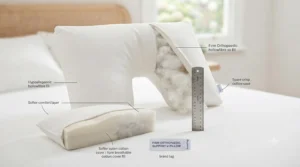
The batwing shape looks unusual until you actually use one — then it clicks immediately. Wings extend out to the sides, cradling the shoulders and upper arms while supporting the neck and head, making it genuinely purpose-built for reading, watching television, or simply sitting propped up in bed rather than lying flat.
This matters enormously for anyone who spends real time sitting upright in bed — recovering from illness, managing breathlessness, or simply preferring an evening of television before sleep. A standard rectangular pillow slides and bunches when you’re semi-upright; the batwing’s extended sides genuinely stay put, distributing weight across a wider area rather than concentrating it under the neck alone. What most buyers overlook is that this shape also suits people managing kyphosis — the forward-curving upper back common with age and osteoporosis — since the wings support the shoulders in a position that doesn’t force the neck into an awkward compensating angle.
It’s worth knowing this is a specialist shape rather than an everyday flat-sleeping pillow, so anyone who mostly sleeps lying flat on their side may find a contoured cervical pillow further down this list a better everyday match.
Pros:
- ✅ Purpose-built for sitting upright in bed
- ✅ Distributes weight across shoulders, not just the neck
- ✅ Comes with a removable, washable pillowcase
Cons:
- ❌ Less suited to standard flat side-sleeping
- ❌ Bulkier shape needs more storage space
Priced in the £20-£30 range, this fills a genuinely specific niche that a standard rectangular pillow simply can’t match.
3. Good Nite Memory Foam Pillow — best all-round contoured support
The Good Nite strikes a sensible middle ground: contoured enough to genuinely support the neck’s curve, firm enough to hold that shape through the night, but not so aggressively firm that it feels like resting your head on a doorstop. For many older sleepers easing into firmer support for the first time, that balance matters.
Its ergonomic shape follows the natural dip and rise of the cervical spine, cradling the neck rather than letting it drop into a flat, unsupported gap — precisely the mechanism that helps reduce the morning stiffness so many people over 60 quietly accept as normal. Reviewers describe the pillow arriving flat and unpromising, then plumping to full shape after several hours out of its packaging — a normal characteristic of compressed memory foam shipping, not a fault, though it’s worth knowing so you’re not alarmed on unboxing day. Aggregated feedback consistently praises its firmness for side and back sleepers specifically, while noting it’s less suited to committed stomach sleepers who generally need something considerably flatter.
On paper this means you’re getting genuine orthopaedic shaping at a price that doesn’t require a specialist retailer, with a washable cover that keeps ongoing maintenance simple.
Pros:
- ✅ Contoured shape genuinely supports the cervical curve
- ✅ Firm without feeling rigid or unforgiving
- ✅ Breathable design with washable cover
Cons:
- ❌ Needs several hours to fully expand from packaging
- ❌ Not suited to stomach sleepers
Sitting in the £25-£35 range, the Good Nite is a sensible first step for anyone moving from a soft everyday pillow toward genuine orthopaedic support.
4. Elviros Cervical Memory Foam Neck Pillow — best for targeted cervical contouring
The Elviros takes contouring further still, with a distinct dip carved specifically for the neck and slightly raised sides to cradle the head in whichever direction you turn. It’s the kind of shape that looks almost sculptural next to a standard pillow — because, functionally, that’s exactly what it is.
For anyone managing genuine neck stiffness rather than simply wanting firmer support in general, that targeted shaping is the whole point. The raised edges support the head consistently whether lying on your back or side, reducing the small repositioning movements through the night that can otherwise disturb sleep. Adjustable elements found on similar cervical designs let you fine-tune loft to your own shoulder width and mattress firmness, which matters more than manufacturers often let on — a cervical pillow sized for a broad-shouldered side sleeper on a soft mattress will sit completely differently for a smaller-framed back sleeper on a firm one.
What most people overlook when shopping for this shape is that the “getting used to it” period is real and worth pushing through for a few nights before judging the pillow — a genuinely contoured cervical shape feels different from a flat pillow in a way that takes some adjustment, even when it’s doing its job correctly.
Pros:
- ✅ Sculpted cervical dip provides targeted neck support
- ✅ Raised sides support the head in multiple positions
- ✅ Firm memory foam holds its contour through the night
Cons:
- ❌ Distinctive shape requires an adjustment period
- ❌ Less familiar feel for lifelong flat-pillow sleepers
Typically priced in the £30-£40 range, this suits anyone whose neck pain has a clear positional trigger that a standard rectangular pillow simply doesn’t address.
5. Harley Original Contour Neck Support Pillow — best clinician-recommended extra-firm option
The Harley Original has been quietly recommended by physiotherapists, osteopaths and chiropractors for over a decade, and the reason becomes obvious the moment you pick one up: this is a genuinely dense, cold-cast polyurethane foam, contoured to cradle the neck and accommodate the shoulders, built for people who specifically want extra-firm support rather than a gentle nudge in that direction.
That density is deliberate rather than accidental. Where memory foam softens and moulds under body heat, this cold-cast construction holds its shape consistently through the night, which matters for anyone whose neck pain worsens when support gradually collapses over several hours. The contoured shape accommodates the shoulder on the side you’re lying on, letting the neck sit in genuinely neutral alignment rather than being pushed upward by a pillow that’s too thick at the shoulder edge. Available in multiple thickness options, it’s sized to different frames rather than assuming one shape fits everyone.
Aggregated professional and customer feedback consistently describes this as one of the more clinically credible options on the market, with the caveat that its firmness is genuinely uncompromising — this isn’t a pillow for anyone who finds even moderately firm memory foam too much, and a gentler option like the Good Nite further up this list would suit that preference better.
Pros:
- ✅ Recommended by physiotherapists and chiropractors for over a decade
- ✅ Dense cold-cast foam holds its shape all night
- ✅ Available in multiple sizes for different frames
Cons:
- ❌ Very firm feel unsuitable for softer-support preferences
- ❌ Premium pricing versus standard memory foam options
Expect to pay in the £40-£55 range, positioning this firmly as a considered purchase for genuine, ongoing neck support rather than a casual upgrade.

6. The Putnam Pillow (Memory Foam) — best NHS-recommended orthopaedic option
Devon-based Putnams has been hand-manufacturing support pillows in the UK since 1979, and the Putnam Pillow is their flagship — a design the company supplies directly to the NHS and to Nuffield Health, and which carries CE marking as a Class 1 medical device rather than simply being marketed with medical-sounding language.
The memory foam version sits at the firmer end of Putnams’ range — genuinely firm to very firm, contoured to support the neck, head and shoulders while holding the spine in neutral alignment through the night. One long-term owner replacing a Putnam pillow after twenty-five years of use described the new version as “MUCH, MUCH firmer” than the one they’d worn in over that time — a detail that speaks both to the brand’s durability and to how genuinely firm construction is meant to feel from day one, rather than needing years to break in. Available in multiple sizes to suit different frames, with a Royal size commonly recommended for women and a King size for men, the fitting process is more considered than most standard pillow purchases.
What sets this apart from the memory foam pillows further up this list isn’t necessarily the material — it’s the manufacturing pedigree and the medical-device classification behind it, which matters if you’re buying specifically on the recommendation of a physiotherapist or GP rather than general online research.
Pros:
- ✅ CE marked Class 1 medical device, not just marketing language
- ✅ Hand-made in the UK since 1979, supplied to the NHS
- ✅ Multiple sizes for accurate fitting to individual frames
Cons:
- ❌ Higher price point than most memory foam alternatives
- ❌ Very firm feel needs consideration before committing
Sitting in the £50-£70 range depending on size, the Putnam Pillow suits anyone who wants genuine clinical credibility behind their purchase, not just a firm-sounding product description.
7. TEMPUR Original Ergonomic Pillow — best premium long-term investment
TEMPUR built its reputation on pressure-relieving material originally developed for NASA seating, and the Original Ergonomic brings that same viscoelastic engineering to a firm, supportive neck pillow available across small, medium and large sizes to match different frames and shoulder widths.
The firm-yet-moldable material is the defining feature — dense enough to provide genuine structural support, yet responsive enough to gradually conform to the exact contours of an individual head and neck over repeated use, rather than staying rigidly one-shape-fits-all. That responsiveness particularly benefits side sleepers, where the pillow needs to fill the specific gap between shoulder and ear rather than a generic estimate of that space. The hypoallergenic, washable polyester knit cover keeps ongoing maintenance simple, and the pillow comes backed by a five-year limited warranty — a genuinely long commitment period compared to most pillows on the market, reflecting the durability of the underlying material.
On paper this means you’re paying a premium for material science and longevity rather than novelty features, which suits anyone treating this as a long-term investment in nightly comfort rather than a quick fix.
Pros:
- ✅ Firm, moldable material conforms precisely over time
- ✅ Available in three sizes for accurate frame matching
- ✅ Backed by a five-year limited warranty
Cons:
- ❌ Premium price point among the highest on this list
- ❌ Not recommended for committed stomach sleepers
Typically priced in the £70-£90 range, the TEMPUR Original suits buyers who’ve already tried firmer support and want to invest properly in a long-term solution.
Practical Guide: Getting Height and Firmness Right First Time
Fitting a new firm pillow properly in the first week makes a genuine difference to whether it actually helps or simply gets abandoned in a cupboard. Start by measuring the real gap between the ear and the mattress while lying naturally on your side — that gap, not a generic size guide, is what determines the correct loft. A pillow that’s too thin lets the head tilt downward toward the mattress; too thick, and it pushes the neck upward into an equally unhelpful angle.
For back sleepers, the aim is different: enough support to cradle the neck’s natural curve without pushing the chin toward the chest, which a genuinely firm pillow with the right contour achieves more reliably than a soft one that simply collapses under the head’s weight. Give any new firm pillow, particularly memory foam or cold-cast foam options, several nights of proper adjustment time before judging it — the sensation of firm, structured support is genuinely different from a lifetime of softer pillows, and that difference initially feels unfamiliar rather than uncomfortable for most people.
The most common early mistake is stacking two softer pillows to try to recreate the height a single firm pillow would provide properly. This rarely works — two soft pillows shift independently through the night and rarely hold a consistent angle, while a single, correctly sized firm pillow maintains steady support without the constant readjustment.
Real-World Scenarios: Matching the Right Pillow to the Right Person
The relative recovering from a hospital stay. Margaret spends much of her day sitting up in bed, reading and watching television while recovering from a chest infection. A batwing-shaped pillow like the Lancashire Textiles model suits this pattern far better than a standard rectangular pillow, since it supports her shoulders and upper back through long periods of sitting upright rather than sliding down within the hour.
The active grandparent with mild neck stiffness. Robert still gardens most days and generally sleeps well, but wakes with occasional neck stiffness that a firmer pillow seems likely to help. A moderately firm, contoured option like the Good Nite or Elviros offers a sensible first step — genuine improvement without jumping straight to the most clinically intense option on the market.
The relative managing diagnosed cervical spondylosis. Joan has been formally diagnosed with cervical spondylosis by her GP and experiences genuine, persistent discomfort most nights. This is precisely the scenario where a clinician-recommended option like the Harley Original or Putnam Pillow makes the most sense — genuine medical-grade construction for a genuine, diagnosed condition, rather than general comfort preference.

Problem → Solution: Common Firm Pillow Complaints
Problem: The pillow feels too firm on the first few nights. This is genuinely common with cold-cast foam and dense memory foam, and it’s usually an adjustment issue rather than the wrong product. Give it a full week before deciding, and consider a slightly thinner size within the same range if the firmness itself is right but the height feels excessive.
Problem: Memory foam pillow arrives flat and doesn’t seem to be expanding. Compressed foam pillows typically need several hours, sometimes overnight, to reach their full shape after unpacking. If it hasn’t expanded properly after 24 hours in a warm room, that’s the point to contact the retailer, not before.
Problem: Neck pain persists despite switching to a firmer pillow. A pillow can support good posture, but it can’t correct an underlying medical condition on its own. If neck pain continues to affect sleep and daily activities, that’s a genuine signal to raise with a GP rather than simply trying yet another pillow.
Problem: Difficulty finding the right size for a smaller or larger frame. Several options on this list, including the Putnam and TEMPUR ranges, come in multiple sizes specifically to address this — a Royal or small size for a smaller frame, King or large for a bigger one. Don’t assume one universal size fits every body shape.
Problem: The pillow shifts or slides during the night. Batwing and heavily contoured shapes are specifically designed to resist this by extending support across a wider area. If a standard rectangular pillow keeps sliding, that’s often a sign a shaped alternative would suit better than simply buying another rectangular one.
✨ Don’t Miss These Exclusive Deals!
🔍 Ready to give a loved one — or yourself — genuinely better neck support tonight? Take a proper look at the models above and check current pricing before stock runs low.
How to Choose an Extra Firm Support Pillow for Older Adults
- Measure the actual ear-to-mattress gap, don’t guess. This single measurement determines correct loft more reliably than any generic sizing chart.
- Match firmness to genuine need, not assumption. Mild stiffness may only need moderate firmness; a diagnosed condition like cervical spondylosis often benefits from a clinically credible extra-firm option.
- Consider sleep position honestly. Side sleepers generally need more loft and firmness than back sleepers; stomach sleepers are poorly served by any of the firm options on this list.
- Check for washable, removable covers. Hygiene matters more with daily use over years, particularly for anyone with mobility limitations who can’t easily manage frequent full-pillow washing.
- Look for genuine sizing options, not one-size-fits-all. A pillow sized for an average frame can sit completely wrong on a notably smaller or larger person.
- Weigh clinical credibility for genuine medical conditions. A GP- or physiotherapist-recommended option, or a CE-marked medical device pillow, carries more weight than marketing language alone when a real diagnosis is involved.
Firm Neck Support Pillow vs Soft Pillows: Why Firmness Matters More With Age
The case for a firm neck support pillow over a soft one strengthens specifically with age, and the reasoning is mechanical rather than a matter of taste. As intervertebral discs lose hydration and height over the decades, the neck’s natural curve tends to flatten, and surrounding muscles and ligaments lose some of the elasticity that once compensated for a slightly unsupportive pillow. A soft pillow that a thirty-year-old spine could shrug off without complaint often leaves an older, less forgiving spine genuinely unsupported by 3am.
Firm support keeps the head at a consistent height and angle throughout the night, rather than gradually sinking as a soft pillow compresses under sustained weight. That consistency matters because repeated small adjustments to compensate for a collapsing pillow — the constant, half-conscious repositioning many people don’t even remember doing — genuinely fragments sleep quality, even when it doesn’t fully wake someone up. Cervical spondylosis, common as people get older, tends to cause stiffness and pain that’s particularly noticeable at night, along with real difficulty finding a comfortable position, and a pillow that holds its shape removes one variable from that already difficult equation.
None of this means firmer is automatically better for everyone regardless of circumstance — stomach sleepers, and anyone with acute, active neck injury rather than chronic wear, may still be better served by a softer, more forgiving pillow. But for the majority of older adults managing ordinary age-related stiffness, the shift toward genuinely firm, well-shaped support tends to help far more than it hinders.
| Factor | Firm/Orthopaedic Pillow | Soft/Standard Pillow |
|---|---|---|
| Overnight height consistency | High | Low, compresses over hours |
| Suits age-related neck changes | Yes, generally | Less reliably |
| Best sleep position match | Side and back sleepers | Front sleepers, light sleepers |
| Adjustment period needed | Often several nights | Minimal |
| Best For | Ongoing stiffness or diagnosed conditions | General comfort preference |
The table underlines a fairly blunt trade-off: firm support asks for a short adjustment period in exchange for genuinely more consistent overnight positioning, which matters more the more a spine has changed with age.
Best Firm Pillow for Elderly Sleepers: Matching Firmness to Sleep Position
There’s no single best firm pillow for elderly sleepers across the board, because sleep position changes what “correctly firm” actually means in practice. Side sleepers generally need the firmest, highest-loft support of any position — the gap between shoulder and ear on your side is considerably larger than most people estimate, and a pillow that’s too soft or too low simply lets the head drop, twisting the neck out of alignment for hours at a stretch.
Back sleepers need firmness too, but paired with a shape that supports the neck’s natural curve without pushing the chin toward the chest — which is precisely where a contoured option like the Elviros or Good Nite earns its keep over a plain firm rectangle. Anyone who shifts between back and side through the night, which describes most people honestly, benefits most from options like the Harley Original or Putnam Pillow that hold a consistent contour regardless of which position you settle into.
Stomach sleeping, worth flagging plainly, isn’t well served by any genuinely firm pillow on this list, and generally isn’t recommended for anyone managing neck stiffness in the first place — the position itself twists the neck to one side for extended periods regardless of pillow choice.

Orthopaedic Firm Pillow for Elderly: What Makes a Pillow Genuinely Orthopaedic
The word “orthopaedic” gets used loosely across the pillow market, so it’s worth being specific about what genuinely earns that label versus what’s simply firm marketing copy. A truly orthopaedic pillow is engineered around the actual anatomy of the cervical spine — supporting its natural curve, filling the specific gap between neck and shoulder rather than assuming a flat, uniform surface will do the job, and maintaining that shape consistently rather than collapsing under sustained weight through the night.
The genuinely orthopaedic options on this list — the Harley Original and the Putnam Pillow in particular — share a common thread: both carry real recommendation histories from physiotherapists, chiropractors or the NHS, rather than simply describing themselves as orthopaedic in product copy. That distinction matters more than it might initially seem, since a pillow marketed purely on firmness without proper cervical shaping can genuinely fail to deliver the support the “orthopaedic” label implies.
For anyone shopping specifically because of a diagnosed condition rather than general comfort preference, it’s worth prioritising options with a genuine clinical or medical-device pedigree over ones that simply use the word “orthopaedic” as a firmness synonym in their listing title.
Cervical Spine Degeneration and Pillow Support: What the Evidence Says
Cervical spine degeneration — the gradual wear affecting discs, joints and ligaments in the neck — is, in the driest possible medical terms, simply what happens to most spines given enough birthdays. Degeneration of the vertebrae is widely recognised as a common cause of persistent neck pain in older people, and most people over the age of 50 show some degree of spondylosis on imaging, often without symptoms severe enough to notice during the day.
Where a pillow enters this picture is straightforward but genuinely meaningful: a small, single-blinded pilot study on patients with cervical spondylosis found that those given an ergonomic pillow alongside standard physiotherapy showed statistically significant reductions in both pain intensity and disability scores compared to those using their usual pillow, after four weeks. That’s a modest study, and pillow support alone isn’t a substitute for proper medical treatment, but it does support the basic mechanical logic: consistent, correctly shaped support genuinely reduces the load on an already-degenerating structure through roughly a third of every day spent asleep.
None of this replaces a GP consultation for anyone experiencing new, worsening, or severe neck symptoms — particularly if there’s numbness, weakness, or pain radiating into the arms, which warrants proper clinical assessment rather than a pillow purchase alone.
Kyphosis Sleep Support: Sleeping Comfortably With a Curved Upper Back
Kyphosis — an excessive forward curve of the upper spine, sometimes called a dowager’s hump — creates a specific sleeping challenge that a standard flat pillow genuinely can’t solve. When the upper back is already curved forward, lying flat on a conventional pillow often leaves a gap between the shoulders and the mattress that the body then has to brace across all night, creating exactly the muscular tension that disrupts sleep.
The Royal Osteoporosis Society’s practical guidance on sleeping with fractures or kyphosis suggests that side sleepers benefit from a pillow in the small of the back plus one between the knees, while back sleepers often find relief from a pillow under the knees, alongside a V-shaped pillow to support the neck specifically. This is precisely where a shaped support pillow like the Lancashire Textiles Batwing earns its place — by supporting the shoulders and upper back rather than assuming a flat surface will suffice, it works with the curve rather than fighting against it.
It’s worth being realistic that kyphosis genuinely benefits from professional guidance beyond pillow choice alone — a physiotherapist or the person’s GP can assess whether additional support, exercises, or further investigation for underlying causes like osteoporosis would help, particularly if the curve has changed noticeably or is accompanied by new pain.
Common Mistakes When Buying a Firm Pillow for an Older Relative
The most common mistake is buying based on personal firmness preference rather than the actual user’s needs. What feels comfortably firm to a fifty-year-old buying on someone else’s behalf may feel genuinely uncomfortable, or conversely still too soft, to the person actually sleeping on it — involve them in the decision wherever possible, even if it means ordering more than one option to compare.
The second mistake is ignoring sizing entirely. A pillow correctly loft-matched for an average adult frame can sit badly wrong for someone notably smaller or larger, tilting the head at an unhelpful angle regardless of how firm or well-reviewed the pillow itself is. Check available sizes before assuming a single option fits everyone.
A third frequent error: expecting an immediate transformation. Genuine adjustment to firmer, properly shaped support typically takes several nights, sometimes up to two weeks, and abandoning a pillow after one uncomfortable night often means missing out on genuine long-term benefit.
Finally, buyers sometimes overlook washability and practical maintenance in favour of firmness specs alone. For anyone managing bedding for a relative with limited mobility, a machine-washable option genuinely matters more day-to-day than a marginal difference in firmness rating.
Safety, Hygiene and When to See a Doctor
Pillow hygiene matters more with age, given generally thinner, more sensitive skin and, in some cases, reduced immune resilience. Choose genuinely washable options where possible, and replace pillows entirely every one to two years even with regular washing, since fill materials lose supportive structure over time regardless of how clean they remain on the surface.
It’s worth being clear-eyed about what a firm pillow can and can’t do. It can genuinely improve comfort and support for ordinary age-related stiffness and mild cervical spondylosis. It cannot replace proper medical assessment for new, worsening, or severe symptoms. The Age UK guidance on getting a good night’s sleep rightly points out that persistent sleep problems in later life are common but shouldn’t automatically be accepted as inevitable — if pain, numbness, weakness, or a noticeably worsening posture accompanies ongoing neck or back discomfort, that’s a signal to see a GP rather than simply trying another pillow.
Frequently Asked Questions
❓ Why do elderly people need a firmer pillow than younger adults?
❓ What firmness pillow is best for cervical spondylosis?
❓ Can a pillow help with kyphosis or a curved upper back?
❓ How long does it take to adjust to a firmer pillow?
❓ How often should an orthopaedic pillow be replaced?
Conclusion
A firm pillow for elderly sleepers isn’t a luxury upgrade — it’s a genuinely practical response to how spines actually change over the decades. Across the seven options covered here, there’s a sensible choice for most situations: the Slumberdown and Good Nite for those testing whether firmer support helps at all, the Lancashire Textiles Batwing for anyone spending real time sitting upright, and the Harley Original or Putnam Pillow for genuine, diagnosed cervical conditions where clinical credibility matters.
Measure properly before buying, match firmness honestly to the person’s real needs rather than personal assumption, and give any new firm pillow a genuine adjustment period before judging it. Do that, and a well-chosen pillow should quietly keep earning its place, night after night, for years to come — and if pain or symptoms persist regardless, treat that as the cue to see a GP rather than simply buying yet another pillow.
Recommended for You
- Lightweight Pillow for Elderly 2026: 7 Easy-Lift Picks
- 7 Best Positioning Pillow for Elderly Care in 2026
- Best Pillow for Elderly UK 2026: 7 Top Picks for Neck Pain & Better Sleep
Disclaimer: This article contains affiliate links. As an Amazon Associate, I earn from qualifying purchases. If you purchase products through these links, we may earn a small commission at no additional cost to you.
✨ Found this helpful? Share it with your friends! 💬🤗
