
In This Article
There’s a particular kind of parenting rabbit hole that starts innocently enough — “does my toddler even need a pillow yet?” — and ends, forty open tabs later, with you comparing memory foam densities at midnight. If that’s you, welcome. You’re not overthinking it. The best pillow for kids isn’t just a soft square to plonk under a small head; it’s one of the few sleep products that genuinely earns its keep, night after night, for years.
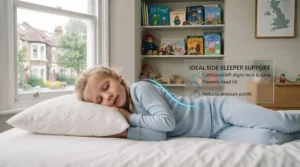
What is the best pillow for kids? In short, it’s a low-loft, breathable, hypoallergenic pillow sized for a child’s smaller frame, designed to keep the neck and spine roughly level rather than propped up or strained — never introduced before around 12 months, and only once your child has actually moved into a cot bed or toddler bed. Getting this right matters more than most parents realise, because a pillow that’s too tall, too firm, or too soft can nudge a growing neck out of its natural alignment.
We’ve spent time digging through real product specifications, genuine aggregated review sentiment from UK retailers and parenting communities, and official <cite index=”87-1″>NHS guidance, which advises against pillows and loose bedding for babies</cite>, to bring you seven pillows worth your money. This isn’t a rehashed Amazon listing — it’s honest analysis of who each pillow actually suits, where it falls short, and how to avoid wasting your cash on the wrong one. Whether you’re outfitting a two-year-old’s first toddler bed or hunting for something that survives a football-mad seven-year-old, there’s a match here. Let’s get into it.
Quick Comparison Table
| Pillow | Best For | Age Suitability | Price Range |
|---|---|---|---|
| ClevaMama ClevaFoam Toddler Pillow | Neck support & first pillows | 12 months+ | £15-£20 |
| Silentnight Safe Nights Anti-Allergy Pillow | Best budget overall | 12 months+ | Under £10 |
| KeaBabies My Little Dreamy Pillow | Kids pillow with pillowcase | 2-5 years | £15-£20 |
| Panda London Kids Memory Foam Bamboo Pillow | Premium memory foam support | 4 years+ | £40-£50 |
| The Little Green Sheep Organic Wool Pillow | Natural, allergy-conscious families | 12 months+ | £35-£45 |
| Woolroom Deluxe Washable Kids Cot Pillow | British wool alternative | 12 months+ | £25-£35 |
| Rohi Cot Bed Duvet and Pillow Set | Toddler pillow and blanket set | 12 months+ | £20-£30 |
Looking at the spread above, there’s a genuine budget-to-premium ladder here rather than seven versions of the same thing. The Silentnight Safe Nights Anti-Allergy Pillow anchors the value end and, according to aggregated parent reviews, punches well above its price point, while the Panda London Kids Memory Foam Bamboo Pillow sits at the top for families who want orthopaedic-grade support and don’t mind paying for a decade-long guarantee. If your child has never used a pillow before, starting cheap with something like the Silentnight or ClevaMama ClevaFoam Toddler Pillow is the sensible move — you can always upgrade once you know they’ll actually keep it on the bed.
💬 Just one click — help others make better buying decisions too!😊
Top 7 Best Pillows for Kids: Expert Analysis
Below is our detailed breakdown of seven real, currently available pillows, spanning budget, mid-range and premium options, plus a couple of clever variants — one that bundles in a pillowcase, and one that comes as part of a duvet set. Affiliate disclosure: this article contains affiliate links, and we may earn a small commission on qualifying purchases, at no extra cost to you.
1. ClevaMama ClevaFoam Toddler Pillow — best for genuine neck and spine support
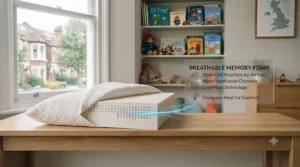
The standout here is the ClevaFoam itself — an open-cell foam developed with input from Trinity College Dublin, built specifically to reduce pressure points around a young head and neck. That research pedigree isn’t just marketing fluff; it’s the reason this pillow gets recommended so consistently by health visitors and paediatric physios alike.
Specification-wise, the pillow uses a breathable, PH-balanced open-cell structure with a removable, machine-washable cover, and the zip is reversed so it can’t catch on your child’s face during the night. Practically, that airflow design matters more than it sounds: standard foam traps heat, and an overheating toddler is a restless one. Based on the spec comparison with flatter fibre pillows, this one holds its shape night after night rather than flattening into a pancake by month three, which is a common complaint elsewhere in this category.
Reviewers consistently report that the ClevaFoam is soft enough for reluctant first-pillow-users but supportive enough that parents notice a difference in how settled their child sleeps, and the brand cites over 25,000 five-star ratings across retail platforms. It’s a strong pick for children with mild colds, congestion or reflux, where a very slightly raised, evenly supported head genuinely helps.
Pros:
- ✅ Foam developed with university research into spinal alignment
- ✅ Breathable open-cell structure reduces overheating
- ✅ Removable, machine-washable cover with face-safe zip
Cons:
- ❌ Pricier than basic fibre-filled alternatives
- ❌ Firmer feel may not suit children who prefer a plush pillow
At around £15-£20 in the mid-budget bracket, this is genuinely good value for a pillow with a real ergonomic rationale behind it — worth the extra over a basic fibre pillow if neck support is your priority.
2. Silentnight Safe Nights Anti-Allergy Cot Bed Pillow — best budget pillow overall
What most buyers overlook about this pillow is that “cheap” and “flimsy” aren’t the same thing here — it’s consistently rated as the best all-round toddler pillow by UK parenting communities despite sitting at the bottom of the price ladder. The standout feature is simply how well it balances slimness with genuine support for a small head.
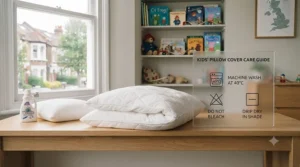
The pillow is filled with anti-allergy hollowfibre that’s approved by the British Allergy Foundation, machine washable at 40°C and tumble-dry safe, backed by a two-year manufacturer’s guarantee — a rarity at this price. Silentnight has been making British bedding for over 75 years, and that manufacturing scale shows in the consistency of the stitching and fill distribution, which matters more than it sounds when a three-year-old is using a pillow as a punchbag by day three.
Aggregated retailer review data describes it as “soft, breathable… praised for comfort, size and value,” though some buyers do find it a touch thin or soft for older, heavier sleepers, with mixed durability reported after repeated washing. This is honestly the pillow we’d recommend to most families buying their child’s very first pillow, purely because the financial risk of getting it wrong is so low.
Pros:
- ✅ British Allergy Foundation approved anti-allergy filling
- ✅ Two-year manufacturer’s guarantee at a budget price
- ✅ Machine washable and tumble-dry safe for easy care
Cons:
- ❌ Some reviewers find it too thin for older children
- ❌ Loft can flatten with frequent washing over time
At under £10, this is close to unbeatable value, and it’s the pillow we’d point a nervous first-time buyer towards without hesitation.
3. KeaBabies My Little Dreamy Pillow — best kids pillow with pillowcase included
If you’re specifically after a kids pillow with pillowcase bundled in, this is the standout of that sub-category, and the appeal is obvious the moment it arrives: no separate shopping trip for bedding that actually fits. The pillow measures roughly 33 x 46cm (13 x 18 inches), a genuinely toddler-proportioned size rather than a scaled-down adult pillow.
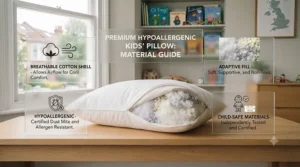
Both the pillow shell and the included pillowcase are made from organic cotton, certified to OEKO-TEX Standard 100 and GOTS organic standards, and the brand states it consulted a children’s chiropractor during the ergonomic design process. What most buyers overlook about “pillow with pillowcase” bundles generally is the sizing mismatch risk — buy them separately and you often end up with an ill-fitting case that bunches up under a sleeping head. This bundle sidesteps that entirely.
Genuine UK buyer reviews describe it as “a lovely size for a cot/toddler bed,” with parents noting it “supports the head very well” and that the included case is a welcome bonus rather than an afterthought. A minority of reviewers found the pillow narrower than expected, with one mentioning their toddler rolling off it during the night, so if your child is a restless sleeper, consider sizing up to the jumbo version.
Pros:
- ✅ Matching organic cotton pillowcase included, properly fitted
- ✅ GOTS and OEKO-TEX certified materials
- ✅ Ergonomic design consulted with children’s chiropractor
Cons:
- ❌ Standard size can feel narrow for wriggly sleepers
- ❌ Loft runs slightly higher than some parents expect
Priced around £15-£20, factoring in that you’re not buying a separate pillowcase, this represents solid value for parents who want a complete, ready-to-use set.
4. Panda London Kids Memory Foam Bamboo Pillow — best premium pick for real orthopaedic support
The standout advantage is straightforward: third-generation visco memory foam that actually contours to a child’s sleeping position, rather than the fibre-fill “flat by morning” experience most budget pillows offer. At 53 x 38 x 10cm, it’s noticeably taller and denser than anything else on this list, which is exactly the point for children who need consistent head and neck alignment through the night.
The cover blends bamboo viscose with polyester, is OEKO-TEX Standard 100 and CertiPUR certified, and complies with BS 7177 UK fire safety regulations for children’s bedding. Here’s what the spec sheet won’t tell you, but tester reviews consistently note: memory foam takes a few nights to adjust to, and it runs warmer than fibre pillows despite the “cooling bamboo” branding, because a solid foam core simply retains more heat than loose fill. Mother&Baby’s tester reported her daughter “very happy to go to bed every night” after the adjustment period, with the cover staying comfortably cool to the touch.
The genuinely compelling part of the value proposition is the 10-year guarantee paired with a 30-night home trial — a level of confidence budget brands simply can’t match, and one that should factor heavily into any long-term cost comparison.
Pros:
- ✅ Orthopaedic-grade memory foam holds its shape for years
- ✅ 10-year guarantee and 30-night trial reduce buying risk
- ✅ OEKO-TEX, CertiPUR and BS 7177 fire safety compliant
Cons:
- ❌ Noticeably firmer adjustment period than fibre pillows
- ❌ Among the most expensive options on this list
At roughly £40-£50, this sits firmly in premium territory, but the guarantee genuinely changes the cost-per-year maths in its favour — more on that later.
5. The Little Green Sheep Organic Wool Pillow — best natural, allergy-conscious pick
The standout feature is the filling itself: certified organic British wool, GOTS certified, made in the UK rather than imported and rebranded. For families actively avoiding synthetic foams and polyester fibre, this is one of the few genuinely natural options on the UK market sized specifically for cot beds.
Wool is naturally temperature-regulating, dust-mite resistant and hypoallergenic by virtue of its structure rather than a chemical treatment, which matters if your child reacts to the anti-allergy sprays used on some synthetic pillows. Based on the spec comparison, the 40 x 60cm size and BS 4578 compliance put it on par with other premium cot pillows, and it’s machine washable on a cold cycle (though it cannot be tumble dried, so factor drying time into laundry day).
Here’s the honest part: verified customer review data on this specific pillow is genuinely mixed, with at least one major UK retailer showing a notably lower average star rating than the brand’s other wool bedding lines, so this isn’t a universally beloved product the way some competitors are. What most buyers overlook is that natural wool pillows compress differently to foam or fibre — some children adapt instantly, others find the initial firmness needs a settling-in period. If your priority is organic, chemical-free materials over guaranteed instant comfort, it’s still a defensible premium choice.
Pros:
- ✅ Certified organic British wool, made in the UK
- ✅ Naturally hypoallergenic and temperature-regulating
- ✅ BS 4578 compliant and Baby Products Association approved
Cons:
- ❌ Review sentiment is mixed compared to rival premium pillows
- ❌ Cannot be tumble dried, extending laundry time
At around £35-£45, you’re paying a premium for provenance and material ethics as much as raw comfort, so weigh that trade-off honestly before buying.
6. Woolroom Deluxe Washable Kids Cot Pillow — best British wool alternative
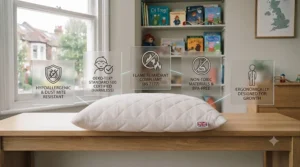
The standout here is the “deluxe washable” positioning — Woolroom built its reputation on solving wool bedding’s one real drawback, that it’s traditionally been fiddly to clean, by engineering a fully machine-washable version without sacrificing the natural fibre benefits. It’s handcrafted from 100% British wool, aimed squarely at families who want the Little Green Sheep-style natural credentials with an easier care routine.
Wool’s structure inherently resists dust mites and regulates temperature far better than synthetic fill, which is genuinely useful for a child who tends to sleep hot or has mild allergies. In practice, this means fewer 2am wake-ups over a damp, overheated pillow, something parents of restless sleepers will recognise instantly. Being marketed as travel-friendly also suggests a more compact, packable design than some bulkier wool competitors, useful for staying at grandparents’ or on holiday.
In honesty, independently verified customer review data for this specific model was limited at the time of our research, so rather than inventing sentiment we don’t have, we’d recommend checking the live reviews on the current listing before buying — what we can verify is the material specification and the brand’s broader reputation for quality British wool bedding, which is solid.
Pros:
- ✅ Fully machine-washable British wool construction
- ✅ Naturally hypoallergenic and breathable
- ✅ Compact, travel-friendly sizing
Cons:
- ❌ Verified customer review volume is currently limited
- ❌ Sits at a premium price point for a wool pillow
Expect to pay somewhere in the £25-£35 range, positioning it as a slightly more accessible natural-fibre alternative to the Little Green Sheep pillow above.
7. Rohi Cot Bed Duvet and Pillow Set — best toddler pillow and blanket set
The standout advantage of this one is convenience: rather than buying a duvet and pillow separately and hoping the tog rating and sizing line up, you get both in one coordinated 7.5 tog set, sized for a standard 120 x 150cm cot bed duvet. For parents setting up a toddler bed from scratch, that’s genuinely one less decision to agonise over at 11pm in a baby shop car park.
Both pieces use anti-allergy microfibre filling, are lightweight and breathable, and are machine washable, which matters enormously given how often toddler bedding needs an emergency wash. The 7.5 tog rating sits at the warmer end for a toddler duvet, so it suits autumn-to-spring use in most UK homes better than height of summer, when you’d want to swap to a lighter set or drop the duvet in favour of a sleeping bag.
As with the Woolroom pillow above, we want to be upfront: detailed, verified review sentiment specifically for this bundle wasn’t something we could confirm during research, so treat our take here as honest analysis of the specification rather than a report on lived customer experience. What we can say with confidence is that duvet-and-pillow sets like this solve a genuine practical problem — colour and tog mismatches between separately bought pieces — even if you should still check current buyer feedback before committing.
Pros:
- ✅ Matched pillow and duvet removes sizing guesswork
- ✅ Anti-allergy microfibre filling throughout
- ✅ Fully machine washable for easy care
Cons:
- ❌ 7.5 tog may run warm for summer months
- ❌ Limited independently verified review data currently available
At roughly £20-£30 for the set, it’s competitively priced against buying a comparable duvet and pillow separately, and it’s a sensible option if you’re kitting out a toddler bed in one go.
Setting Up Your Child’s First Pillow: A Practical Guide
Getting the pillow itself right is only half the job — how you introduce it matters just as much. Rushing this stage is where most of the “my toddler won’t keep their pillow on the bed” complaints actually come from.
Start no earlier than 12 months, and ideally only once your child has moved from a cot to a cot bed or toddler bed with the sides down, since <cite index=”87-1″>the NHS specifically advises against pillows and loose bedding for babies</cite> in a standard cot. In the first week, introduce the pillow during daytime naps rather than overnight sleep, so you can observe how your child actually uses it — some toddlers hug it, some kick it to the floor entirely, and both are normal. Wash the cover before first use, even on a brand-new pillow, since manufacturing residue can occasionally irritate sensitive skin. For the first month, expect the pillow to migrate around the cot bed; this is developmentally normal and not a sign you’ve bought the wrong product. A common mistake is buying a full-size adult pillow “so they get more use out of it” — resist this, since an oversized pillow pushes a small neck out of alignment far more than a correctly sized one ever would. Finally, set a loose washing routine — every one to two weeks for the cover, and every few months for a full pillow wash if the label allows it — because toddler pillows accumulate drool, spilled milk and the occasional biscuit crumb at a genuinely alarming rate.
Real-World Scenarios: Which Pillow Actually Suits Your Child?
Specs only tell half the story, so here’s how three common family situations map onto the products above. If you’re a parent with a two-year-old just transitioning out of the cot, on a tight budget, and mainly wanting something safe and simple, the Silentnight Safe Nights Anti-Allergy Pillow is the obvious starting point — low financial risk, low pressure to “get it right” first time. If you’re dealing with a child who suffers from eczema, hay fever or dust mite sensitivity, the natural-fibre route via The Little Green Sheep Organic Wool Pillow or the Woolroom Deluxe Washable Kids Cot Pillow makes more sense than anything synthetic, even at a higher price point, because you’re solving a genuine medical comfort issue rather than a preference. And if you’re outfitting an older child, say five or six, who’s outgrown their toddler pillow and complains of neck stiffness after sleepovers or long car journeys, the Panda London Kids Memory Foam Bamboo Pillow earns its premium price through genuine orthopaedic support and a guarantee that spans most of their remaining childhood. Matching the pillow to the actual problem you’re solving, rather than simply the cheapest or most popular option, tends to produce far better results.
What Is the Best Pillow for Kids?
The best pillow for kids is a low-loft, breathable, hypoallergenic pillow proportioned for a child’s smaller head and shoulders, introduced no earlier than 12 months and only once they’re in a cot bed or toddler bed. It should keep the neck roughly level with the spine rather than tilting it upward or letting it sink too low, and it should be genuinely washable, since children’s pillows get considerably dirtier than adult ones.
Pillow Size by Age: A Simple Chart
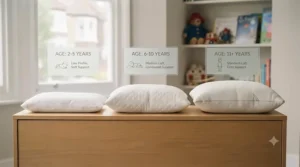
Sizing confusion is one of the most common mistakes we see, so here’s a straightforward pillow size by age reference based on typical UK product ranges.
| Age | Typical Pillow Size | Loft (Height) | Notes |
|---|---|---|---|
| Under 12 months | No pillow | N/A | NHS advises against pillows for babies |
| 1-2 years | 30-40cm x 40-46cm | Very low, 2-4cm | Thin, soft, easily compressible |
| 2-4 years | 40cm x 60cm (cot bed) | Low-medium, 4-6cm | Standard toddler pillow size |
| 4-8 years | 40cm x 60cm to 48cm x 74cm | Medium, 6-10cm | Transition toward standard sizing |
| 8+ years | Standard adult, 48cm x 74cm | Medium-high, per preference | Firmness now matters more than size |
Reading across the chart, the jump between the 2-4 and 4-8 age brackets is where most parents get caught out, buying a “big kid” pillow years before it’s actually needed because a sibling or friend already has one. A pillow that’s too large for a child’s frame does the opposite of what you want, tilting the neck at an angle rather than supporting it — so when in doubt, size down rather than up, and only upgrade once your child has visibly outgrown their current pillow in width, not just in age.
Support for Your Child’s Neck Development: What the Evidence Says
This is where a lot of pillow marketing overpromises, so let’s be precise about what’s actually established. Consistent, correctly aligned sleep posture supports healthy resting muscle tone in the neck and shoulders, and <cite index=”103-1″>poor posture over time can put unnecessary strain on the neck’s joints and tissues</cite>, according to NHS guidance for children and young people. A well-fitted pillow is one small piece of that puzzle, not a cure-all — the bulk of postural development actually happens during waking hours, through play, movement and how a child sits and carries their school bag, not through eight hours of sleep.
That said, what most buyers overlook is that an incorrectly sized pillow can actively work against good posture rather than neutrally doing nothing. A pillow that’s too high pushes the chin toward the chest and can restrict breathing comfort; one that’s too flat offers no support at all and lets the head tip backward on its side. The Physiotherapy Kids team notes that the best sleeping position for children is one that maintains neutral neck and spine alignment, which is the practical justification behind every low-loft, correctly proportioned pillow on this list. If your child regularly complains of neck stiffness that doesn’t resolve after switching to a properly sized pillow, that’s a conversation for your GP or health visitor, not something to solve with an ever-firmer foam pillow.
Safe Sleep Guidelines for Children: What Parents Need to Know
Before any pillow enters the conversation, safe sleep guidelines for children need to be front and centre, because the rules genuinely change with age. For babies under 12 months, <cite index=”88-2″>official guidance is unambiguous: do not use duvets, pillows, cot bumpers, pods or nests, or soft toys where a baby is sleeping</cite>, since these increase the risk of overheating and Sudden Infant Death Syndrome. This isn’t overly cautious box-ticking; it’s based on decades of international research and it’s the single most important guideline on this entire page.
Once your child moves into a toddler bed, typically somewhere between 18 months and three years depending on the individual child, a thin, appropriately sized pillow becomes reasonable, provided your child can move freely and isn’t hemmed in by bulky bedding. For a broader safety checklist covering the whole sleep environment, NHS advice on reducing the risk of Sudden Infant Death Syndrome remains the definitive UK reference, and it’s worth revisiting even once your child is well past babyhood, since several of its temperature and bedding-weight principles still apply to toddlers. Every pillow featured in this guide is explicitly marketed as suitable from 12 months onward, in line with this guidance — never introduce a pillow earlier, regardless of how enticing a “newborn pillow” product might look online.
Children’s Pillow Age 2+: When Is It Time for a Pillow?
There’s no single magic birthday for this. A children’s pillow age 2+ recommendation is common across UK retailers, but readiness genuinely varies by child, and rushing it rarely goes well. The clearest signal is behavioural, not chronological: your child has moved into a cot bed or toddler bed with the sides removed, sleeps in a relatively stable position rather than rolling constantly, and shows active interest in using one, often by borrowing yours. Some children are ready at 14 months; others happily sleep pillow-free until three or four, and both are entirely normal. If in doubt, introduce a very low-loft option like the Silentnight Safe Nights Anti-Allergy Pillow first, since the financial and adjustment risk is minimal, and observe rather than force the transition.
Kids Pillow with Pillowcase: Does the Bundle Actually Matter?
It’s a fair question whether paying extra for a kids pillow with pillowcase bundle is worth it over buying separately. In practice, yes, more often than not — cot bed and toddler pillow sizes aren’t fully standardised across brands, so a separately bought pillowcase can end up baggy, bunched, or requiring an awkward fold to fit. Bundles like the KeaBabies My Little Dreamy Pillow guarantee a correct fit from the outset, and the matching print often becomes part of the appeal for the child themselves, who may be more willing to accept an unfamiliar new pillow if the case features a favourite colour or character. The trade-off is reduced flexibility: if you later want to coordinate the pillowcase with a specific duvet set, a bundled case might clash, so factor your existing bedding into the decision.
Toddler Pillow and Blanket Set: Worth Buying as a Bundle?
Similar logic applies to a toddler pillow and blanket set like the Rohi Cot Bed Duvet and Pillow Set. The genuine value-add is tog and sizing coordination — buying a duvet and pillow together removes the guesswork of matching thickness and dimensions, which matters more than shoppers often assume, since an overly warm duvet paired with a bulky pillow can contribute to overheating, one of the risk factors flagged repeatedly in NHS sleep guidance. The downside is less choice over individual components; if your child needs a specifically low-loft pillow but a warmer-than-average duvet for a chilly bedroom, a fixed bundle won’t accommodate that as well as buying pieces separately would.
Common Mistakes When Buying a Pillow for Kids
The single biggest mistake, by a wide margin, is introducing a pillow too early, before 12 months, driven by a well-meaning but misguided instinct that a baby “looks uncomfortable” without one. A close second is buying based on price alone without checking the fill and cover materials — the cheapest fibre pillows can flatten within weeks, effectively costing more per year of use than a mid-range option that lasts. Parents researching options on Mumsnet’s toddler pillow reviews consistently flag a third mistake: buying an adult-sized pillow “so it lasts longer,” which, as covered above, actually works against correct neck alignment rather than for it. A fourth common error is ignoring wash instructions until the pillow is genuinely grim — many toddler pillows need a specific low-heat or no-tumble-dry approach, and getting this wrong shortens the product’s life dramatically. Finally, some parents skip checking for anti-allergy or hypoallergenic certification entirely, only to discover an issue after their child develops a reaction, when checking the OEKO-TEX or British Allergy Foundation credentials up front would have avoided it.
Pillows for Kids vs Adult Pillows
| Feature | Kids Pillow | Adult Pillow | Best For |
|---|---|---|---|
| Typical Loft | 2-8cm | 10-15cm+ | Kids pillow for correct neck angle |
| Sizing | 30-60cm range | Standard 48x74cm | Kids pillow matches smaller frame |
| Firmness | Soft to medium | Wide range | Kids pillow for gentler support |
| Wash Frequency Needed | Weekly-fortnightly | Monthly | Kids pillow built for frequent washing |
| Certifications | Anti-allergy common | Varies | Kids pillow typically higher hypoallergenic focus |
The table makes the core issue obvious: an adult pillow simply isn’t engineered for a child’s proportions, and using one “because it’s already in the house” tends to create the exact postural problems parents are trying to avoid. Kids pillows are also built around a much higher washing frequency by design, using covers and fills that tolerate weekly laundering without breaking down, which adult pillows generally aren’t optimised for. If you’re tempted to skip buying a dedicated children’s pillow to save money, this comparison is the honest reason not to.
✨ Don’t Miss These Exclusive Deals!
🔍 Take your child’s bedtime routine to the next level with one of these carefully selected pillows. Click through to check current pricing and availability, and give your little one the comfortable, well-supported sleep they deserve tonight.
Long-Term Cost & Maintenance
Judging these purely on sticker price misses the real picture. A £7 Silentnight Safe Nights pillow that needs replacing every 8-12 months as it flattens works out at roughly £7-£14 a year. A £45 Panda London pillow backed by a genuine 10-year guarantee, by contrast, could realistically cost under £5 a year averaged across its usable life, assuming the cover is replaced once or twice along the way. That’s the honest ROI case for premium pillows: it’s not always about immediate comfort, it’s about total cost of ownership over several years of use. Maintenance-wise, budget pillows generally tolerate rougher, more frequent washing without much thought, while premium foam and wool pillows often need more careful, lower-temperature care to protect their guarantee terms — factor the time cost of that into your decision if you’re already stretched for laundry time.
FAQ
❓ What age can a child start using a pillow?
❓ How often should I wash my child's pillow?
❓ Is memory foam safe for toddlers?
❓ What size pillow does a 2 year old need?
❓ Do toddler pillows need to be hypoallergenic?
Conclusion
If there’s one takeaway from all this, it’s that the best pillow for kids genuinely does depend on your specific child, not a single universal winner. For most families starting out, the Silentnight Safe Nights Anti-Allergy Pillow remains the sensible, low-risk first purchase — it’s cheap enough that getting it “wrong” costs you almost nothing, and the aggregated review sentiment backs it up as a genuine crowd favourite. If your child has allergy concerns or you’re committed to natural materials, The Little Green Sheep Organic Wool Pillow or the Woolroom Deluxe Washable Kids Cot Pillow are honest, well-specified choices, even if their review data is thinner than the more mainstream options. And for families ready to invest properly in years of consistent support, the Panda London Kids Memory Foam Bamboo Pillow, with its ten-year guarantee, makes a genuinely strong long-term cost case despite the higher upfront price.
Whichever you choose, the fundamentals matter more than the brand name: never introduce a pillow before 12 months, size it correctly for your child’s age rather than buying for growing room, and check the wash care instructions before you’re three weeks in and desperate. Get those three things right, and pretty much any pillow on this list will serve your family well.
✨ Don’t Miss These Exclusive Deals!
🔍 Ready to pick the perfect pillow? Check current pricing on any of today’s featured products and treat your little one to a genuinely better night’s sleep, starting tonight.
Recommended for You
- Leg Elevation Pillow Bed Bound: 7 Best Picks for 2026
- Pressure Sore Prevention Pillow: 7 Genuine Picks for 2026
- Pillow for Bed Bound Patients: 7 Best Picks for 2026 (UK Guide)
Disclaimer: This article contains affiliate links. As an Amazon Associate, I earn from qualifying purchases. If you purchase products through these links, we may earn a small commission at no additional cost to you.
✨ Found this helpful? Share it with your friends! 💬🤗
