
In This Article
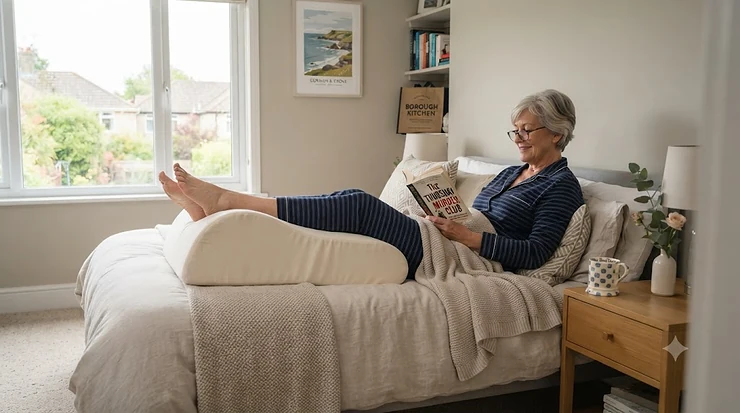
Anyone who has cared for someone who cannot get out of bed knows that “just prop their legs up” is easier said than done. A leg elevation pillow bed bound patients can actually keep in place — one that doesn’t slide off, go flat by week three, or leave heels dangling awkwardly off the edge — is a different animal entirely from the flimsy wedge gathering dust in most linen cupboards. Whether you’re nursing a relative through a hip replacement, managing a parent’s chronic oedema, or kitting out a care home room, the right pillow does real clinical work: it takes pressure off the sacrum and heels, helps fluid drain, and can make the difference between a peaceful night and one spent adjusting cushions every twenty minutes.

What is a leg elevation pillow bed bound patients need, specifically? At its simplest, it’s a firm, wedge- or contour-shaped foam support, typically 15–25cm high, positioned under the calves and heels to raise the legs above heart level while lying flat in bed. Unlike a stack of ordinary pillows, which compress and slump within an hour, a purpose-built elevation pillow holds its angle all night — something that matters enormously for anyone managing swelling, circulation problems, or recovery from leg surgery.
This guide draws on real product specifications, aggregated genuine customer feedback, and current NHS and clinical guidance to walk you through seven genuinely good options available through Amazon UK and specialist retailers, plus the practical know-how — set-up, common mistakes, and buyer-type advice — that no product listing gives you. We’ll also touch on related needs, from wedge elevation pillow care home procurement to upper body elevation pillow bed bound setups for reflux and breathing comfort. As always with Amazon UK listings, treat any price you see as a snapshot — check current price before buying, since these fluctuate constantly.
Quick Comparison Table
| Pillow | Best For | Height | Price Range |
|---|---|---|---|
| Putnams Memory Foam Leg Raiser | NHS-style therapeutic elevation | 20cm | £60–£80 range |
| Putnams Bed Wedge (Triangular) | Dual leg + upper body use | 15cm | £45–£65 range |
| NRS Healthcare Repose Positioning Wedge | Vascular conditions, care settings | 15–20cm | £35–£55 range |
| NRS Healthcare Supportive Bed Wedge | Budget multi-position support | 20cm | Under £40 |
| Milliard Bed Wedge Pillow | Best-selling all-rounder | 20–30cm | £35–£55 range |
| Foam Bed Positioning Leg Elevation Pillow (hospital-grade) | Care homes, hospital beds, bariatric use | 15–20cm | £35–£90 range |
| Contour Legacy Leg & Knee Support Pillow | Side-lying comfort with elevation | 15cm | £30–£45 range |
Looking at the spread above, there’s a clear pattern: the more clinically specific a pillow’s design (contoured heel cut-outs, vascular-condition shaping, hospital-bed sizing), the more you’ll typically pay, while the general-purpose wedges cluster around the budget-to-mid range. For bed-bound care specifically, height matters more than most buyers expect — too low and you’re not achieving meaningful elevation above heart level; too high and circulation to the popliteal area (behind the knee) can actually be restricted. Putnams Memory Foam Leg Raiser and the Foam Bed Positioning Leg Elevation Pillow sit at the more specialist, clinically-shaped end, while NRS Healthcare Supportive Bed Wedge and Milliard Bed Wedge Pillow are more general-purpose and versatile across use cases.
💬 Just one click — help others make better buying decisions too!😊
Top 7 Leg Elevation Pillows for Bed-Bound Care: Expert Analysis
1. Putnams Memory Foam Leg Raiser — NHS-recommended memory foam comfort
The standout feature here is straightforward: this is one of the few leg elevation pillows on the UK market that’s actually used within NHS settings, not just marketed alongside NHS branding. Made in the UK from CertiPUR-certified foam with a one-inch memory foam top layer, the Putnams Memory Foam Leg Raiser measures 66cm x 50.5cm x 20cm and is contoured to follow the natural curve of the lower leg rather than forcing it flat against a plain wedge. In practice, that contour matters more than it sounds — a flat wedge concentrates pressure under the calf and heel, while a shaped one distributes weight across a wider surface, which is exactly the kind of pressure-relief logic that underpins NHS guidance on avoiding sustained point-loading in immobile patients.
Based on the spec comparison with flatter, unshaped wedges, this is best suited to people managing chronic oedema, phlebitis, varicose vein discomfort, or early-stage pressure area risk, where the heel needs to hang free of the mattress rather than dig into firm foam. Reviewers of Putnams products consistently mention the foam’s slow recovery and the fact it doesn’t flatten the way cheaper polyfoam wedges do within a few months, which lines up with the CertiPUR-certified spec sheet. The two-year guarantee also signals a manufacturer confident in the product’s durability under daily use — worth noting for care settings where pillows see near-constant wear.
Pros:
- ✅ Contoured shape reduces heel and calf pressure points
- ✅ UK-manufactured with CertiPUR-certified foam and 2-year guarantee
- ✅ Washable, removable poly-cotton cover included
Cons:
- ❌ Sits at the premium end of the price range
- ❌ Single fixed height, no adjustability for different leg lengths
At around the £60–£80 range, the Putnams Memory Foam Leg Raiser isn’t the cheapest option here, but for anyone managing a genuine medical need rather than occasional comfort, the contoured design and NHS-adjacent credibility make it a strong value pick — check current price on Amazon UK or via Putnams directly before buying.
2. Putnams Bed Wedge (Triangular) — three-in-one leg, back and upper body elevation
The standout advantage of the Putnams Bed Wedge is versatility: it’s a genuinely triangular 15cm-high wedge designed to work in three completely different positions — under the pillow for upper body elevation, upright against a headboard for back support, or flipped to the foot of the bed for leg elevation. For a household managing multiple needs (say, a bed-bound relative with both reflux and swollen ankles), that flexibility can save buying two separate products.
The 15cm height sits within the range that NHS-aligned guidance on reflux and sleep positioning generally recommends, and the high-density foam is built to resist the flattening that ordinary pillows suffer within weeks. What most buyers overlook about a triangular wedge is that the same incline serving your upper body for acid reflux is often too shallow, on its own, for serious leg swelling — in those cases, this wedge does better paired with a dedicated calf-height leg raiser rather than as a stand-alone solution for significant oedema. Aggregated customer sentiment around Putnams wedges is generally positive on comfort and shape retention, with occasional notes that the standard foam option feels firmer than shoppers coming from a soft mattress-topper mindset might expect.
Pros:
- ✅ Genuinely multi-purpose — leg, back or upper body use
- ✅ High-density foam holds its incline over time
- ✅ Available with memory foam or latex top upgrades
Cons:
- ❌ Standard foam version can feel firm to first-time users
- ❌ Less leg-specific contouring than dedicated leg raisers
In the £45–£65 range depending on foam option, the Putnams Bed Wedge earns its keep through flexibility rather than specialism — a smart pick for households juggling more than one positioning need from a single piece of kit.
3. NRS Healthcare Repose Positioning Wedge — purpose-built for vascular conditions
What sets the NRS Healthcare Repose Positioning Wedge apart is that it’s explicitly designed around vascular need rather than general comfort — NRS Healthcare is a long-established UK mobility and disability aids supplier, and this wedge is specifically positioned as a tool to help prevent and manage circulatory conditions in the legs. The firm foam core is angled to elevate the lower leg while allowing the foot to remain relatively neutral, which matters for anyone whose ankles swell but who also needs to avoid excessive plantar-flexion (toes pointing down) overnight.
Here’s what to weigh: this isn’t the softest or most luxurious option on this list, and it isn’t trying to be. It’s built for functional, repeated clinical use — the kind of wedge a district nurse or care worker would recognise on sight. For a family carer supporting someone with venous insufficiency or early lymphoedema, that clinical pedigree, backed by a brand widely used across NHS-adjacent community equipment loan services, is arguably more reassuring than a plush memory foam alternative. Reviewers of NRS Healthcare wedge products in this category tend to note that the firmness, while less cushioned than premium foam options, correlates with better long-term shape retention.
Pros:
- ✅ Designed specifically for vascular and circulatory support
- ✅ Firm foam maintains angle without sagging
- ✅ Recognised UK healthcare-sector brand
Cons:
- ❌ Firmer feel than memory-foam alternatives
- ❌ Basic cover options compared with premium competitors
Priced in the £35–£55 range, the NRS Healthcare Repose Positioning Wedge is a sensible mid-range pick for anyone whose GP or district nurse has specifically flagged circulation as the priority.
4. NRS Healthcare Supportive Bed Wedge — budget-friendly multi-position support
The standout here is accessibility: this is a genuinely affordable entry point into properly firm, purpose-shaped positioning foam, rather than a compromise product. The NRS Healthcare Supportive Bed Wedge is a foam wedge designed for upright or reclining positioning — behind the upper body for sitting up in bed, under the knees sloping downward, or at the foot of the bed to raise the feet and relieve swelling and fatigue.
On paper this means a genuinely multi-role product at a price point that makes it realistic to buy two (one for each end of the bed, or a spare for a second household member) without a significant outlay. Reviewers consistently mention that it’s noticeably firmer than a standard pillow and holds up well over months of use, though a small number of buyers have noted the foam carries a temporary odour on first unpacking that airs out within a day or two, and that it can feel a little high for smaller-framed users — in which case using it foot-up rather than foot-down is a simple workaround. For care-home procurement on a tighter per-resident budget, or for a family trying more than one positioning approach before committing to a premium product, this is a genuinely useful stepping stone.
Pros:
- ✅ Genuinely low price point for a purpose-built wedge
- ✅ Multiple use positions from a single product
- ✅ Removable, washable Proban-treated cotton cover
Cons:
- ❌ New-foam odour reported by some buyers initially
- ❌ Can feel too high for smaller or shorter users
At under £40 in most cases, the NRS Healthcare Supportive Bed Wedge represents the strongest value-for-money entry on this list for anyone testing whether elevation genuinely helps before investing further.
5. Milliard Bed Wedge Pillow — best-selling all-rounder on Amazon UK
The Milliard Bed Wedge Pillow stands out for sheer market presence: Milliard has built a long track record as one of the most consistently best-selling bed wedge brands on Amazon UK, with a memory foam top layer bonded to a firmer high-density foam base — a two-layer construction intended to combine cushioning comfort with the structural firmness needed to actually hold an elevation angle overnight.
Based on the spec sheet, the memory foam top layer is the meaningful upgrade over single-density foam wedges: it contours slightly around the calf and heel rather than presenting one flat plane, reducing point pressure in a way that matters over an eight-hour night. What the spec sheet won’t tell you, but the sheer volume of long-standing sales suggests, is that this product has proven durable enough to become a repeat purchase across a very wide range of buyers — from acid-reflux sufferers to those managing leg swelling — which is a reasonable, if indirect, signal of reliability. Verified individual review breakdowns specific to leg-elevation use weren’t available in our research, so treat this as a strong general-purpose pick rather than one engineered around a single clinical need.
Pros:
- ✅ Two-layer memory foam and high-density foam construction
- ✅ Long-established bestseller with wide size availability
- ✅ Breathable, washable cover
Cons:
- ❌ Not shaped specifically for calf or heel contouring
- ❌ Individual leg-elevation review data is limited
In the £35–£55 range depending on size, the Milliard Bed Wedge Pillow is a sound, low-risk choice if you want a well-established brand without committing to a highly specialised, clinically-shaped product.

6. Foam Bed Positioning Leg Elevation Pillow (hospital-grade) — sized for hospital beds and bariatric care
The standout feature of this hospital-supply-grade wedge is scale: it’s specifically manufactured and sold through UK hospital and care-equipment suppliers, available in standard and large sizes to accommodate both single-person home care and bariatric or larger-frame patients — something most consumer Amazon listings simply don’t offer. The firm foam inner is designed for durability under frequent repositioning and cleaning cycles, which matters enormously in care home settings where a wedge might be used, wiped down, and repositioned multiple times per shift.
Here’s what to weigh: this is a functional, no-frills clinical tool rather than a home-comfort product, and it’s priced and specified accordingly — the large size, aimed at bariatric use or a more dramatic incline, sits notably above the standard size. For care home procurement teams or families supporting a larger-framed relative, the availability of a genuinely larger size solves a real gap that most consumer wedges leave unaddressed, since standard foam wedges can bottom out or shift under higher body weight. As with most hospital-supply items, individually verified customer review data is harder to source publicly than for mainstream Amazon listings, so this recommendation rests primarily on the specification and its established use in NHS and care-home procurement channels rather than aggregated star ratings.
Pros:
- ✅ Genuine large/bariatric size option available
- ✅ Built for frequent care-home cleaning and repositioning
- ✅ Multifunctional design for raiser or general mobility use
Cons:
- ❌ Basic cover, less plush than consumer memory foam wedges
- ❌ Large size priced significantly above standard
Pricing spans a wide £35–£90 range depending on size and finish, making this one to check current price on carefully — the standard size competes with budget options, while the large/bariatric version sits at the premium end for good reason.
7. Contour Legacy Leg & Knee Support Pillow — contoured comfort for side-lying elevation
The standout feature of the Contour Legacy Leg & Knee Support Pillow is its shaped, ergonomic profile — rather than a plain wedge, it’s moulded to cradle the leg and knee together, which makes it a strong option for bed-bound patients who spend significant time side-lying rather than flat on their back, where a straight wedge doesn’t sit as naturally between or under the legs.
The 15cm foam profile is lower than several dedicated leg raisers on this list, so on its own it delivers gentler elevation rather than the more aggressive angle needed for significant oedema or DVT-risk management — but paired with side-lying positioning, it does double duty as a joint-alignment aid, easing pressure on hips and knees while offering some elevation benefit. Based on the spec comparison, this makes it a complementary product rather than a sole solution for someone whose primary need is maximum leg elevation; it shines for comfort and joint support during the many hours a bed-bound patient spends repositioned onto their side, which NHS pressure-area guidance recommends doing regularly. Contour Living has an established reputation in the side-sleeper support category, though specific verified review data for leg-elevation-focused use in bed-bound care is limited.
Pros:
- ✅ Contoured shape ideal for side-lying positioning
- ✅ Doubles as knee and hip pressure relief
- ✅ Established, reputable support-pillow brand
Cons:
- ❌ Lower elevation angle than dedicated wedges
- ❌ Less effective as a stand-alone oedema solution
At around £30–£45 in the range, the Contour Legacy Leg & Knee Support Pillow works best as a second product alongside a taller wedge, rather than the only elevation aid in the room.
Practical Usage Guide: Setting Up Leg Elevation Correctly
Getting a leg elevation pillow bed bound patient positioned correctly is less obvious than it looks. First, place the pillow so the highest point sits under the calf, not directly under the knee joint — pressure directly behind the knee (the popliteal fossa) can actually restrict blood flow, which defeats the purpose entirely. The heel should ideally hang slightly off the end of the pillow or rest in a contoured cut-out, since heels are one of the most common sites for pressure damage in immobile patients.
For the first 30 days, check the skin at the heel and calf daily for redness that doesn’t fade within 20–30 minutes of repositioning — this is standard NHS pressure-area monitoring practice and applies just as much to elevation pillows as to mattresses. A common early mistake is leaving the same pillow position for many hours straight; even with elevation, periodic repositioning (as covered below) remains essential. For maintenance, most foam wedges benefit from an occasional airing out of the cover — remove and wash according to the label, and check the foam core isn’t developing permanent indentations, which signals it’s time to replace it. Rotating between two products, if you have them, extends the working life of each and reduces the “always-on-one-spot” wear pattern.
✨ Ready to build a proper positioning set-up?
🔍Explore our top picks above and check current pricing before you order! 🛏️
Real-World Scenarios: Matching the Pillow to the Person
Consider three genuinely different situations. First, a woman in her late seventies recovering at home after a knee replacement, mobile enough to reposition herself but needing consistent elevation for the first fortnight to control swelling — for her, the Putnams Memory Foam Leg Raiser or Milliard Bed Wedge Pillow offers the comfort and consistency she’ll be using nightly for weeks, without the clinical starkness of a hospital-supply product.
Second, a care home resident with limited mobility, chronic venous insufficiency, and a daily repositioning schedule managed by staff across multiple residents — here, durability and ease of wipe-down cleaning outweigh plushness, making the NRS Healthcare Repose Positioning Wedge or the standard-size Foam Bed Positioning Leg Elevation Pillow the more sensible procurement choice, since staff need something that survives repeated handling without degrading.
Third, a family caring for a larger-framed relative recovering from a stroke, bed-bound and needing both upper body elevation for safe swallowing and comfortable breathing, and separate leg elevation to manage oedema from reduced mobility — this household likely needs two products working together: the Putnams Bed Wedge positioned under the pillow for upper body support, and the large-size Foam Bed Positioning Leg Elevation Pillow at the foot of the bed, given the bariatric sizing need.

Problem → Solution: Common Leg Elevation Challenges
Problem: the pillow keeps sliding down the bed. This usually happens on slippery duvet covers or with lightweight foam. Solution: choose a wedge with a non-slip base, such as those with rubberised or grippy fabric undersides, or place a thin non-slip mat beneath it.
Problem: swelling isn’t improving despite nightly elevation. Elevation helps but isn’t a cure-all for oedema with an underlying medical cause. Solution: continue elevation as one part of a broader routine — gentle ankle exercises, correctly fitted compression if prescribed, and a GP review if swelling persists beyond a few weeks, as the NHS advises.
Problem: the pillow has gone flat within a few months. This typically signals low-density foam under sustained nightly weight. Solution: check the foam density spec before buying — CertiPUR-certified or high-density foam products like the Putnams Memory Foam Leg Raiser are built to resist this specific failure mode.
Problem: discomfort behind the knee after using the pillow. This suggests the elevation point is too far up the leg. Solution: reposition so the peak height sits under the calf muscle, not the knee joint itself.
Problem: heel pressure marks appearing. Solution: look for a pillow with a contoured heel cut-out, such as the Putnams Memory Foam Leg Raiser or Contour Legacy Leg & Knee Support Pillow, or add a small additional heel-relief cushion.
How to Choose a Leg Elevation Pillow for a Bed-Bound Patient
- Match the height to the medical need. Mild comfort and fatigue relief needs less incline than active DVT prevention or post-surgical oedema management — 15cm suits general comfort, while 20cm-plus is more common for therapeutic use.
- Prioritise foam density over softness. A pillow that compresses under nightly weight stops doing its job within weeks; check for high-density or CertiPUR-certified foam specifications.
- Consider contouring for heel and calf protection. Flat wedges concentrate pressure; shaped products distribute it, which matters for anyone at pressure-area risk.
- Check sizing against body frame. Bariatric or larger-frame patients need genuinely wider, taller products rather than standard sizing stretched to fit.
- Factor in cleaning frequency. Care home and shared-care settings need wipeable, washable, quick-drying covers far more than home users typically realise.
- Weigh versatility against specialism. A triangular multi-position wedge suits varied needs; a purpose-shaped leg raiser suits a single, specific clinical priority.
- Verify the guarantee and return policy. A genuine multi-year guarantee, as offered on several Putnams products, is a reasonable proxy for manufacturer confidence in foam longevity.
Common Mistakes When Buying a Leg Elevation Pillow
The most frequent mistake is buying based on price alone and ending up with a low-density foam wedge that flattens within two or three months — a false economy once you factor in the cost of replacing it. A close second is buying a single pillow to solve two entirely different problems (upper body reflux comfort and lower leg oedema), when these genuinely need either a dual-position product like the Putnams Bed Wedge or two separate pillows entirely.
Buyers also frequently overlook cover material until after purchase — a fabric that traps heat can be genuinely uncomfortable for someone in bed for extended periods, and a cover that isn’t machine washable becomes a hygiene headache fast, particularly relevant for anyone managing incontinence alongside immobility. Finally, many people underestimate how much height variation matters between individuals: a 20cm pillow that’s ideal for one person may feel excessive for someone shorter or with more limited hip flexibility, so checking exact measurements against the individual’s needs — not just the product category — avoids a costly wrong purchase.
Wedge Pillows vs Adjustable Profiling Beds
For anyone managing bed-bound care long-term, it’s worth understanding how a foam wedge compares with an adjustable profiling bed (one with a powered, tilting leg section).
| Factor | Foam Wedge Pillow | Adjustable Profiling Bed |
|---|---|---|
| Upfront cost | £30–£90 range | Several hundred pounds upward |
| Adjustability | Fixed angle per product | Continuously variable |
| Portability | Fully portable | Fixed installation |
| Best for | Short-to-medium term care, flexible households | Long-term, permanent bed-bound care |
The comparison makes the trade-off fairly clear: a wedge pillow wins decisively on affordability and flexibility, letting a household adapt care at home without committing to major equipment, while an adjustable profiling bed offers precision and hands-free repositioning that becomes genuinely valuable once care needs are long-term and stable. In practice, many care homes and long-term home-care set-ups use both together — a profiling bed for the base elevation and a foam wedge like the NRS Healthcare Repose Positioning Wedge layered on top for extra height or contouring the bed’s mechanism alone can’t provide.

What to Expect: Real-World Comfort and Performance
Specs only tell part of the story. In practice, most well-made leg elevation pillows take a night or two to feel completely natural — much like a new mattress, there’s a settling-in period where the body adjusts to a consistent incline rather than the variable comfort of stacked pillows. Reviewers across this product category commonly report that the biggest quality-of-life improvement isn’t dramatic overnight — it’s the absence of the constant readjustment that ordinary pillows demand, since a proper wedge holds its shape through a full night’s movement.
Expect a genuine, noticeable difference in morning swelling within the first week for people managing mild-to-moderate oedema, though more significant medical swelling will still need the broader management the NHS recommends, including movement, compression where appropriate, and medical review. For post-operative use, most people report the pillow becomes far less necessary once mobility and normal circulation return, typically over several weeks, which is a useful marker for when to scale back nightly use.
Leg Elevation Pillows for Care Homes and Domiciliary Carers
Procuring a wedge elevation pillow care home teams can rely on daily is a different exercise from buying one for personal home use. Durability under repeated cleaning is the priority — foam that degrades after a handful of hot washes or antibacterial wipe-downs becomes a false economy fast across a whole facility, so products like the Foam Bed Positioning Leg Elevation Pillow and NRS Healthcare Supportive Bed Wedge, both designed with institutional use in mind, tend to outperform consumer-grade alternatives here.
Bulk procurement also raises practical questions around VAT: many disability and chronic-sickness equipment purchases qualify for VAT relief under UK rules, though care homes buying stock for general resident use — rather than an individual’s personal, domestic use — typically don’t qualify in the same way individual purchasers do, so it’s worth checking eligibility carefully before assuming a discount applies. Staff training matters too: even the best pillow only works if care staff consistently position it correctly and as part of a documented repositioning schedule, which NICE guidance recommends reviewing at least every four to six hours for at-risk residents.
Upper Body Elevation for Bed-Bound Patients: When and How
An upper body elevation pillow bed bound patients need is a genuinely different tool from a leg raiser, even though the products often look similar. Elevating the head and torso — typically to around 30 degrees — helps with acid reflux, reduces aspiration risk during swallowing, and can ease breathing for patients with respiratory conditions or heart failure, all of which are common concerns for people confined to bed long-term.
The Putnams Bed Wedge is a genuine dual-purpose option here, designed to work under the pillow for upper body elevation as well as at the foot of the bed for legs. What most buyers overlook is that upper body elevation and leg elevation solve different problems and generally shouldn’t be combined into one extreme incline — raising the whole bed dramatically can actually increase shear force on the skin, a known contributor to pressure damage, according to NHS and NICE guidance on positioning. The safer approach for someone needing both is a moderate head elevation combined with a separate, appropriately angled leg wedge, rather than one steep incline covering the entire body.
Oedema and DVT: Why Elevation Angle Matters
An oedema elevation pillow works on a simple principle: gravity. Fluid that pools in the lower legs during the day, when someone is sitting or standing, drains more effectively when the legs are raised above the level of the heart, reducing the hydrostatic pressure that pushes fluid out of blood vessels and into surrounding tissue. The NHS’s guidance on swollen ankles, feet and legs specifically recommends raising the affected area on a chair or pillows whenever possible, alongside gentle movement, as a genuine first-line self-care step.
DVT prevention leg elevation follows related but distinct logic. Immobility is one of the clearest risk factors for deep vein thrombosis, since the calf muscle pump — which normally helps push venous blood back toward the heart — stops working when someone isn’t walking. Elevating the legs when resting, alongside prescribed measures like compression stockings or anticoagulation where appropriate, supports venous return and is a standard part of clinical DVT management guidance from NHS trusts. It’s worth being clear-eyed here: a pillow supports these goals but doesn’t replace medical assessment — sudden one-sided leg swelling, redness, or calf pain warrants urgent medical attention rather than a wait-and-see approach with elevation alone.
Post-Operative Leg Elevation: Getting the Timing Right
A post-operative leg elevation pillow earns its keep most clearly in the first one to two weeks after procedures like knee replacement, hip surgery, or ankle/foot surgery, when swelling is at its most pronounced and mobility is often at its most limited. Surgical teams commonly advise elevating the operated leg above heart level for extended periods in the initial recovery window specifically to control swelling and manage post-operative discomfort.
Reviewers of dedicated post-op leg pillows across this category consistently describe the early recovery period — particularly the first week after foot or ankle surgery — as the point where a proper elevation pillow makes the most noticeable difference, since keeping a limb raised on ordinary pillows for hours at a time is genuinely difficult without slippage. As recovery progresses and swelling reduces, most people gradually reduce nightly elevation use, though it’s always worth following specific surgical team guidance rather than a generic timeline, since recovery trajectories vary considerably by procedure and individual.
Long-Term Cost & Maintenance
Thinking in terms of total cost of ownership changes the calculation considerably. A budget wedge at under £40 that needs replacing every six to eight months due to foam breakdown can end up costing more over two years than a single £70 CertiPUR-certified product built to last several years with proper care. For a household or care setting using a pillow nightly, that durability gap adds up quickly — not just in replacement cost, but in the disruption of switching products mid-care.
Maintenance costs are modest but real: replacement covers typically run in the £10–£20 range when a wedge’s original cover eventually wears out, and it’s worth checking whether a manufacturer sells spares before buying, since some budget wedges don’t offer replacement covers at all, forcing a full repurchase. Guarantee length is a genuinely useful proxy here — the two-year guarantee on Putnams products, for instance, signals a manufacturer willing to stand behind foam longevity in a way that shorter or absent guarantees don’t.
Features That Actually Matter (And Those That Don’t)
Foam density and shape genuinely matter — they determine whether the product does its clinical job for months or weeks. A washable, removable cover genuinely matters, especially in care settings. A non-slip base genuinely matters for anyone in a bed with slippery bedding. On the other hand, elaborate marketing claims about “orthopaedic design” without a specific density or certification behind them are largely meaningless — CertiPUR certification or a clearly stated foam density (measured in kg/m³) tells you far more than the word “orthopaedic” printed on packaging. Similarly, decorative cover patterns and colours are a genuine nice-to-have for home comfort but irrelevant to the pillow’s actual function, and shouldn’t drive the buying decision over foam quality and shape.
Safety, Hygiene and Regulatory Considerations
For anyone buying on behalf of a chronically sick or disabled person for personal, domestic use, it’s worth checking GOV.UK’s guidance on VAT relief for disability equipment, since qualifying purchases can be bought VAT-free with a simple supplier declaration — though, as noted above, this generally doesn’t extend to bulk institutional purchases for care home stock.
On hygiene, foam covers should be genuinely washable rather than just “wipeable” for anyone managing incontinence or wound care alongside immobility, and covers should be laundered regularly per the manufacturer’s instructions. On positioning safety, NICE’s quality standard on pressure ulcer repositioning recommends repositioning at least every six hours for adults at risk of pressure damage, and at least every four hours for those at high risk — a leg elevation pillow supports comfortable positioning but doesn’t replace this repositioning schedule. Anyone with signs of an existing pressure injury, sudden localised swelling, or symptoms suggestive of a blood clot should seek medical advice rather than relying solely on a positioning aid.

FAQ
❓ How high should a leg elevation pillow be for bed-bound patients?
❓ Can I use ordinary pillows instead of a dedicated leg elevation pillow?
❓ Is a leg elevation pillow suitable for DVT prevention?
❓ How often should leg position be changed for a bed-bound patient?
❓ Are leg elevation pillows covered by VAT relief in the UK?
Conclusion
Choosing the right leg elevation pillow bed bound care demands isn’t about finding the single “best” product — it’s about matching foam density, shape, and sizing to the actual clinical need, whether that’s mild evening comfort, active oedema management, post-operative recovery, or long-term care home procurement. The Putnams Memory Foam Leg Raiser and Putnams Bed Wedge lead on therapeutic credibility and versatility respectively, the NRS Healthcare wedges bring recognised clinical-sector pedigree at more accessible prices, Milliard Bed Wedge Pillow offers dependable, well-established value, and the Foam Bed Positioning Leg Elevation Pillow and Contour Legacy Leg & Knee Support Pillow fill more specialist bariatric and side-lying comfort niches respectively.
Whatever you choose, remember that a pillow supports good care rather than replacing it — regular repositioning, skin checks, and medical guidance for persistent swelling or pain remain essential alongside any product on this list. Take the time to match height and shape to the individual’s specific situation, check current pricing before you commit, and you’ll likely find the right elevation set-up makes a genuinely noticeable difference to comfort, circulation, and quality of life.
✨ Don’t Miss These Exclusive Deals!
🔍 Take your leg elevation set-up to the next level with these carefully selected picks. Click on any highlighted product above to check current pricing and availability on Amazon UK. The right pillow can make a genuine difference to comfort and recovery for someone you care about!
Recommended for You
- Pressure Sore Prevention Pillow: 7 Genuine Picks for 2026
- Pillow for Bed Bound Patients: 7 Best Picks for 2026 (UK Guide)
- Firm Pillow for Elderly: 7 Best Orthopaedic Picks 2026
Disclaimer: This article contains affiliate links. As an Amazon Associate, I earn from qualifying purchases. If you purchase products through these links, we may earn a small commission at no additional cost to you.
✨ Found this helpful? Share it with your friends! 💬🤗
